The contenders
Side by side
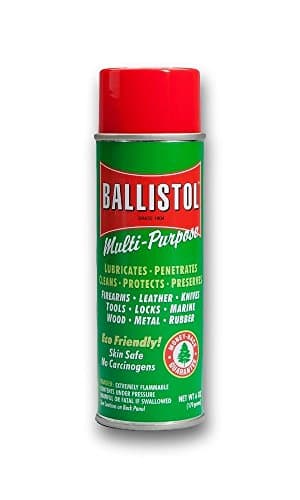
Pick for one can that also handles wood, leather and rubber
Ballistol Multipurpose Oil
8.1/10Alkaline by design, pH 8 to 8.5, which Ballistol says neutralizes mild acids including hand sweat. Safe on metal, wood, leather, rubber and most plastics. It smells like black licorice.
$16.79Amazon#ad · Price as of October 9, 2026 · How we make money for the link to Ballistol Multipurpose Oil
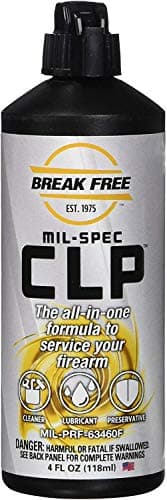
Pick for the military specification and the temperature range
Break Free CLP
8.6/10MIL-SPEC 63460F Type-A, a published -65 F to +475 F working range, synthetic oils and a boundary film Break Free says reduces metal-to-metal wear. Sold in sizes from 20 ml up.
$34.99Amazon#ad · Price as of October 9, 2026 · How we make money for the link to Break Free CLP
These two come up together because they promise the same three jobs from one container: clean the fouling out, leave a lubricating film behind, and protect the metal from rust. That is what the letters in CLP stand for, and both products claim all three. What they do not share is their chemistry, their published specs, or what else in your house they are safe on.
Everything below is quoted from each maker's own pages, checked on the date at the top of this page. We have not run a corrosion test or measured anything; this site reads what makers publish and tells you which claims are backed by a specification and which are not. Our method is on how we pick gear.
The published specs side by side
| Published spec | Ballistol Multipurpose Oil | Break Free CLP |
|---|---|---|
| Does | "Cleans, lubricates, protects and preserves firearms" (maker's claim) | Cleaner, Lubricant & Preservative (CLP) |
| Standard | Not published | "MIL-SPEC 63460F Type-A"; "was the first to pass MIL-SPEC 63460" (maker's claim) |
| Temperature range | Not published | "Performs in temperatures ranging from -65 F to +475 F" (maker's claim) |
| Fouling | "Removing carbon deposits and lead fouling" (maker's claim) | Not published |
| Sizes | Not published | 20 ml to 5 L, including 1 oz, 2 oz, 4 oz and 16 oz |
| Pack contents | Package A: 6 oz aerosol, 4 fl oz liquid, 10 wipes | Not published |
| Score | 8.1/10 | 8.6/10 |
The shape of that table is the story. Break Free fills in the rows a specification demands. Ballistol fills in the rows about versatility. Neither is hiding anything; they are selling different things.
Both are sold as CLPs
It is worth clearing up a common misreading. Ballistol is often described as "just an oil" next to Break Free's "real CLP." Ballistol's own site does not agree: its home page calls the product the "World's Most Versatile Multi-Purpose Oil and Gun CLP," and its gun care range says it "cleans, lubricates, protects and preserves firearms."
Break Free's CLP page makes the same three-part claim in plainer language: "CLP cleans burnt powder residue and other fouling materials from the gun's bore, moving parts, and exterior. The formula also reduces friction and protects against corrosion."
So the question is not which one is a CLP. Both are. The question is which chemistry and which claim set fits your guns. If you are still deciding whether you want an all-in-one at all, our CLP vs gun oil page covers the one-bottle-or-two decision and brings a dedicated bore solvent into the comparison.
The chemistry split: alkaline vs synthetic
This is the real difference, and both makers state it openly.
Ballistol is deliberately alkaline. Its FAQ says the product "has a pH between 8 and 8.5" because it is "capable of neutralizing mild acids and human hand sweat, which is of a slightly acidic nature." Its gun care range describes "alkaline compounds that neutralize acidic residues." That is a specific, unusual design goal: not just displacing moisture, but chemically countering the acids that attack steel.
Break Free CLP is a synthetic film. Break Free says its formula is "made from the highest-quality synthetic oils," that it "reduces metal-to-metal wear by protecting treated surfaces with an advanced boundary film," that it uses "special rust inhibitors," and that it "will not break down under extreme temperatures or pressure."
One neutralizes what lands on the metal. The other builds a durable layer between moving metal parts. For a new shooter cleaning a handgun after fifty rounds, the practical difference is small. For a rifle that gets hot, or a gun stored in a humid garage, the emphasis matters.
What each is safe on
Ballistol publishes a surface-by-surface list, and it is the broadest we have seen from any gun-care maker. From its FAQ, in its own words:
- Wood: Ballistol "will bring out the color and grain on finished and unfinished wood."
- Rubber: it "will clean rubber and prevent it from drying out."
- Plastics: "safe on most plastics," with Ballistol advising caution on soft or non-oil-resistant types.
- Metal: "safe on all metals when used as directed." On nickel, chrome and gold plating it says to wipe off any excess.
- Suede: the one flat no. "Do not use Ballistol on suede. Ballistol can stiffen suede."
Ballistol's home page summarizes the same idea: it works on "metal, wood, leather, rubber, and most plastic surfaces," and it describes the product as "skin-safe and environmentally friendly." Its FAQ adds that it "does not contain ingredients considered hazardous by the FDA."
Break Free's page does not publish an equivalent list. It talks about the gun's "bore, moving parts, and exterior" and about metal wear and corrosion. That is not a warning against using it near wood or rubber; it is simply a narrower published claim, and we will not fill the gap with a guess. If you own a wood-stocked rifle or a leather sling and want one product for everything, Ballistol is the one that says so in writing.
Carbon, powder and lead fouling
Both makers claim fouling removal, and the wording differs in a way worth reading closely.
Ballistol names lead directly. Its gun care material describes "removing carbon deposits and lead fouling," and says the formula "dissolves stubborn carbon buildup." For a range shooter firing lead-cored or plated ammunition, naming lead is relevant.
Break Free says it "cleans burnt powder residue and other fouling materials." That is a broad claim that covers carbon and powder residue without singling out lead.
Neither is a bore solvent in the dedicated sense, and that is the honest caveat on any CLP. If you have let a bore go too long, a product sold specifically to cut heavy fouling, such as Hoppe's No. 9, is the tool for that job, and then a CLP goes back on afterward for the lubricate-and-protect half. Our gun cleaning supplies list lays out the full kit in the order a beginner actually needs it.
Lead is also a reason to think about the cleanup itself, not just the gun. Washing your hands properly after a session matters more than which bottle you used; see our page on lead exposure at the range.
Cold, heat and saltwater
Break Free owns this category outright, because it is the only one of the two that publishes numbers. Its page states the product "performs in temperatures ranging from -65 F to +475 F, and after saltwater immersion," and that it "will not break down under extreme temperatures or pressure."
Those are the maker's claims, not our measurements, but they are claims tied to a military specification rather than loose marketing. Ballistol publishes no temperature range we could find, which does not mean it fails in the cold; it means the figure is not available to cite.
For most readers of this site, firing a handgun at an indoor range in shirtsleeves, none of this decides anything. If you hunt in genuine cold, or shoot near salt water, the bottle with a published range is the defensible pick.
The smell, honestly
You will see Ballistol's odor mentioned in every forum thread about it, so here is what Ballistol itself says: "The odor comes from natural ingredients and smells very similar to black licorice," and it typically "dissipates and becomes completely odorless in 10–15 minutes."
Whether that is charming or unbearable is personal. What matters practically is ventilation and where you clean. If you clean at the kitchen table, a licorice smell that clears in a quarter of an hour may bother the household less than a solvent smell that does not. If you clean in a closed basement, open a window either way.
Break Free does not characterize its own smell on the page we checked. Treat it as a petroleum-product smell and work somewhere with air moving.
Sizes, formats and what fits a range bag
Break Free publishes the wider size ladder: its page lists 20 ml, 1 oz, 2 oz, 4 oz, 16 oz, 1 liter, a gallon and 5 liters, across applicator types including a needle applicator, a spray bottle and a squeeze trigger. The 20 ml and 1 oz sizes are the ones worth knowing about: a needle applicator that small lives in a range bag pocket and lets you put one drop exactly where it belongs.
Ballistol sells aerosol cans, non-aerosol liquid and pre-soaked wipes, and bundles them. Its Package A is a 6 oz aerosol, a 4 fl oz liquid and ten wipes together, which is a sensible starter combination: aerosol for flushing, liquid for precise application, wipes for a quick exterior pass at the range.
One practical note: when we checked, Ballistol's own store listed most of its gun-care bundles as sold out, while both products were readily available from firearms retailers and on Amazon. Maker pages are spec sources on this site, not buy links, so that does not change the pick, but do not take a sold-out line on a maker's own store as a sign the product is discontinued.
An aerosol is also the one format to think twice about with a range bag. Pressurized cans and a hot car trunk are a bad combination, and an aerosol that discharges into a bag full of eye and ear protection ruins a good day. Keep the aerosol on the workbench and carry a small liquid or a wipe packet. Our range bag checklist covers what else earns a slot.
Check your firearm's manual first
Before either bottle, read what the people who built your gun say. Manufacturers publish lubrication guidance, and some of it is specific and sparing. Glock's care instructions for its pistols, for example, are a good reminder that modern handguns generally want very little lubricant in very particular places, not a generous coating everywhere.
That guidance outranks anything on this page, and it also answers the question people ask next: how often to do this at all. Our page on how often to clean your gun works through the sourced answers.
Who each one suits
| If this is you | Pick | Why |
|---|---|---|
| One polymer handgun, first bottle ever | Either | Both claim clean, lubricate and protect; buy the smallest size you can find |
| Wood-stocked rifle or shotgun, leather sling | Ballistol | Published as safe on wood, leather, rubber and most plastics |
| You want a specification, not a slogan | Break Free CLP | MIL-SPEC 63460F Type-A and a published temperature range |
| Cold-weather hunting or coastal shooting | Break Free CLP | -65 F to +475 F and after saltwater immersion, per Break Free |
| Shared living space, smell matters | Your call | Ballistol smells of licorice and says it clears in 10 to 15 minutes; Break Free publishes nothing on odor |
| Heavy fouling in a neglected bore | Neither alone | Use a dedicated bore solvent first, then a CLP to lubricate and protect |
Or consider
- A dedicated bore solvent if your gun has been sitting dirty. Hoppe's No. 9 is sold specifically to remove carbon, powder and lead fouling, and it pairs with either CLP rather than replacing it.
- A complete kit if you own no rods, brushes or patches yet. A bottle is useless on its own; our best gun cleaning kits roundup covers what a first kit should contain, and best pistol cleaning kits narrows it to handguns.
- A cleaning mat so solvent and oil do not reach your table. See best gun cleaning mats.
In detail
The contenders, in full
Pick for one can that also handles wood, leather and rubber
Ballistol Multipurpose Oil
Alkaline by design, pH 8 to 8.5, which Ballistol says neutralizes mild acids including hand sweat. Safe on metal, wood, leather, rubber and most plastics. It smells like black licorice.
Published specsResearched · every value sourced
| Does | "Cleans, lubricates, protects and preserves firearms"Maker's claim |
|---|---|
| Fouling | "Removing carbon deposits and lead fouling"Maker's claim |
| Pack contents | Package A: 6 oz aerosol, 4 fl oz liquid, 10 wipes |
How the 8.1 score breaks down
- Does the job as published (35%)
- 8.5
- Compatibility & fit (25%)
- 8.5
- Easy for a first-timer (20%)
- 8.5
- Durability as published (20%)
- 6.5
What the specs support
- Ballistol says it cleans, lubricates, protects and preserves, so one product covers the basics
- Ballistol names carbon deposits and lead fouling as what it removes
- Package A gives you an aerosol, a liquid bottle and 10 wipes together
Where it falls short
- Package A is sold on Ballistol's own store; our Amazon link searches for the aerosol, so check what the listing includes
- No temperature range or military specification in what we could verify, unlike Break Free CLP
Skip it if…
…you want one small bottle for the range bag; Package A is three items, and Break Free CLP comes in sizes down to 20 ml.
#ad · Price as of October 9, 2026 · How we make money for the link to Ballistol Multipurpose Oil
Pick for the military specification and the temperature range
Break Free CLP
MIL-SPEC 63460F Type-A, a published -65 F to +475 F working range, synthetic oils and a boundary film Break Free says reduces metal-to-metal wear. Sold in sizes from 20 ml up.
Published specsResearched · every value sourced
| Does | Cleaner, Lubricant & Preservative (CLP) |
|---|---|
| Standard | "MIL-SPEC 63460F Type-A"; "was the first to pass MIL-SPEC 63460"Maker's claim |
| Temperature range | "Performs in temperatures ranging from -65 F to +475 F"Maker's claim |
| Sizes | 20 ml to 5 L, including 1 oz, 2 oz, 4 oz and 16 oz |
How the 8.6 score breaks down
- Does the job as published (35%)
- 8.5
- Compatibility & fit (25%)
- 9
- Easy for a first-timer (20%)
- 9
- Durability as published (20%)
- 8
What the specs support
- Cleans, lubricates and preserves in one product, so a first kit needs only one bottle
- Break Free lists a military specification, MIL-SPEC 63460F Type-A
- Wide published temperature range, -65 F to +475 F
- Small sizes (1 oz, 2 oz) suit a range bag
Where it falls short
- The page we checked makes no specific claim about lead fouling, which Hoppe's No. 9 and Ballistol do
- Liquid only: you still need patches and a rod, bore snake or kit
Skip it if…
…you want a dedicated solvent for heavy fouling; Hoppe's No. 9 is sold specifically to remove carbon, powder and lead fouling.
#ad · Price as of October 9, 2026 · How we make money for the link to Break Free CLP
How we scored this
Every pick, scored on numbers you can check
Every pick here is labeled Researched: we compiled each maker's published specs (the EPA-labeled NRR on hearing protection, the Z87+ mark on glasses), read the manuals, checked the standards behind them, and scored everything on a public rubric. Every figure links to where it came from, and marketing claims are labeled “maker's claim,” so you can see exactly why a pick ranks where it does.
Scores are editorial judgments built from that documented research. Commissions never set a score or decide a pick. The rubric and its weights are published.
What changed
- First published. Both makers' pages checked the same day, including Ballistol's FAQ for pH, odor and surface guidance.
Questions
Common questions
Is Ballistol a CLP?
Which is better for a beginner, Ballistol or Break Free CLP?
Why does Ballistol smell like licorice?
Can Ballistol be used on a wood gun stock?
What does MIL-SPEC 63460F Type-A mean on Break Free CLP?
Can I use Ballistol or Break Free CLP as the only product in my kit?
Where this comes from
Sources
- Safariland Group, Break Free CLP Cleaner, Lubricant & Preservative product page, accessed 2026-10-09
- Ballistol, home page (product description and history), accessed 2026-10-09
- Ballistol, Frequently Asked Questions (surfaces, pH, odor), accessed 2026-10-09
- Ballistol, Gun Care collection page, accessed 2026-10-09
- Ballistol, Package A product page, accessed 2026-10-09
- Hoppe's (primos.com), No. 9 Gun Bore Cleaner product page, accessed 2026-10-09
- GLOCK, Caring for your pistol, accessed 2026-10-09
Specs come from each maker's own pages and data sheets (linked on every product); ratings like NRR and Z87+ are explained from the standards and agencies behind them. Prices are set by Amazon and change often, so the buy button always takes you to the current one. Where a figure isn't published, we say so. Read the full method.