Safety first. This is general information, not a substitute for hands-on instruction. Follow your range's rules and your firearm's manual, and consider a certified safety course. See our gun safety rules.
Quick picks
The picks at a glance
| # | Product | Best for | Score | Price |
|---|---|---|---|---|
| 1 | 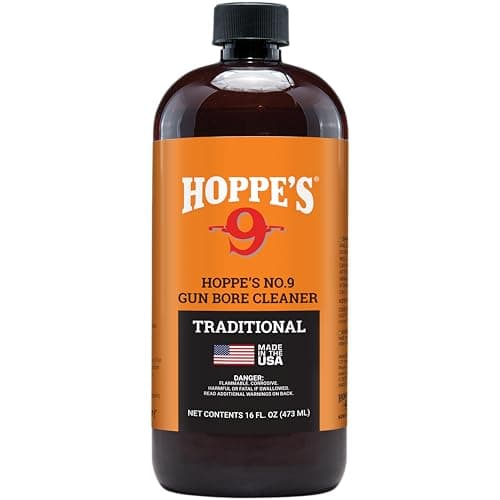 Hoppe's No. 9 Gun Bore Cleaner The bottle that has been on American gun benches since 1903. Hoppe's lists it for all pistol, rifle and shotgun bores and names carbon, powder and lead fouling. It is a cleaner only. | Best first bore solvent | 7.9/10Researched | $13.99Amazon #ad · Disclosure |
| 2 | 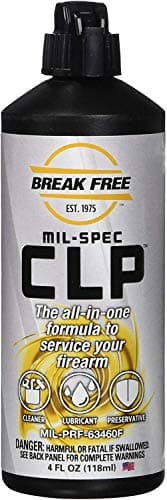 Break Free CLP A cleaner, lubricant and preservative in one, built to a military specification, with a published temperature range. The simplest honest answer for a first handgun. | Best if you only want one bottle | 8.6/10Researched | $35.99Amazon #ad · Disclosure |
| 3 | 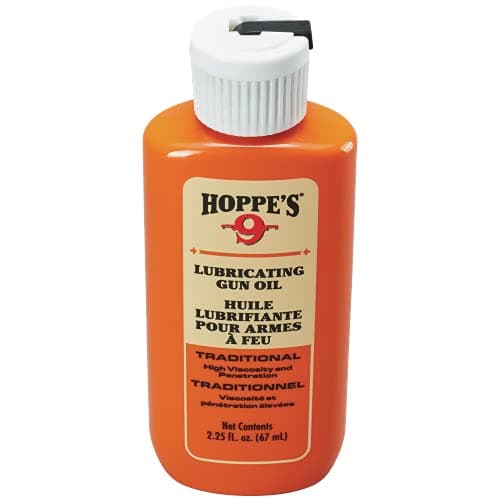 Hoppe's Lubricating Oil Hoppe's own answer to what follows No. 9: an oil it says neutralizes the cleaner and leaves an even coat, and that does not harden or gum up. | Best oil to pair with a solvent | 7.9/10Researched | $3.99Amazon #ad · Disclosure |
| 4 | 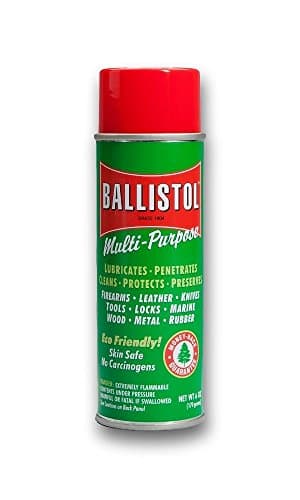 Ballistol Multipurpose Oil The one on this page with published guidance for wood, rubber and plastic as well as metal, which matters if your gun has a wood stock. | Best for mixed surfaces | 8.1/10Researched | $16.40Amazon #ad · Disclosure |
| 5 | No image Real Avid Bore-Max Bore Solvent (4 oz) The only pick here that names copper specifically, which is a rifle problem rather than a handgun one. A solvent only, in one 4 oz size. | Best for copper fouling | 7.5/10Researched | Check price · Amazon #ad · Disclosure |
#ad · Prices come live from Amazon, last checked November 3, 2026. Scores are ours, built from published specs and manuals, not hands-on tests. Photos come from the product's own Amazon listing. Tap a row for the full write-up.
How we picked
This site does not test gear, and nothing below is a performance comparison. Chemicals are the hardest category in shooting to review honestly: nobody outside a laboratory can tell you how many milligrams of carbon one solvent lifts against another, and the people who publish such claims are selling the bottle. So this page ranks on something you can check: what each maker says its product is for, whether that claim is specific, and how many bottles the routine actually takes.
- A published job description. "Cleans, lubricates and protects" is a claim we can quote and you can hold the maker to. "Advanced formula" is not.
- Currently sold, in the size we name. Every pick was checked on the maker's own store on 2026-10-23, including which sizes were in stock.
- Named fouling beats vague cleaning. Carbon, lead and copper are different problems. A product that names which one it dissolves is more useful than one that does not.
- Beginner-proof over powerful. One bottle used every time beats four bottles used once.
- Nothing invented. No dwell times, no material cautions and no temperature ranges appear here unless the maker published them. Where a maker is silent, this page says so.
Before any of it: the gun is unloaded and verified clear the way your owner's manual shows, the action is open, and the NRA's cleaning rule applies — "be sure that no ammunition is present in the cleaning area."
Three jobs, not one
Everything in this aisle does one or more of three jobs, and the whole category makes sense once you separate them.
- Cleaning. Dissolving the fouling that burning powder leaves behind so a patch or a brush can carry it out. This is what a solvent does. Hoppe's No. 9 and Real Avid's Bore-Max solvent are cleaners.
- Lubricating. Leaving a film where metal slides on metal — slide rails, a bolt, a hinge pin. This is what an oil does. Hoppe's Lubricating Oil is an oil.
- Protecting. Leaving a film that keeps moisture off steel between range trips. This is a preservative, and it is the job people forget until they find rust.
A CLP claims all three in one bottle. Break Free CLP is the original of the type and Ballistol is sold the same way. Our CLP vs gun oil page is the longer version of this argument, and Ballistol vs Break Free CLP picks between the two all-in-ones directly.
How many bottles you need
Fewer than the shelf suggests. Here are the three honest answers, in order of how many people they fit.
One bottle: a CLP. If you own a handgun you shoot a few times a year, buy Break Free CLP or Ballistol and stop. One bottle, one rag, done. This is the correct recommendation for most readers of this site, and the fact that it is also the cheapest is a coincidence worth having.
Two bottles: a solvent and an oil. The traditional routine, and the one most instructors learned: No. 9 on a patch through the bore, then Hoppe's Lubricating Oil on the wear points. The reason to prefer it is that a dedicated solvent is a stronger cleaner than a CLP has to be, and a dedicated oil is a better lubricant. The reason not to is that it is two steps and twice the shelf space.
Three or more: you have a reason. A copper solvent for a rifle you shoot for groups. A grease for a shotgun's hinge pin. A dry lube for a dusty climate. Buy these when a specific problem appears, not before.
Carbon, lead and copper
Three deposits, three different difficulties, and this is where the picks separate.
Carbon is burned powder residue, and it is what everybody has. It goes everywhere: the bore, the chamber, the breech face, the bolt. Every product on this page claims carbon.
Lead comes from unjacketed or partly jacketed bullets, which is most cheap range ammunition and almost all .22 rimfire. Hoppe's says No. 9 "penetrates deeply to remove carbon, powder, and lead fouling", and Ballistol names carbon deposits and lead fouling too. Lead is also a health question, not only a cleaning one: our lead exposure guide covers the hand-washing part, and best lead removal wipes covers the products for it.
Copper comes from jacketed bullets, builds up in rifle bores over hundreds of rounds, and is the one a general-purpose CLP does not claim. Real Avid's Bore-Max Bore Solvent is the pick here that names it: a "powerful copper and carbon eliminator" formulated to dissolve "performance inhibiting copper and powder fouling", in the maker's words. If you shoot a handgun and nothing else, you can ignore copper entirely.
The CLP trade-off
A CLP is a compromise by definition: a single chemistry doing three jobs cannot be the best at any one of them. The question is whether the compromise costs you anything that matters, and for ordinary range shooting the honest answer is no.
What you get for it is published and specific in Break Free's case. Safariland lists CLP against MIL-SPEC 63460F Type A, with a working range from -65 F to +475 F, saltwater-immersion testing and sizes from 20 ml up to 5 liters. That is more verifiable detail than any other bottle on this page publishes, and the 20 ml size is the one that belongs in a range bag.
Where a CLP genuinely falls short is a heavily fouled rifle bore and long-term storage of a gun you will not touch for a year. For the first, add a bore solvent. For the second, read your manual — some makers specify a preservative rather than a lubricant for storage.
Wood, polymer and rubber
This is the question nobody asks until a stock goes sticky. Solvents are aggressive by design, and a bore cleaner that is perfect on steel can mark a finish.
Ballistol is the pick on this page with published guidance here. Its own FAQ gives surface guidance for wood, rubber, plastic and metal, states a pH of 8 to 8.5, says plainly "do not use Ballistol on suede", and notes that its black-licorice odor clears in 10 to 15 minutes. It also says it does not contain ingredients considered hazardous by the FDA. If your gun is a wood-stocked shotgun or an older rifle, that documentation is worth more than a stronger cleaning claim.
For a polymer-framed modern handgun, none of this is a problem — keep solvent off the finish as a habit rather than out of fear, and wipe rather than soak.
Ventilation, skin and storage
We are not going to invent safety data. What we can say is what the makers publish and what follows from it.
Every bottle here carries its own label and, for most, a safety data sheet the maker publishes separately. Read the label on the bottle you buy: it is the authoritative document for that chemical, and it is more specific than any roundup. Clean somewhere with moving air, keep solvent off your skin, and keep the bottle closed between uses — an open can of solvent on a bench is both a fume source and a spill.
Two habits that matter more than product choice. Keep cleaning chemicals away from where you store ammunition, and keep them where children cannot reach them. And wash your hands when you finish, not because of the solvent but because of the lead on the patches — the lead exposure guide has the detail.
Which one for which gun
- One 9mm handgun, a few range trips a year: Break Free CLP, one bottle, nothing else.
- You want the traditional two-step: Hoppe's No. 9 for the bore, Hoppe's Lubricating Oil afterward.
- A wood-stocked shotgun or an heirloom rifle: Ballistol, for the published multi-surface guidance.
- A rifle you shoot for accuracy: add Real Avid Bore-Max Bore Solvent for copper, on top of one of the above.
- An AR-15: the chemical matters less than reaching the carbon. See best cleaning kits for the AR-15 and how to clean an AR-15.
- You have no cleaning gear at all yet: buy a kit rather than loose bottles — best gun cleaning kits, or best pistol cleaning kits for a handgun only.
In detail
The picks, in full
Rank 1
Best first bore solvent
Hoppe's No. 9 Gun Bore Cleaner
The bottle that has been on American gun benches since 1903. Hoppe's lists it for all pistol, rifle and shotgun bores and names carbon, powder and lead fouling. It is a cleaner only.
Published specsResearched · every value sourced
| Does | "Penetrates deeply to remove carbon, powder, and lead fouling"Maker's claim |
|---|---|
| Works with | "All pistol, rifle, and shotgun bores" |
| Sizes | 2 oz aerosol, 2 oz, 5 oz, 1 pint, 1 quart |
How the 7.9 score breaks down
- Does the job as published (35%)
- 8
- Compatibility & fit (25%)
- 9
- Easy for a first-timer (20%)
- 8
- Durability as published (20%)
- 6
What the specs support
- Hoppe's names carbon, powder and lead fouling as what it removes
- Listed for all pistol, rifle and shotgun bores
- Sizes from a 2 oz bottle up to a quart
Where it falls short
- Sold as a bore cleaner, not a lubricant; you still need oil or CLP
- Solvent only: you'll also need patches and a rod, cable or bore snake
Skip it if…
…you want one bottle that cleans and lubricates; Break Free CLP is sold as a cleaner, lubricant and preservative in one.
#ad · Price as of November 3, 2026 · How we make money for the link to Hoppe's No. 9 Gun Bore Cleaner
Rank 2
Best if you only want one bottle
Break Free CLP
A cleaner, lubricant and preservative in one, built to a military specification, with a published temperature range. The simplest honest answer for a first handgun.
Published specsResearched · every value sourced
| Does | Cleaner, Lubricant & Preservative (CLP) |
|---|---|
| Standard | "MIL-SPEC 63460F Type-A"; "was the first to pass MIL-SPEC 63460"Maker's claim |
| Temperature range | "Performs in temperatures ranging from -65 F to +475 F"Maker's claim |
| Sizes | 20 ml to 5 L, including 1 oz, 2 oz, 4 oz and 16 oz |
How the 8.6 score breaks down
- Does the job as published (35%)
- 8.5
- Compatibility & fit (25%)
- 9
- Easy for a first-timer (20%)
- 9
- Durability as published (20%)
- 8
What the specs support
- Cleans, lubricates and preserves in one product, so a first kit needs only one bottle
- Break Free lists a military specification, MIL-SPEC 63460F Type-A
- Wide published temperature range, -65 F to +475 F
- Small sizes (1 oz, 2 oz) suit a range bag
Where it falls short
- The page we checked makes no specific claim about lead fouling, which Hoppe's No. 9 and Ballistol do
- Liquid only: you still need patches and a rod, bore snake or kit
Skip it if…
…you want a dedicated solvent for heavy fouling; Hoppe's No. 9 is sold specifically to remove carbon, powder and lead fouling.
#ad · Price as of November 3, 2026 · How we make money for the link to Break Free CLP
Rank 3
Best oil to pair with a solvent
Hoppe's Lubricating Oil
Hoppe's own answer to what follows No. 9: an oil it says neutralizes the cleaner and leaves an even coat, and that does not harden or gum up.
Published specsResearched · every value sourced
How the 7.9 score breaks down
- Does the job as published (35%)
- 8
- Compatibility & fit (25%)
- 8.5
- Easy for a first-timer (20%)
- 8.5
- Durability as published (20%)
- 6.5
What the specs support
- Made to follow a solvent, which is the step most beginners skip
- Hoppe's says it does not harden or gum up, which is the failure mode of a wrong oil in a stored gun
- Sold in a 2.25 oz bottle, which is a lifetime of handgun lubrication for most owners
- The dropper bottle puts oil where you want it instead of over the whole gun
Where it falls short
- A lubricant only: it is not a cleaner and not a protectant, so it is the second bottle rather than the only one
- Hoppe's publishes no temperature range for it, unlike Break Free's CLP
- An aerosol can is easy to over-apply; a gummy, over-oiled gun attracts grit
Skip it if…
…you want one bottle to do everything; a CLP such as Break Free or Ballistol cleans, lubricates and protects, and Hoppe's own No. 9 plus this oil is deliberately a two-bottle system.
#ad · Price as of November 3, 2026 · How we make money for the link to Hoppe's Lubricating Oil
Rank 4
Best for mixed surfaces
Ballistol Multipurpose Oil
The one on this page with published guidance for wood, rubber and plastic as well as metal, which matters if your gun has a wood stock.
Published specsResearched · every value sourced
| Does | "Cleans, lubricates, protects and preserves firearms"Maker's claim |
|---|---|
| Fouling | "Removing carbon deposits and lead fouling"Maker's claim |
| Pack contents | Package A: 6 oz aerosol, 4 fl oz liquid, 10 wipes |
How the 8.1 score breaks down
- Does the job as published (35%)
- 8.5
- Compatibility & fit (25%)
- 8.5
- Easy for a first-timer (20%)
- 8.5
- Durability as published (20%)
- 6.5
What the specs support
- Ballistol says it cleans, lubricates, protects and preserves, so one product covers the basics
- Ballistol names carbon deposits and lead fouling as what it removes
- Package A gives you an aerosol, a liquid bottle and 10 wipes together
Where it falls short
- Package A is sold on Ballistol's own store; our Amazon link searches for the aerosol, so check what the listing includes
- No temperature range or military specification in what we could verify, unlike Break Free CLP
Skip it if…
…you want one small bottle for the range bag; Package A is three items, and Break Free CLP comes in sizes down to 20 ml.
#ad · Price as of November 3, 2026 · How we make money for the link to Ballistol Multipurpose Oil
Rank 5
Best for copper fouling
Real Avid Bore-Max Bore Solvent (4 oz)
The only pick here that names copper specifically, which is a rifle problem rather than a handgun one. A solvent only, in one 4 oz size.
Published specsResearched · every value sourced
How the 7.5 score breaks down
- Does the job as published (35%)
- 8
- Compatibility & fit (25%)
- 7.5
- Easy for a first-timer (20%)
- 8
- Durability as published (20%)
- 6
What the specs support
- Names copper fouling specifically, which a general-purpose CLP does not claim to remove
- A squeeze bottle wets a patch or a brush without pouring solvent down the bench
- Pairs with the Bore-Max brushes and jags if you already own that system
Where it falls short
- A solvent only: no lubrication, no rust protection, so you still need an oil
- Real Avid publishes no dwell time, no material-safety guidance and no surface cautions on the product page
- The 4 oz bottle is the only size listed
- Copper fouling is a rifle problem; a handgun owner is paying for a claim they will rarely use
Skip it if…
…you own one handgun and want the simplest routine; Hoppe's No. 9 plus an oil, or a single CLP, covers a pistol bore without a dedicated copper solvent.
#ad · Price as of November 3, 2026 · How we make money for the link to Real Avid Bore-Max Bore Solvent (4 oz)
What to look for in a cleaning chemical
- Which of the three jobs it claims. Cleaner, lubricant, preservative, or all three. If the label will not say, do not buy it.
- Which fouling it names. Carbon is table stakes. Lead matters for rimfire and cheap range ammo. Copper matters for rifles.
- A size that matches your shooting. A 2 oz bottle is a year of handgun cleaning for most people. A quart is for a club, not a closet.
- A delivery method you can control. A dropper or a squeeze bottle puts oil on one spot. An aerosol coats everything in a three-foot radius, including your bench.
- Published surface guidance if your gun has wood or rubber. Ballistol publishes it; most do not.
- Stated compatibility with your manual's instructions. The manual wins. Buy what it describes.
- Nothing you cannot name a use for. The fourth bottle is almost always the one that dries out unopened.
Beginner mistakes
- Buying a solvent and calling it done. A cleaner does not lubricate. A gun cleaned with No. 9 and left dry is worse off than before you started.
- Over-oiling. Oil attracts grit and runs into places it should not be. A film, not a coat.
- Using a bore solvent as a general lubricant. Different chemistry, different job.
- Mixing products in the same pass. Finish the solvent step, wipe dry, then oil. Hoppe's designed its oil to follow its own cleaner for exactly this reason.
- Cleaning with ammunition on the bench. The NRA rule above, and the one that actually injures people.
- Ignoring the hand-washing step. Patches carry lead. See lead exposure at the range.
- Buying the biggest bottle first. Solvent that sits for ten years is not a bargain.
How we scored this
Every pick, scored on numbers you can check
Every pick here is labeled Researched: we compiled each maker's published specs (the EPA-labeled NRR on hearing protection, the Z87+ mark on glasses), read the manuals, checked the standards behind them, and scored everything on a public rubric. Every figure links to where it came from, and marketing claims are labeled “maker's claim,” so you can see exactly why a pick ranks where it does.
Scores are editorial judgments built from that documented research. Commissions never set a score or decide a pick. The rubric and its weights are published.
Questions
Common questions
What is the best gun cleaning solvent for a beginner?
Do I need both a solvent and an oil?
What is the difference between a solvent, an oil and a CLP?
Will gun solvent damage a polymer frame or a wood stock?
How often should I use a bore solvent?
Does any of this remove copper fouling?
Where this comes from
Sources
- Hoppe's, No. 9 Gun Bore Cleaner product page (checked 2026-10-23)
- Hoppe's, Lubricating Oil product page (checked 2026-10-23)
- Real Avid, Bore-Max Bore Solvent 4 oz product page (checked 2026-10-23)
- Safariland, Break Free CLP product page
- Ballistol, FAQ (surfaces, pH, odor)
- Glock, Caring for your pistol
- NRA, Gun Safety Rules (cleaning)
Specs come from each maker's own pages and data sheets (linked on every product); ratings like NRR and Z87+ are explained from the standards and agencies behind them. Prices are set by Amazon and change often, so the buy button always takes you to the current one. Where a figure isn't published, we say so. Read the full method.