Safety first. This is general information, not a substitute for hands-on instruction. Follow your range's rules and your firearm's manual, and consider a certified safety course. See our gun safety rules.
An AR-15 is cleaned back to front, and almost every beginner does it front to back. The bore gets twenty minutes and a dozen patches, the bolt gets a wipe with a rag, and the rifle starts short-stroking three hundred rounds later because the carbon that actually matters is still in the places nobody touched.
This page is about those places. It is not a substitute for your rifle's manual, which is the authority on disassembly for your specific upper and lower. Read that first, then use this for the order and the tools.
Before you start
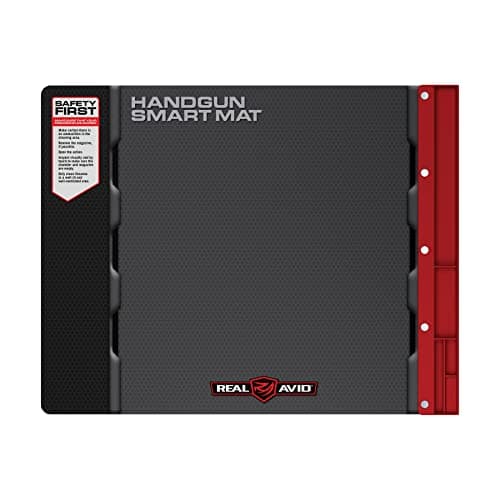
Lay out a mat. Not for neatness: a rifle field-strips into small springs and pins that roll, and the AR mats sold for this come printed with a parts diagram. Wheeler's Delta Series AR Maintenance Mat is the one in our picks, and our best gun cleaning mats page covers the category.
Why an AR is not just a long pistol
The difference is the gas system. A direct-impingement AR vents propellant gas from the barrel back down a tube into the bolt carrier group, which is how the action cycles. That design is reliable and light, and it means combustion residue is deliberately routed into the heart of the mechanism rather than out of the muzzle.
So an AR accumulates hard, baked carbon in four specific places, all of them inside the bolt carrier group or the chamber, and all of them awkwardly shaped. A pistol does not have an equivalent. That is why our how to clean a pistol page does not cover any of what follows, and why AR-specific kits exist as a category rather than as marketing.
Field-stripping, in order
- Confirm it is unloaded. Again.
- Push out the rear takedown pin and hinge the upper off the lower.
- Pull the charging handle back and slide the bolt carrier group out of the upper. The charging handle comes out behind it.
- Separate the bolt carrier group: firing pin retaining pin out, firing pin out, rotate the cam pin a quarter turn and lift it, then slide the bolt out of the carrier.
- Stop there. That is a field strip and it is all a routine clean needs. The extractor, the gas rings and anything in the lower come apart only when there is a reason.
If any of those steps is unfamiliar, your rifle's manual has them with photographs for your exact rifle, and the manual is the authority if it contradicts anything here.
1. The bolt tail and gas rings
This is the hardest carbon on the rifle and the most consequential. The rear of the bolt, behind the gas rings, sits directly in the gas path and builds a crust that is not coming off with a patch and a rag.
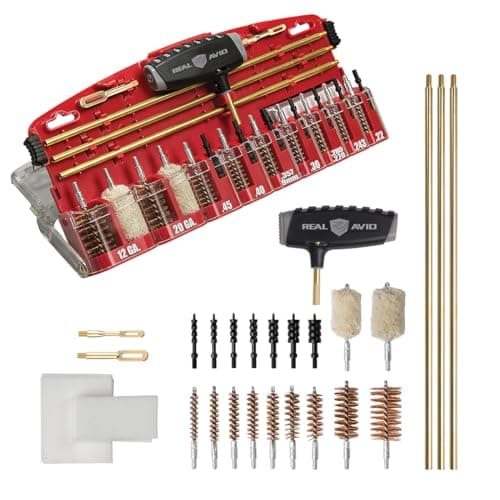
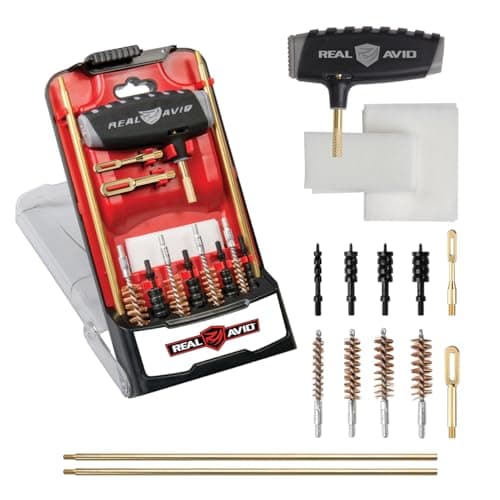
It is also exactly the shape problem that AR-specific tools solve. Otis's MSR/AR kit includes what Otis calls the "B.O.N.E. Tool", shaped for the bolt, bolt carrier and firing pin, plus a locking lug scraper. Real Avid's Gun Boss Pro AR15 kit includes a bolt carrier brush and a "90 degree angled brass scraper". Brass rather than steel is the detail that matters: brass is softer than the parts you are scraping.
Soak the bolt tail in solvent for a few minutes before you touch it with anything. Carbon that has been wet for five minutes comes off with a fraction of the force, and force is what damages parts.
2. Inside the carrier
The bolt carrier is a tube, and the inside of that tube collects the same baked carbon as the bolt tail. You cannot see most of it and you certainly cannot reach it with a rag.
A carrier brush is a long bristle brush sized for the bore of the carrier, and both kits in our picks include one for this. Run it through wet with solvent, then dry, then look through the carrier at a light. The gas key at the front, where the gas tube meets the carrier, deserves the same attention.
3. The locking lugs
The bolt's lugs rotate into the barrel extension to lock up, and the gaps between them trap fouling. It is a small amount of carbon in an awkward slot, and a skipped slot eventually becomes a rifle that does not lock up consistently.
Otis names a dedicated locking lug scraper in its MSR kit contents, and both kits include picks for exactly this kind of corner. Work the solvent in, scrape gently, wipe out. The barrel extension end deserves a look too, which is what a bore illuminator in a kit is actually for.
4. The star chamber
The star chamber is the recess at the rear of the barrel the bolt lugs rotate into, and it is the single most overlooked part of an AR. It is shaped like a star, it collects carbon in every point of that star, and no round brush fits it.
Real Avid's AR15 kit lists a "star chamber brush and star chamber cleaning pads", which is the purpose-built answer: the brush agitates and the shaped pad wipes the recess out. Otis includes a .223/5.56 chamber brush. This is the clearest single reason not to clean an AR with a general kit, because no universal kit contains either tool. Our best gun cleaning kits for the AR-15 page compares the two on exactly this.
The bore, last
Now the part everyone starts with. It goes last for two reasons: anything you dislodge in the chamber ends up in the bore, and the bore is the part that least needs attention on a modern rifle.
- Clean from the chamber end toward the muzzle whenever the design allows it, which on an AR it does, so fouling leaves the way the bullet did.
- Solvent on a brush, then patches until they come out clean. Then one lightly oiled patch, then one dry patch to take the excess out. A bore full of oil is a bore that makes the first shot go somewhere unexpected.
- Cable or rod, both work. Otis uses a "30" aircraft grade Memory-Flex cable" pull-through; Real Avid uses a 29-inch sectional brass rod in four sections. The cable packs smaller; the rod is what you want if you ever need to push an obstruction out. Our bore snake vs cleaning rod page covers the trade, and misfire vs hangfire vs squib covers the obstruction case.
- Do not chase every trace. A nitride or chrome-lined AR barrel does not need a mirror bore to shoot well, and aggressive bore work does more harm than carbon does.
How much lubricant
ARs want more lubricant than pistols do, and in specific places. The gas system runs hot and the bolt carrier slides a long way on steel rails, so a dry AR gets sticky in a way a dry pistol does not.
Where it goes: the bolt carrier rails and the outside of the carrier, the bolt body and the cam pin, the charging handle, and a light film on the bolt lugs. Where it does not go: inside the gas tube, the chamber, the bore beyond a wiped film, or the trigger group in any quantity.
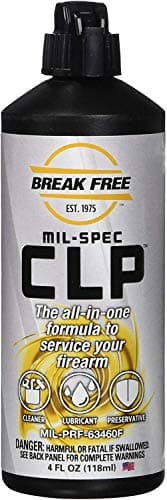
A CLP does all three jobs in one bottle, which is why the Otis kit ships with half an ounce of FP-10 in the box. Break-Free CLP is the other common answer, and its published specs name MIL-SPEC 63460F Type-A and a temperature range from -65 F to +475 F, which matters on a part that gets as hot as a gas key. Our CLP vs gun oil page covers whether one bottle is enough, and Ballistol vs Break-Free CLP compares the two most common choices.
Your rifle's manual is the authority on quantity, and whatever it says beats this page. Our how often to clean your gun page covers the schedule.
The kit for this job
The two AR-specific kits plus the CLP and the mat. Note that the Real Avid kit lists no solvent, so with that one you are buying a bottle separately.
Our picks for this
What an AR clean actually needs
Published contents from each maker. The tools that matter here are the bolt tool, the carrier brush, the locking lug scraper and the star chamber brush.
- Otis TechnologyNo image
Best compact AR-15 kit
Otis MSR/AR Cleaning Kit (.223/5.56) with B.O.N.E. Tool
7.1/10ResearchedThe B.O.N.E. Tool for the bolt, carrier and firing pin, a locking lug scraper, a 5.56 chamber brush and half an ounce of FP-10 CLP, all in a 4 x 4 x 2.5 inch pouch.
Check price · Amazon#ad · Price as of November 3, 2026 · How we make money for the link to Otis MSR/AR Cleaning Kit (.223/5.56) with B.O.N.E. Tool
- Real AvidNo image
Best AR-15 kit overall
Real Avid Gun Boss Pro AR15 Cleaning Kit
6.4/10ResearchedThe only kit here with a star chamber brush and star chamber pads, plus a bolt carrier brush, a 90-degree brass scraper and a 29-inch sectional brass rod. No solvent included.
Check price · Amazon#ad · Price as of November 3, 2026 · How we make money for the link to Real Avid Gun Boss Pro AR15 Cleaning Kit
Best all-in-one CLP
Break Free CLP
8.6/10ResearchedOne bottle for cleaning, lubricating and protecting. Break-Free publishes MIL-SPEC 63460F Type-A and a range of -65 F to +475 F.
$35.99Amazon#ad · Price as of November 3, 2026 · How we make money for the link to Break Free CLP
- WheelerNo image
Best mat for a rifle
Wheeler Delta Series AR Maintenance Mat
7.8/10ResearchedA printed AR maintenance mat, which is what keeps a cam pin from rolling off the table and under a cabinet.
Check price · Amazon#ad · Price as of November 3, 2026 · How we make money for the link to Wheeler Delta Series AR Maintenance Mat
Washing up afterward
Combustion residue from firearms contains lead, and cleaning a rifle puts your hands in it for half an hour. NIOSH's work on indoor firing ranges (Pub. 2009-136) documents lead exposure as a recognized hazard in the shooting environment.
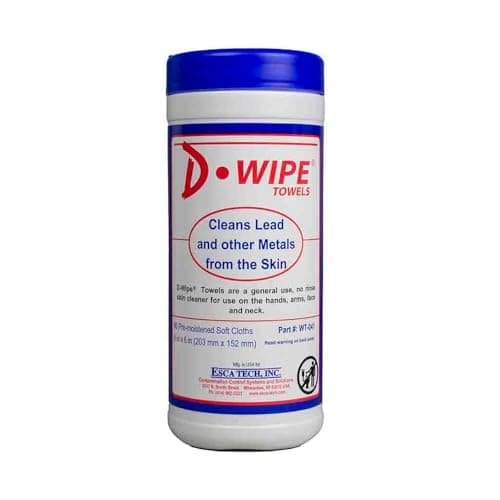
So: wash with cold water and a soap made for the job rather than hand sanitizer, which does nothing for metal particulate. Esca Tech's D-Wipe towels are the field version for when there is no sink. Do not eat or drink at the cleaning bench, and keep the whole operation off the kitchen counter if you can. Our lead exposure at the shooting range page covers the routine properly, and gun cleaning supplies list has the full bench inventory.
How we scored this
Every pick, scored on numbers you can check
Every pick here is labeled Researched: we compiled each maker's published specs (the EPA-labeled NRR on hearing protection, the Z87+ mark on glasses), read the manuals, checked the standards behind them, and scored everything on a public rubric. Every figure links to where it came from, and marketing claims are labeled “maker's claim,” so you can see exactly why a pick ranks where it does.
Scores are editorial judgments built from that documented research. Commissions never set a score or decide a pick. The rubric and its weights are published.
Questions
Common questions
How do you clean an AR-15 step by step?
What part of an AR-15 collects the most carbon?
Do you need an AR-specific cleaning kit?
How much oil does an AR-15 need?
Should you clean an AR-15 bore from the chamber or the muzzle?
How often should you clean an AR-15?
Where this comes from
Sources
- Otis Technology, MSR/AR Rifle Cleaning Kit .223 cal/5.56mm with B.O.N.E. Tool product page, accessed 2026-10-10
- Real Avid, Gun Boss Pro AR15 Cleaning Kit product page, accessed 2026-10-10
- Safariland, Break-Free CLP Cleaner Lubricant and Preservative product page, accessed 2026-10-10
- Wheeler, Delta Series AR Maintenance Mat product page, accessed 2026-10-10
- NRA, Gun Safety Rules, accessed 2026-10-10
- NSSF, Rules of Firearm Safety, accessed 2026-10-10
- NIOSH, Preventing Occupational Exposures to Lead and Noise at Indoor Firing Ranges (Pub. 2009-136), accessed 2026-10-10
- Esca Tech, D-Wipe Towels product page, accessed 2026-10-10
Specs come from each maker's own pages and data sheets (linked on every product); ratings like NRR and Z87+ are explained from the standards and agencies behind them. Prices are set by Amazon and change often, so the buy button always takes you to the current one. Where a figure isn't published, we say so. Read the full method.