Not legal advice. Transport and age rules vary by state, city and range. This page summarizes the official sources linked in the text, checked . Laws change: check your state's official guidance and your range's own rules before you rely on them.
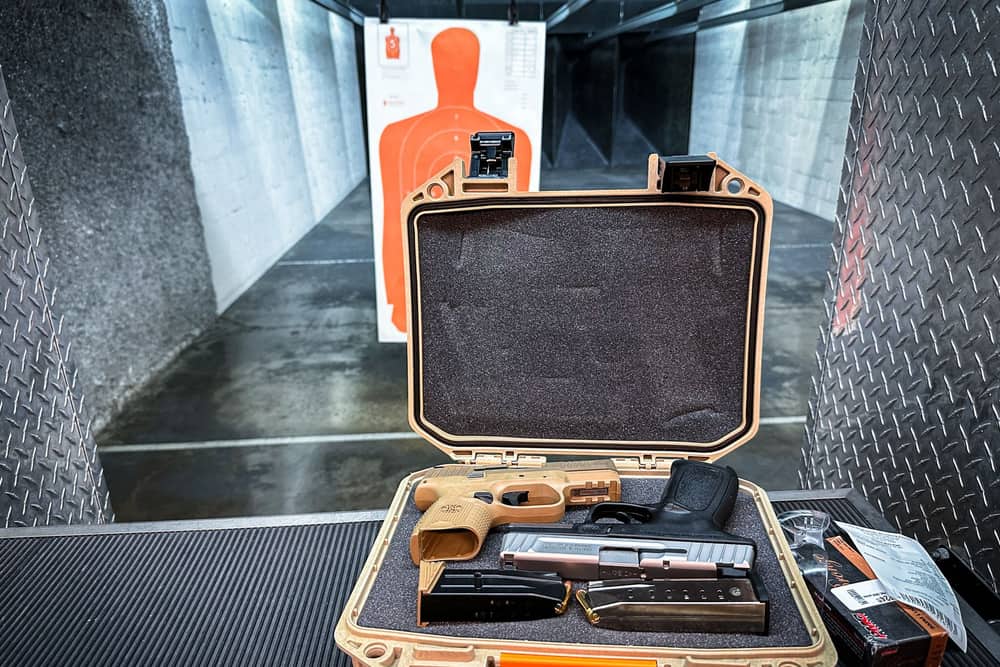
The first time you take your own gun to the range, the drive can feel like the most nerve-racking part. It doesn't need to be. There's a widely followed routine for getting a firearm from your home to the range, a federal law that describes safe transport between places, and a set of state and local rules that you need to check for yourself. This guide covers the first two in plain English and shows you where to look for the third.
We're not lawyers, and this isn't legal advice. We quote the official text so you can read it yourself, and we don't summarize any state's law. Rules change, so check the official sources before you rely on anything here.
The common practice, step by step
Ranges, safety organizations and the federal text all point the same way. Here's a widely used routine for a trip to the range. Treat it as common practice, not as a promise that you're following the law where you live.
- Unload at home and check that it's clear, following your owner's manual, with the muzzle pointed in a safe direction. The NRA's rules say to keep the gun unloaded until ready to use, and: "If you do not know how to open the action or inspect the chamber(s), leave the gun alone and get help from someone who does" (NRA Gun Safety Rules).
- Put it in a case and lock it. A case you can lock, with a padlock or a built-in lock. Our hard vs soft pistol case comparison explains the difference.
- Keep the ammunition separate, in its box, in a different container from the gun. NSSF's safety rules say that when not in use, "firearms and ammunition should be secured in a safe place, separate from each other," and that "There is never any excuse to carry a loaded gun in a scabbard, a holster not being worn or a gun case" (NSSF).
- Put the case and ammunition out of reach of everyone in the car, for example in the trunk. That's the condition the federal text describes, below.
- Follow the range's check-in rules when you arrive, which may say exactly how the gun comes through the door.
What the federal safe-passage law says
The federal provision people call "safe passage" is 18 U.S.C. § 926A, titled "Interstate transportation of firearms." It was added in 1986 (Pub. L. 99–360). Here's the full operative text, as published by Cornell's Legal Information Institute and identical to the official U.S. Code copy:
In plain English, the text sets out who it covers, what trip it covers, and the conditions:
- Who: "any person who is not otherwise prohibited by this chapter from transporting, shipping, or receiving a firearm."
- Which trip: transport "for any lawful purpose" from a place where you "may lawfully possess and carry" the firearm to another place where you "may lawfully possess and carry" it. Both ends of the trip matter.
- Condition 1: the firearm is unloaded.
- Condition 2: neither the firearm nor any ammunition is "readily accessible or is directly accessible from the passenger compartment."
- Condition 3, for some vehicles: if the vehicle has no compartment separate from the driver's compartment, the firearm or ammunition goes in "a locked container other than the glove compartment or console."
What the text doesn't do is tell you what's lawful at either end of your trip; that depends on the laws where you start and where you're going. It also doesn't say whether a "locked container" must be hard-sided or soft, and it doesn't define which vehicles lack a separate compartment. Those are questions for your state's official sources, or a lawyer, not for us.
ATF's 2026 proposal (not law)
You may see news about a new federal transport rule. In May 2026, ATF published a notice of proposed rulemaking titled "Clarifying Interstate Transportation of Firearms Under the Gun Control Act" (Federal Register document 2026-08916). In its own words, "ATF proposes amending Department of Justice ('Department') regulations to clarify that, for purposes of transporting firearms interstate, any activities that are reasonably necessary to transportation such as staying overnight in temporary lodging, stopping for food, fuel, vehicle maintenance, an emergency, or medical treatment, or transiting between modes of transportation, are considered 'transport'" (full text).
That is a proposal, not law. Comments were due by August 4, 2026, and when we checked the Federal Register on September 19, 2026, it showed the proposed rule and no final rule. The statute quoted above is the current law. We'll update this page if a final rule is published.
State and local laws vary
This is the part you have to check yourself, and it matters most for everyday trips to a range close to home. We don't summarize state laws on this site, because a summary we can't source to an official page is worse than none. We also didn't find a single official source that covers every state. Here's where to look instead:
- Your state's official website, usually the attorney general or state police. Look for pages on transporting firearms in a vehicle.
- Your city or county, if you live somewhere with local firearm rules.
- Every state you'll drive through, if the trip crosses a state line.
- The range itself, for how it wants firearms brought in.
Even TSA, whose rules cover only air travel, reminds travelers: "When traveling, comply with the laws concerning possession of firearms as they vary by local, state and international governments" (TSA).
Arriving at the range and leaving
Ranges set their own rules for the moment you walk in, and they don't all say the same thing. A few examples, each belonging only to the range named:
- Shoot Indoors (Pennsylvania): "It is required that you bring any outside firearms into the range cased and unloaded" (Shoot Indoors).
- The Range 702 (Las Vegas): "It's also a good idea to bring your firearm into the range unloaded and in a case. The range officer will likely want to inspect your weapon before allowing you to take it on their range" (The Range 702).
- Mississippi's state ranges: "Firearms shall be unloaded and either holstered or cased, as you enter or depart the range area!" (MDWFP).
- Louisiana's state ranges: "Firearms must be uncased, unloaded, magazines removed, and actions open when entering the range" (LDWF).
Notice that two of these point in opposite directions: one wants the gun cased, the other uncased with the action open. That's why the safest habit is to ask the staff, before you open the case, where and when they want you to do it. Unless they tell you otherwise, keep the case closed until you're at your lane. Mississippi's rules add that firearms shall not be handled while anyone is downrange, "This includes while setting up or packing up your gear!"
Leaving works the same way in reverse. Florida's FWC rules say "Firearms must be safe (unloaded - magazines removed and actions opened) when entering or exiting the range" (FWC). Unload and check it's clear at the bench, case it, lock it, and pack the ammunition separately again for the drive home. Our guide to your first time at a shooting range covers check-in, and shooting range etiquette covers the range commands.
Flying with a firearm: TSA's rules
If the range is a flight away, TSA's rules apply at the airport, and they're specific. From TSA's page on transporting firearms and ammunition:
- "You may transport unloaded firearms in a locked hard-sided container as checked baggage only. Declare the firearm and/or ammunition to the airline when checking your bag at the ticket counter."
- "The container must completely secure the firearm from being accessed. Locked cases that can be easily opened are not permitted."
- "Ammunition is prohibited in carry-on baggage, but may be transported in checked baggage." It "must be packaged in a fiber (such as cardboard), wood, plastic, or metal box specifically designed to carry ammunition and declared to your airline," and "may be transported in the same hard-sided, locked case as a firearm if it has been packed as described above."
- "Firearm parts, including magazines, clips, bolts and firing pins, are prohibited in carry-on baggage, but may be transported in checked baggage." That includes the magazines in your range bag.
- "For civil enforcement purposes, TSA also considers a firearm to be loaded when both the firearm and ammunition are accessible to the passenger."
- "Declare each firearm each time you present it for transport as checked baggage. Ask your airline about limitations or fees that may apply," and "check with your airline for quantity limits for ammunition."
TSA also warns that "the container the firearm was in when purchased may not adequately secure the firearm when it is transported in checked baggage." And remember that landing somewhere means the laws at your destination apply, too.
What to look for in a transport case
A good transport case doesn't make a trip legal on its own, but the right one makes the routine easy:
- A way to lock it. Padlock holes or tabs, or a built-in lock. Pelican publishes the padlock hole diameter on its Vault V100 (0.46 in), so you can check a padlock fits.
- Hard-sided, if you'll fly. That's TSA's wording. A soft case can work for the drive where your state allows it, but not for a checked firearm.
- A fit for your pistol. Measure it. Pelican lists the V100's interior at 11.00 x 8.00 x 4.50 in; Vaultek says its LifePod 10 fits handguns up to 7.75 in overall length, 6 in wide and 1.75 in tall.
- A security cable, if you want to tether the case to something fixed. SnapSafe includes a 4 ft steel cable with its Lock Box LG, and Vaultek includes a 48 in cable.
- Maker TSA wording, read as the maker's claim. Plano says its All Weather 2 "Features TSA-approved dual-stage latches to ensure secure transport"; SnapSafe says the Lock Box LG "Meets TSA airline guidelines for firearms storage." We found no TSA claim from Pelican for the V100 case itself. TSA's own rules, quoted above, are what you follow at the airport.
Our picks for this
Lockable cases for the trip to the range
Three lockable options from what each maker publishes: a padlock-ready hard case, a sealed hard case and a steel lock box. A case alone doesn't make a trip legal; check your state's rules. We don't test gear.
- Stock photo
Best padlock-ready hard case
Pelican Vault V100 Small Pistol Case
6.0/10ResearchedHard case with published interior (11.00 x 8.00 x 4.50 in) and a 0.46 in padlock hole, so you can size both the pistol and the lock before you buy.
Check price · Amazon#ad · Price set by Amazon · How we make money for the link to Pelican Vault V100 Small Pistol Case
- Stock photo
Best weather-sealed pistol case
Plano All Weather 2 Single-Pistol Case
6.6/10ResearchedHard case with a seal Plano calls watertight and dust-proof, pluck foam and padlock compatibility; Plano's own wording is "TSA-approved dual-stage latches."
Check price · Amazon#ad · Price set by Amazon · How we make money for the link to Plano All Weather 2 Single-Pistol Case
- Stock photo
Best steel lock box with key or combination
SnapSafe Lock Box LG
6.0/10ResearchedA 16 gauge steel lock box with key or combination versions and a 4 ft steel security cable. Measure your pistol against its 6.5 x 9.5 x 1.75 in size first.
Check price · Amazon#ad · Price set by Amazon · How we make money for the link to SnapSafe Lock Box LG
Back home
The trip ends when the gun is stored. The NRA's rules say to "Store guns so they are not accessible to unauthorized persons" (NRA), and NSSF's say firearms and ammunition should be secured separately when not in use. If you're cleaning the gun after the trip, unload and verify it's clear first and keep ammunition out of the cleaning area. For the rest of what comes along on range day, see what to put in a range bag and the basic gun safety rules. When you're ready to buy a case, our best lockable pistol cases compares every one we track.
How we scored this
Units we claim to have tested: none
Most gear sites say they tested thirty muffs. We haven't put these on a sound meter, and we say so. Every pick here is labeled Researched: we compiled each maker's published specs (the EPA-labeled NRR on hearing protection, the Z87+ mark on glasses), read the manuals, and scored everything on a public rubric. Every figure links to where it came from, and marketing claims are labeled “maker's claim.”
Scores are editorial judgments from that documented research, not test results. Commissions never set a score or decide a pick. The rubric and its weights are published.
What changed
- Published.
Questions
Common questions
How do you transport a handgun to the range?
Does a gun have to be in a locked case to go to the range?
Can I keep my gun in the glove box on the way to the range?
Can ammo go in the same case as the gun?
Is ATF's new interstate transport rule in effect?
Where this comes from
Sources
- 18 U.S.C. § 926A, Interstate transportation of firearms (Cornell Legal Information Institute), accessed 2026-09-19
- 18 U.S.C. § 926A (Office of the Law Revision Counsel, uscode.house.gov), accessed 2026-09-19
- TSA, Transporting Firearms and Ammunition, accessed 2026-09-19
- Federal Register, ATF proposed rule 2026-08916, Clarifying Interstate Transportation of Firearms Under the Gun Control Act (May 6, 2026; proposed only), accessed 2026-09-19
- Federal Register document 2026-08916, full text (govinfo PDF), accessed 2026-09-19
- NRA, NRA Gun Safety Rules, accessed 2026-09-19
- NSSF, Firearm Safety: 10 Rules of Safe Gun Handling, accessed 2026-09-19
- Shoot Indoors (King of Prussia, PA), Pistol Range Etiquette: 4 Things To Know, accessed 2026-09-19
- The Range 702 (Las Vegas, NV), First-Time Indoor Range Visit guide, accessed 2026-09-19
- Mississippi MDWFP, Shooting Facility Rules & Regulations, accessed 2026-09-19
- Louisiana LDWF, Shooting Range Information, accessed 2026-09-19
- Florida FWC, Range Safety Rules, accessed 2026-09-19
- Pelican, Vault V100 Small Pistol Case product page, checked 2026-09-19
- Plano, All Weather 2 Single-Pistol Case product page, checked 2026-09-19
- SnapSafe (Hornady), Lock Box LG product page, checked 2026-09-19
- Vaultek, LifePod 10 product page, checked 2026-09-19
We haven't tested the gear on this page and we don't pretend to. Specs come from each maker's own pages and data sheets (linked on every product); ratings like NRR and Z87+ are explained from the standards and agencies behind them. Prices are set by Amazon and change often, so we don't print them. Where a figure isn't published, we say so. Read the full method.