Safety first. This is general information, not a substitute for hands-on instruction. Follow your range's rules and your firearm's manual, and consider a certified safety course. See our gun safety rules.

Steel targets are fun: you hear the hit the moment it lands. They also throw bullet fragments, which is why the distance you shoot them from matters more than it does with paper. The honest answer to "how far away should steel targets be" is that it depends on the target, the ammunition and the maker's rules. This page gives you the published numbers we could verify, attributed to the company that publishes them, and nothing else.
Why there's no single steel target safe distance
A steel target's safe distance is set by whoever made the target, because it depends on the plate's thickness and steel, how it's mounted, and what's hitting it. We looked for an official, freely available NRA or NSSF page with steel-target distances and didn't find one. That leaves the target makers.
Here's what we found on the maker pages we checked (September 19, 2026):
- Champion publishes a full list of Steel Target Warnings, including minimum distances by ammunition type. It's the only maker in our research that does.
- Do-All Outdoors describes its 8" AR500 steel target as 3/8-inch "AR500 class steel" rated "for 9mm to 30.06 caliber firearms." The page gives no minimum shooting distance. A caliber rating is not a distance.
- Caldwell's Ultimate Steel Target Stand page gives no distance either. A stand isn't a target, so that's expected: the distance comes from the steel you hang on it.
You'll find shorter distances quoted on blogs and forums. They aren't from the target makers, so we don't repeat them. If your target's maker publishes a distance, use it. If it doesn't, ask the maker before you shoot it, or choose a target from a maker that does.
Champion's published minimum distances
These are Champion's rules for Champion steel targets, quoted from its Steel Target Warnings. The ammunition column uses Champion's exact wording. Don't read them as universal numbers for every steel target.
| Ammunition (Champion's wording) | Minimum shooting distance |
|---|---|
| "non-magnum class handgun, supersonic .22LR rimfire, and shotgun birdshot ammunition" | 15 yards |
| "shotgun buckshot" | 25 yards |
| "magnum class handgun ammunition, and shotgun slugs" | 50 yards |
| "standard rifle ammunition under 2,500 fps upon impact and less than 3000 ft/lb of energy upon impact" | 100 yards |
| "magnum class rifle ammunition under 2,500 fps upon impact and less than 3000 ft/lb of energy upon impact" | 250 yards |
Champion adds two rules about going farther than the minimum:
"To extend the life of your target, projectiles must be traveling less than 2500 fps upon impact and deliver less than 3000 ft/lb of energy upon impact while maintaining the above minimum distances. Reference ballistic tables for your cartridge to determine appropriate shooting distances while maintaining the above minimum distances."
"If you notice unacceptable wear, ensure you are following the above directions for minimum shooting distances. Otherwise extend the shooting distance to the target until wear is minimized."
Notice that Champion sorts ammunition by class, not by caliber name. Its warnings don't mention 9mm or any other cartridge by name. To see which class your ammunition falls in, read its box or ask the ammunition maker. If you're not sure, ask the range staff before you shoot steel. And remember these are minimums: Champion's own fix for excess wear is to move farther back.
Target thickness changes the rules
Champion ties what you can shoot to how thick the plate is. Its warnings say:
- "1/4" thick targets are intended for use with non-magnum class handgun, shotgun birdshot, and supersonic .22LR rimfire ammunition only at appropriate distances described below."
- "3/8" thick targets are intended for use with handgun, rifle, and supersonic rimfire cartridges as well as shotgun birdshot, buckshot and slugs only at appropriate distances described below."
So before you pick a distance, know your plate's thickness. The Champion Center Mass AR500 listing we checked names the line as AR500 steel but didn't state plate thickness, so confirm it on the listing or the packaging before your first session.
Angle, backstop and what's around the target
Distance is one rule of several. Champion's warnings on setup, verbatim:
- Angle: "Target must be mounted with the shooting face of the target angled down toward the ground. A 10-20 degree angle from vertical is recommended."
- Backstop and shooting angle: "Target must have a proper backstop and never be shot at an angle from the side that might cause a bullet to deflect in an unsafe direction."
- Ground underneath: "Target must be placed over a surface that will reduce or eliminate the likelihood of bullet fragments traveling in an unsafe direction."
- Fire risk: "Use target only in an area that will not cause a fire due to hot bullet fragments or sparks caused by bullet impact with target or target mounting system."
In practice, that means shooting steel straight on from your lane, on a stand made to hold it at the angle the maker calls for, in front of the range's berm, and never over dry grass. A flat paper-target stand isn't built for that; our best target stands roundup separates the stands made for steel from the ones made for paper.
Where everyone stands
Champion's first two warnings are about people, not steel: "Always wear proper eye and ear protection while shooting," and "All persons must remain behind the shooter when the target is in use." That includes friends, family and anyone watching. If you've brought a new shooter along, set that expectation before the first shot. Our guide to taking kids to the shooting range covers where young spectators belong.
Ammunition steel isn't rated for
We don't recommend ammunition, but you do need to know what not to shoot at steel. Champion's list:
"Steel targets are not rated for use with sub-sonic rimfire ammunition, steel shot, non-lead pellets or BB's, steel core, steel jacketed, bi-metal jacketed, incendiary, armor piercing, tracer, A-frame style, solids, solid brass, or solid copper bullets. Targets are designed for use with lead and copper jacketed lead core bullets only."
If you can't tell from the box whether your ammunition is on that list, don't shoot it at steel until you've checked with the ammunition maker or the range.
Inspect the target before every session
Steel wears. Champion says "All targets are considered consumable and will wear as they are shot," and tells you what to do about it:
"Inspect target before each use and replace target when severely pitted or otherwise damaged. Remember, both sides of the target can be used. A severely pitted or damage steel target can present a hazardous situation due to unpredictable bullet fragmentation or ricochet."
For any other maker's steel, inspect it per that maker's instructions. Champion also warns that "targets and target stands will accumulate lead residue when shot. Always wash your hands with soap and water after handling targets, target stands, and before eating or drinking." Our lead exposure guide covers the rest of that routine.
Eye protection for steel
Look for the Z87+ mark (the high-impact mark on safety glasses). HexArmor, a safety-eyewear maker, explains that "Z87+ means that the eyewear meets a higher impact standard" than plain Z87, and that a high-impact pair shows a "+" next to the Z87 marking on the sidearm, or on the lens. Our Z87 vs Z87+ explainer walks through the markings, and our best shooting glasses lists only pairs whose makers state the high-impact rating.
Your range's rules come first
A range can set its own steel rules, such as a longer minimum distance, specific bays for steel, or no steel at all, so ask before you bring any. Where the range's rule and the maker's rule differ, follow the stricter one. And you only go downrange to set up or check steel when the range is cold. Florida's wildlife commission puts it plainly in its range safety rules: on a cold range, "No one is permitted to handle firearms or stand at the firing line." If you're still deciding whether steel belongs in your first kit, our paper vs steel targets comparison lays out the trade-offs.
What to look for in a steel target
- A published minimum distance from the maker. This is our gate: we don't list a steel target unless its maker publishes one. See our how we pick page.
- A stated plate thickness and steel grade, so you can match it to the maker's ammunition rules. If the listing doesn't say, ask before you buy.
- A mount that angles the face down, the way the maker specifies.
- A clear list of ammunition the steel isn't rated for.
- Z87+ glasses for everyone who'll be there, bought with the target, not after.
Our picks for this
Steel with published rules, and the glasses to wear
The two steel targets here are covered by Champion's published Steel Target Warnings. The glasses carry a maker-stated Z87.1 high-impact rating. Specs come from the makers' pages; we haven't shot these ourselves.
- Stock photo
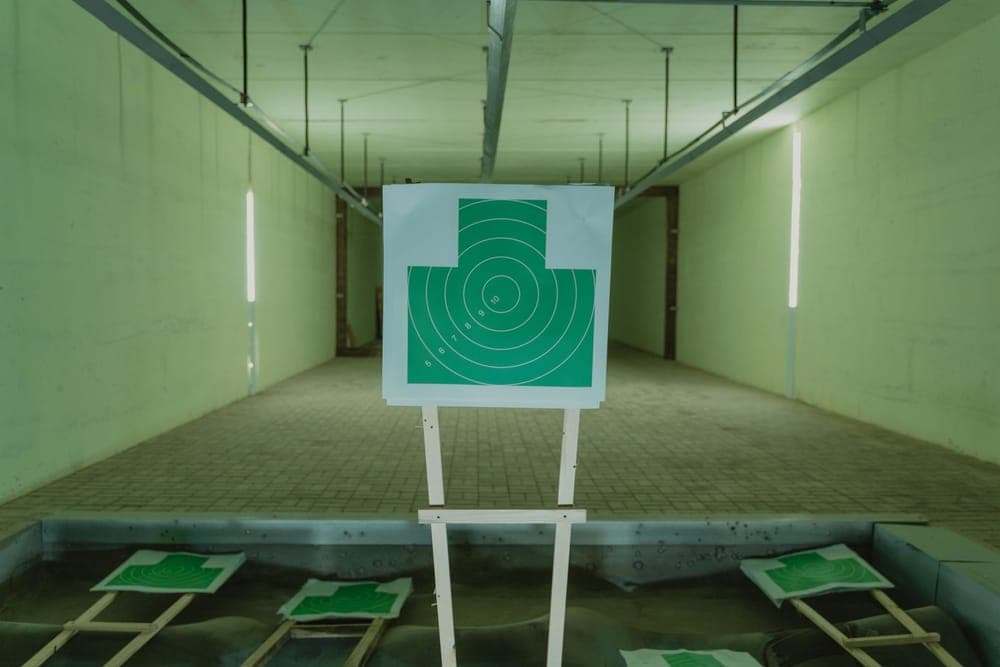
Best first steel target (outdoor ranges)
Champion Center Mass AR500 Steel Target
5.1/10ResearchedCovered by Champion's warnings: 15 yards minimum for non-magnum handgun, face angled 10-20 degrees down. Plate thickness wasn't on the listing we checked, so confirm it.
Check price · Amazon#ad · Price set by Amazon · How we make money for the link to Champion Center Mass AR500 Steel Target
- Stock photo
Champion steel gong for centerfire
Champion Centerfire Hanging Gong
4.6/10ResearchedChampion says it's built to withstand centerfire calibers, and the same published warnings apply. Steel grade and thickness aren't stated on its page.
Check price · Amazon#ad · Price set by Amazon · How we make money for the link to Champion Centerfire Hanging Gong
- Stock photo
Best first pair of shooting glasses
Pyramex Intruder
Z87+6.9/10ResearchedPyramex states ANSI/ISEA Z87.1-2020 + High Impact on its own page. Buy a pair for every person who'll be standing behind the line.
Check price · Amazon#ad · Price set by Amazon · How we make money for the link to Pyramex Intruder
Pyramex lists that rating on its Intruder product page. For the full field of steel, paper and reactive picks, see our best shooting targets for beginners.
How we scored this
Units we claim to have tested: none
Most gear sites say they tested thirty muffs. We haven't put these on a sound meter, and we say so. Every pick here is labeled Researched: we compiled each maker's published specs (the EPA-labeled NRR on hearing protection, the Z87+ mark on glasses), read the manuals, and scored everything on a public rubric. Every figure links to where it came from, and marketing claims are labeled “maker's claim.”
Scores are editorial judgments from that documented research, not test results. Commissions never set a score or decide a pick. The rubric and its weights are published.
What changed
- Published.
Questions
Common questions
How far away should steel targets be?
What is the safe distance for shooting 9mm at steel?
Can you shoot steel targets closer than 15 yards?
What angle should a steel target be set at?
Do you need eye protection to shoot steel targets?
When should you replace a steel target?
Where this comes from
Sources
- Champion / Primos, Steel Target Warnings, items 1-18 (checked 2026-09-19)
- Champion (primos.com), Center Mass AR500 Steel Targets listing (checked 2026-09-19)
- Do-All Outdoors, 8" AR500 Steel Target product page (no minimum distance stated; checked 2026-09-19)
- Caldwell, Ultimate Steel Target Stand product page (no minimum distance stated; checked 2026-09-19)
- NRA, NRA Gun Safety Rules (checked 2026-09-19)
- HexArmor, Safety eyewear: What do lens markings and ANSI Z87+ mean? (checked 2026-09-19)
- Florida Fish and Wildlife Conservation Commission, Range Safety Rules (checked 2026-09-19)
- Pyramex, Intruder product page (checked 2026-09-19)
We haven't tested the gear on this page and we don't pretend to. Specs come from each maker's own pages and data sheets (linked on every product); ratings like NRR and Z87+ are explained from the standards and agencies behind them. Prices are set by Amazon and change often, so we don't print them. Where a figure isn't published, we say so. Read the full method.