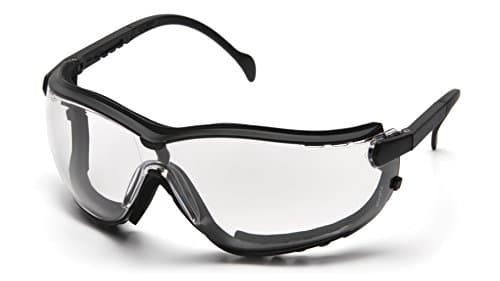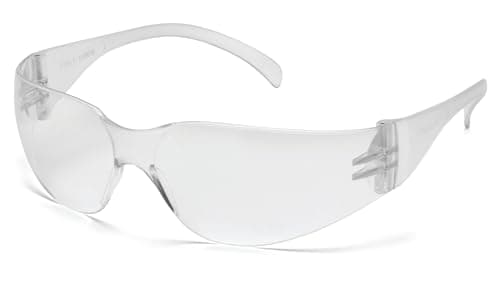
The method, in order
Pyramex publishes a cleaning procedure for its H2MAX-coated safety lenses, and it is the best maker-stated sequence we have found because it is written for a coated safety lens rather than for spectacles. In Pyramex's own words: "Start by removing loose debris and then rinse with water or a soap and water solution. Use a Pyramex cleaning cloth, or any other soft cotton or microfiber cloth to gently pat lens dry."
Expanded into the steps you actually perform at a bench or a sink:
- Get the grit off before anything touches the lens. Running water is best; a firm puff of breath or a shake is the field version. This step is the whole page — everything that scratches a lens is already sitting on it before you start wiping.
- Rinse with water, or water with a little mild soap. Lukewarm, not hot. Soap matters when there is oil involved, which with shooting glasses there usually is.
- Pat dry with a clean, soft cotton or microfiber cloth. Pat, not scrub. Pressure plus any remaining particle equals a scratch.
- Let the frame air dry. Water trapped in a foam gasket or a vent will fog the lens next time you put them on.
If there is no sink — which at an outdoor range there usually is not — a pre-moistened lens towelette made for safety eyewear is the sensible substitute, because the wipe carries its own liquid and lifts rather than drags. That is what the picks below are for.
Why dry-wiping fails
A shooting lens after a session is not merely smudged. It has fine particles on it: unburnt powder, carbon, dust off the berm, grit off the bench. A dry cloth does not remove those particles first, it moves them across the lens under whatever pressure your fingers are applying. That is an abrasive process, and the result is the fine haze of micro-scratches that makes a pair of glasses feel "worn out" long before anything has broken.
ZEISS is blunt about the consequence: "Scratches can't be wiped away, no matter if you have plastic or glass lenses" . There is no repair, only replacement.
Coated lenses need care
Most shooting glasses worth owning have something on the lens: an anti-fog treatment, an anti-scratch hard coat, or both. Those coatings are thin, and some cleaning habits take them off.
The reassuring news for Pyramex's H2MAX is that the maker tested for exactly this, stating that "repeated cleaning in testing showed no loss of adhesion to the coating", and that the coating can also be cleaned with lens-cleaning towelettes. Other makers treat the durability of the coating as a headline feature too: 3M publishes its Scotchgard anti-fog coating material, and Honeywell publishes a HydroShield anti-fog datasheet.
Two practical rules follow. First, read the maker's own cleaning line for the lens you own, because "anti-fog" is not one material. Second, if a lens has no published cleaning guidance, default to water, mild soap and a patted microfiber cloth, which is the gentlest method that still works. Our how to stop shooting glasses from fogging page covers the coatings and treatments themselves.
What not to use
- Paper towels, tissues and napkins. Wood fiber is harder than you think and the surface is nothing like a cloth.
- Household glass cleaner. Formulated for window glass, not for a coated polycarbonate lens.
- Solvents, acetone, alcohol wipes and gun cleaner. A bench covered in CLP is the worst possible place to clean eyewear. Some of these craze polycarbonate outright.
- Hot water. ZEISS's guidance on microfiber cloths warns against water warmer than 40 degrees Celsius (104 Fahrenheit) for the cloth; the same caution is sensible for the lens and its coating.
- Your breath plus a sleeve. Fog plus abrasion. It is the dry wipe with extra moisture.
- Spit. People genuinely do this as an anti-fog trick. It cleans nothing and leaves a film.
Range residue is not ordinary dirt
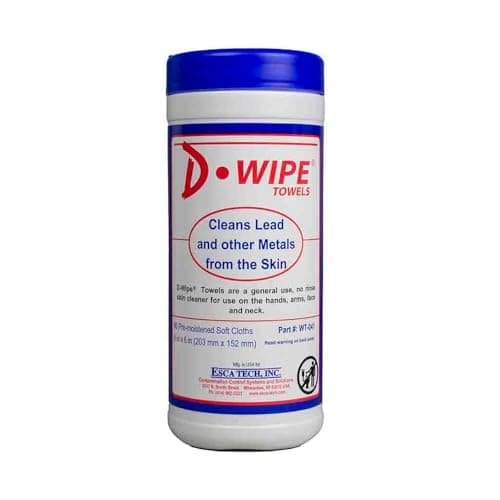
There is a reason to care about the film on your lenses beyond optics. A CDC health alert about indoor firing ranges notes that NIOSH research shows washing hands with soap and water "is not completely effective in removing lead (and other toxic metals) from the surface of the skin", and recommends cleaning hands, forearms and faces after shooting.
Your glasses sit in the middle of that. They collect the same residue your face does, you handle them with the same hands, and then you put them back on your face. Two habits follow:
- Clean your hands before you clean your glasses. Otherwise you are transferring residue onto the lens you are trying to clean.
- Do not store glasses loose in the bottom of a range bag with spent brass. Both for the scratches and for what is on the brass.
Our lead exposure at the shooting range page covers the hygiene routine with its sources, and best lead removal wipes covers the products.
Looking after the cloth
A microfiber cloth that has been in a pocket for a year is a bag of grit shaped like a cloth. It needs washing, and ZEISS publishes two specific cautions for that: "Don't wash microfiber cloths in water warmer than 40 degrees Celsius (104 Fahrenheit), and don't add fabric softener".
Fabric softener is the one people get wrong. It coats the fibers, which is the opposite of what a microfiber cloth does for a living: a softened cloth smears instead of lifting. Wash cool, no softener, air dry, and keep the cloth somewhere it is not collecting debris. If that sounds like more maintenance than you will do, buy single-use towelettes instead and accept the per-use cost.
What to keep in the bag
Our picks for this
Three ways to clean a lens at the range
A sink and a microfiber cloth beat all of these at home. These are what to carry for a bench with no running water, ranked by what the makers publish.
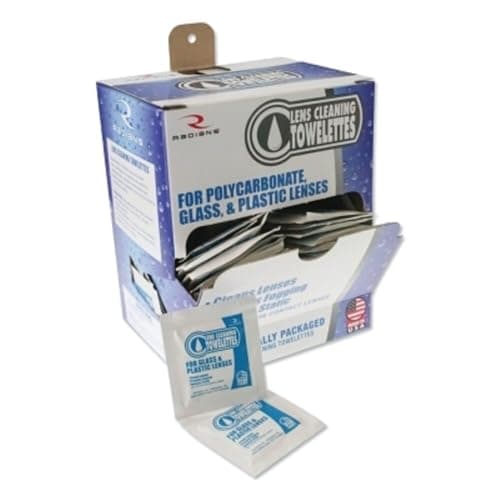
Best lens wipes made for safety glasses
Radians Lens Cleaning Towelettes
9.4/10ResearchedMade for safety glasses specifically: Radians says they clean greasy and oily lenses while leaving an anti-fog and anti-static coating, in a 25-count bag or a 100-count box.
$9.99Amazon#ad · Price as of November 4, 2026 · How we make money for the link to Radians Lens Cleaning Towelettes
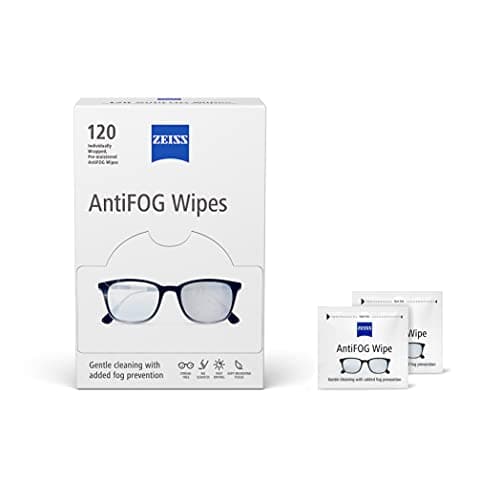
Best anti-fog wipes
ZEISS AntiFOG Wipes
9.5/10ResearchedCleans and treats in one step, with ZEISS claiming fog prevention for up to 24 hours. The simplest thing to throw in a bag pocket.
$18.51Amazon#ad · Price as of November 4, 2026 · How we make money for the link to ZEISS AntiFOG Wipes
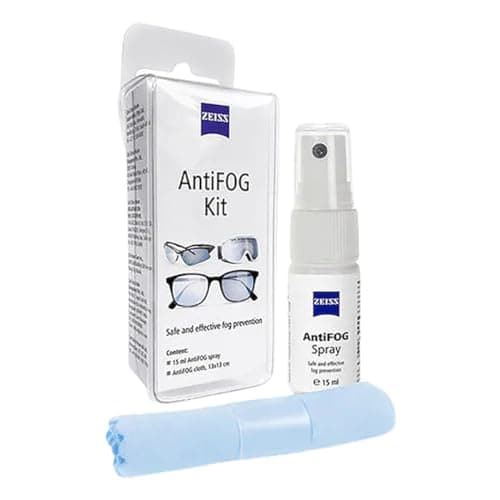
Best anti-fog spray
ZEISS Fog Defender System
9.5/10ResearchedA spray plus cloth kit with ZEISS's longest fog claim, up to 72 hours. Two steps rather than one, and the cloth is included.
$15.00Amazon#ad · Price as of November 4, 2026 · How we make money for the link to ZEISS Fog Defender System
Note what these are and are not. Radians' towelettes are a cleaning product that leaves a coating; ZEISS's products are fog treatments that also clean. If your problem is a dirty lens, any of the three works. If your problem is fogging in a warm indoor bay, read shooting glasses for indoor ranges as well, because a vented or dual-pane frame beats any wipe.
When a lens is finished
Scratches cannot be polished out of a safety lens, and you should not want them to be. The impact performance the Z87+ marking refers to belongs to the lens as manufactured — see the ISEA summary of the Z87.1 standard and our Z87 vs Z87+ page — so a lens with a deep gouge in it is no longer the product that was rated.
Replace a lens or a pair when:
- There is a scratch you can feel with a fingernail, not just see.
- There is any crack, chip or star, however small.
- Hazing has reached the point where you are looking around it rather than through it.
- The frame has lost a lens retention feature, a nose pad or a temple screw.
- The lens has been struck by anything hard, even if it looks fine afterwards.
This is the practical argument for the strategy we recommend across the eye-protection hub: buy an inexpensive rated frame, own two, and replace rather than nurse them. Our best shooting glasses under 50 page is built on exactly that, and interchangeable-lens frames are the alternative if you would rather replace a lens than a pair.
Storage, and the frame
Most lens damage happens in a bag rather than on a firing line. Three cheap habits:
- A pouch or a hard case, always. Several frames ship with one. The bottom of a range bag is full of brass, staples and grit.
- Lenses up, not face down. On a bench, rest them on the temple arms.
- Not on your head in the sun. Heat is hard on coatings and on frame shape, and a hot vehicle is worse.
Give the frame the same attention while you are there: rinse the foam gasket if you have one, check the temple screws, and look at the nose pads. A frame that no longer sits where it used to is a frame whose lens is no longer in front of your eye where it was designed to be — and if it has started sitting badly under earmuffs, our glasses to wear under earmuffs page explains why that costs you hearing protection too. For a dedicated spot in the bag, see how to organize a range bag.
How we scored this
Every pick, scored on numbers you can check
Every pick here is labeled Researched: we compiled each maker's published specs (the EPA-labeled NRR on hearing protection, the Z87+ mark on glasses), read the manuals, checked the standards behind them, and scored everything on a public rubric. Every figure links to where it came from, and marketing claims are labeled “maker's claim,” so you can see exactly why a pick ranks where it does.
Scores are editorial judgments built from that documented research, published on our 8.4–9.8 scale: anything that fails a gate, or that we wouldn't hand a new shooter, never reaches a page, so the number tells you how much better one good option is than the next. Commissions never set a score or decide a pick. The rubric and its weights are published.
Questions
Common questions
How do you clean safety glasses without scratching them?
Can you use glass cleaner on shooting glasses?
Will cleaning remove the anti-fog coating?
How do you clean shooting glasses at the range with no sink?
Can scratches be removed from safety glasses?
How should I store shooting glasses between range trips?
Where this comes from
Sources
- Pyramex, H2MAX anti-fog coating bulletin (cleaning procedure and coating adhesion), accessed 2026-10-17
- ZEISS, eyeglass cleaning solutions (microfiber care and scratches), accessed 2026-10-17
- Radians, Lens Cleaning Towelettes product page, accessed 2026-10-17
- Radians, retail Lens Cleaning Towelettes product page, accessed 2026-10-17
- 3M, Scotchgard anti-fog coating brochure
- Honeywell, Uvex HydroShield anti-fog literature
- CDC MMWR, health alert on lead exposure at indoor firing ranges, 2014
- ISEA, updated ANSI/ISEA Z87.1 standard for eye and face protection
Specs come from each maker's own pages and data sheets (linked on every product); ratings like NRR and Z87+ are explained from the standards and agencies behind them. Prices are set by Amazon and change often, so the buy button always takes you to the current one. Where a figure isn't published, we say so. Read the full method.