Quick picks
The picks at a glance
| # | Product | Best for | Score | Price |
|---|---|---|---|---|
| 1 |  Pyramex Intruder Clear, Z87+, and thin enough at the temple that your earmuffs still seal, which matters more indoors than anywhere else. | Best for indoor ranges overallZ87+ | 6.9/10Researched | Check price · Amazon #ad · Disclosure |
| 2 | Pyramex I-Force A sealed dual-pane goggle on a strap, with Pyramex's anti-fog coating. Nothing here resists a warm humid bay better. | Best if you fog badlyZ87+ | 6.7/10Researched | Check price · Amazon #ad · Disclosure |
| 3 | Pyramex V2G A foam seal around the lens blocks brass and dust from the side without committing you to a full goggle. | Best middle groundZ87+ | 7.6/10Researched | Check price · Amazon #ad · Disclosure |
| 4 | 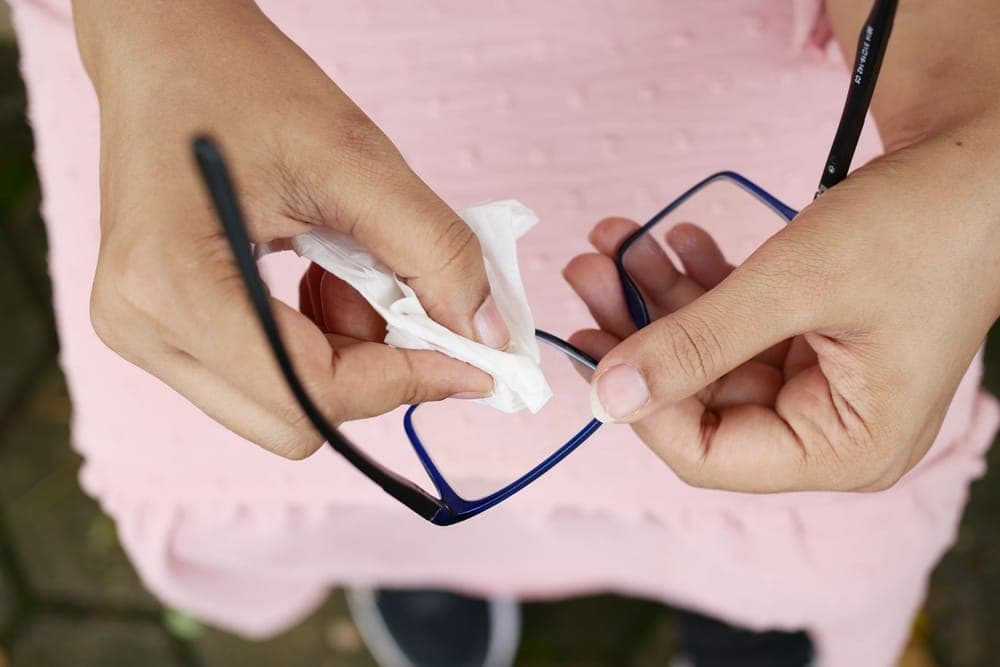 Uvex Ultra-spec 2001 OTG Clear-lens only, which is exactly right indoors, and Uvex sells an anti-fog lens version plus replaceable lenses. | Best over prescription glassesZ87+ | 6.1/10Researched | Check price · Amazon #ad · Disclosure |
| 5 | Howard Leight HL100 Series OTG Glasses Brow venting moves air across the lens, which is the passive answer to fogging if you would rather not treat a lens. | Best vented OTG pairZ87+ | 6.2/10Researched | Check price · Amazon #ad · Disclosure |
#ad · Prices are set by Amazon and change often, so we don't print them. Scores are ours, built from published specs and manuals, not hands-on tests. Photos are illustrative stock. Tap a row for the full write-up.

An indoor range is a concrete box with a ventilation system, overhead lighting and other people standing a few feet either side of you. That environment quietly rules out about half of the shooting glasses on the market, and it does it for reasons nobody mentions when you buy your first pair.
Three things change. The lighting is dimmer than you think, so a tint is a liability rather than a preference. The air is warm and humid and you are breathing hard, so uncoated lenses fog. And the people either side of you are ejecting brass sideways, so the gap between the frame and your temple matters.
Every pick is currently sold, every pick carries a published Z87 high-impact marking, and every spec comes from the maker's own page, linked in Sources. Our best shooting glasses page is the general roundup if you shoot outdoors as well.
What indoors actually changes
Worth being specific, because the differences are not obvious until your first session:
- Light level. Range lighting is engineered to illuminate the target, not the lane. Behind the firing line it is dim. Any tint at all costs you target definition in exactly the place you need it.
- Humidity and temperature. The bay is heated in winter, the ventilation pulls air down the lane away from you, and you are concentrating and breathing harder than normal. That is a fogging environment.
- Ejected brass from your neighbours. A semi-automatic throws hot cases to the right and slightly rearward. In adjacent lanes separated by a partial divider, that lands on you.
- Airborne residue. NIOSH's work on indoor firing ranges is specifically about lead and noise in that room, and it ends up on every surface, including your lenses. That changes how you clean them, which we cover below.
If it is your first indoor trip, the first-time indoor range guide from a commercial range and our own first time at a shooting range page cover the etiquette side.
How we picked
Bench & Berm does not test gear, so nothing here is a test result. Picks are researched from published maker information and scored on the eye rubric published on how we pick: ballistic rating where stated, lens options and tints, fit including over-the-glasses and small sizes, and anti-fog and scratch coatings. The gate is the same as the rest of the hub: marked ANSI Z87.1 high impact on the maker's own page.
Indoors reordered the rest:
- A clear lens has to exist for the frame. Every pick here is available in clear. That sounds trivial until you notice how many shooting glasses are sold only in a tint.
- Anti-fog, or a design that resists fogging. A stated coating, a sealed dual-pane lens, or brow venting. This is the spec that decides whether you keep the glasses on.
- Coverage at the side. A wraparound, a foam seal or a goggle beats a flat lens with a gap at your temple.
- Temple thickness. Because indoors is where you are most likely to be wearing muffs over plugs, and a thick arm undoes the muff.
We did not rank on price. The site shows live prices where it can and a "check price" link where it cannot, because a number typed into an article is stale the week after it is published.
Clear lenses, and nothing else
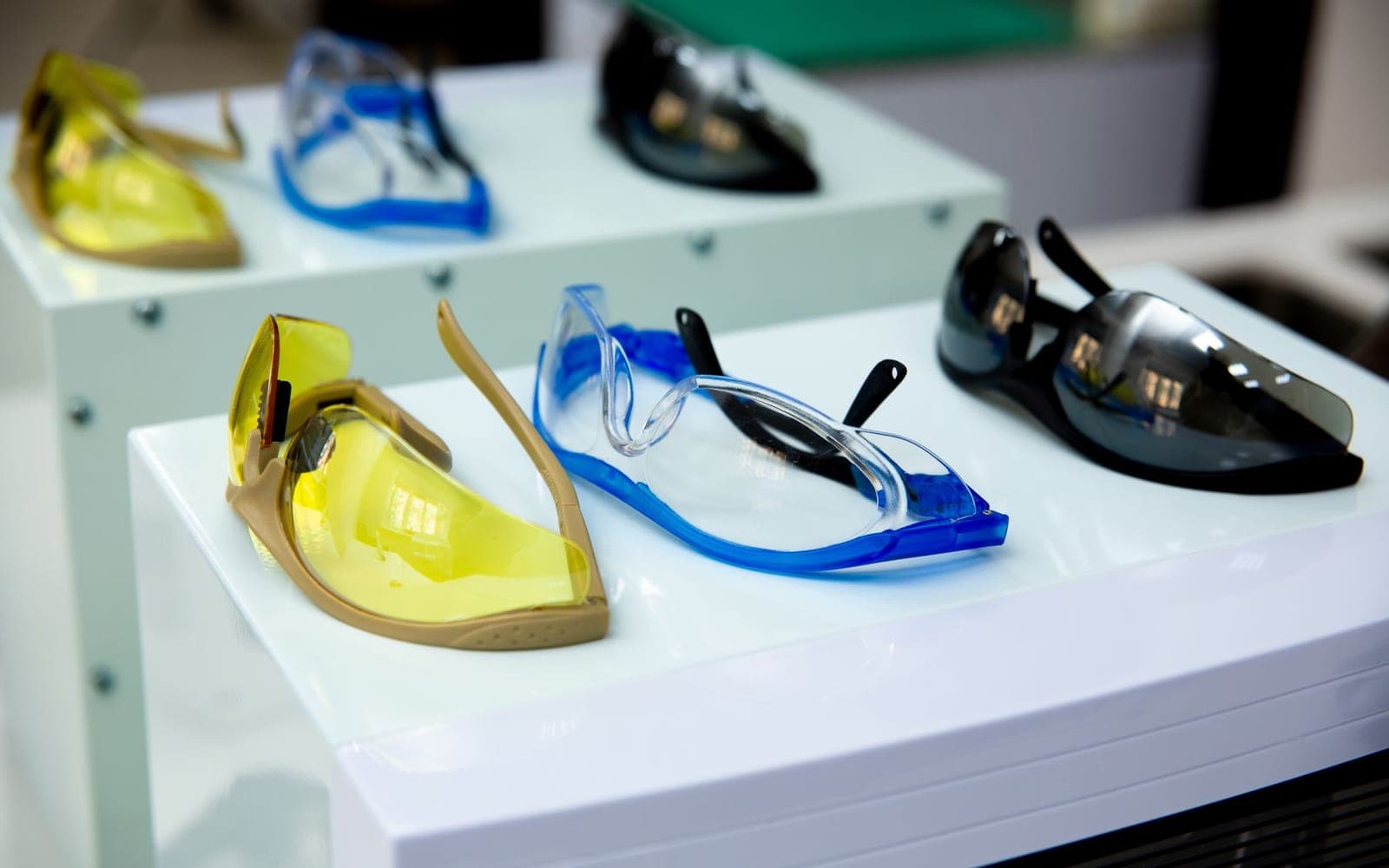
This is the shortest section on the page and the one most likely to save you money. Indoors you want clear. Not amber, not yellow, not smoke, not mirrored.
Amber and yellow are sold as contrast-enhancing, and outdoors in flat light they genuinely are. Indoors they shift color without adding light, and under artificial lighting that usually makes a black front sight against a black target harder to resolve, not easier. Smoke and mirrored lenses simply take light away in a room that has little to spare.
Our shooting glasses lens color guide works through where each tint does earn its place, which is outdoors and on clays. If you shoot both, the answer is two pairs rather than one compromise: at this end of the market that is cheaper than a single premium frame, as our budget shooting glasses page sets out.
Fogging is the main problem, and it has three fixes
Fogging is not a safety failure in itself. It becomes one the moment it makes you take your glasses off on a live firing line, which is exactly what people do. So it is worth solving properly rather than tolerating.
The third fix works on any lens and costs very little: an anti-fog wipe or spray. Our how to stop shooting glasses from fogging page covers what actually works, what makes it worse, and why breathing downward and keeping a mask or high collar off your chin matters more than people expect.
Brass comes from the side
The injury risk indoors is not usually your own gun. It is a hot case from the lane beside you, arriving at the side of your face at an angle a flat lens does not cover, or a fragment coming back off a backstop down a bay with hard walls.
That is an argument for wraparound geometry, a foam seal or a goggle rather than a flat lens on straight temples. It is also an argument for keeping the glasses on from the moment you enter the bay, which every range requires anyway, and which the NSSF's rules treat as part of shooting rather than an optional extra. OSHA's eye and face protection standard, 29 CFR 1910.133, exists for the same reason in workplaces.
A note on what the Z87+ mark does and does not promise: it is an impact standard, and our Z87 vs Z87+ page explains the levels and where the marking is stamped. A guide to reading the markings on a lens is worth five minutes (HexArmor). What it does not cover is coverage: a Z87+ lens with a two-centimetre gap beside your eye is still a gap.
Fit under earmuffs
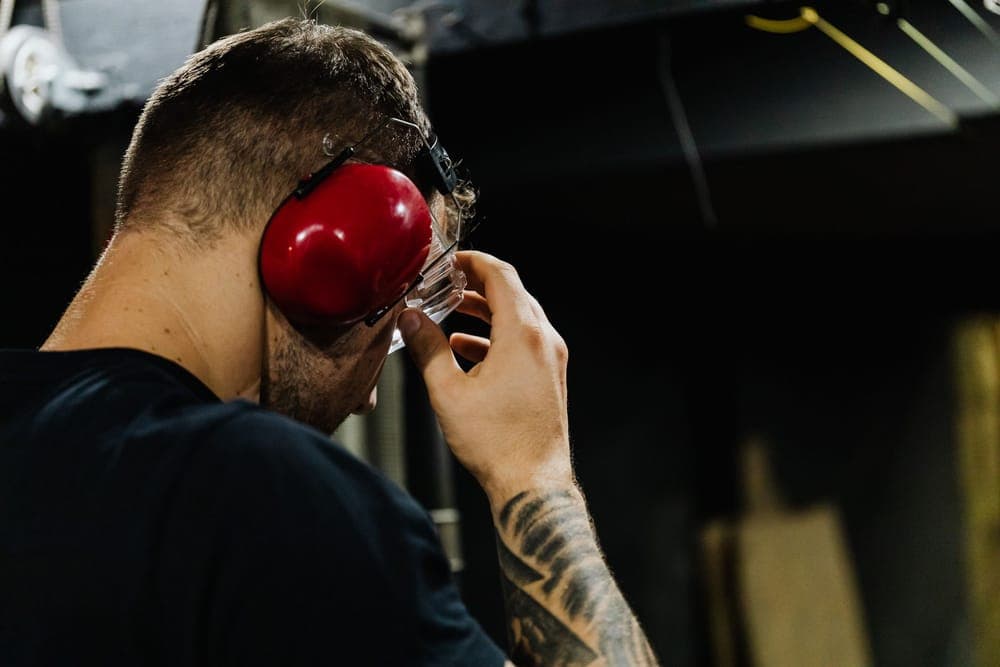
Indoors is where you are most likely to be wearing muffs, often over plugs, because a concrete bay is the hardest noise environment a single protector faces. Which makes the interaction between your glasses and your muff cushion a real spec rather than a footnote.
A spectacle temple crossing the cushion breaks the seal and costs you measurable hearing protection. Thin, flat arms cost you least. This is where the humble Pyramex Intruder quietly beats sportier frames, and it is why the I-Force is interesting: on its strap it has no temple arms at all, so the muff seals as if you were wearing nothing.
Our best shooting glasses to wear under earmuffs page ranks specifically on this, and ear protection with glasses covers it from the muff side.
Lead on your lenses, and how to clean them
Everything in an indoor bay picks up combustion residue, including the front of your glasses. NIOSH's guidance for indoor firing ranges recommends washing hands with soap and water or using lead decontamination wipes after shooting, handling spent cartridge cases or cleaning firearms.
Three habits follow, and they also make your lenses last:
- Do not wipe a lens on your shirt. At a range the shirt is one of the dirtiest things you own, and the grit scratches the coating you paid for.
- Use a proper lens wipe, and do it after you wash your hands. Not before.
- Store them in a case, not the bottom of the bag. A scratched lens in the middle of your sightline is a reason to buy a new pair, which is another argument for owning two cheap pairs rather than one expensive one.
Our lead exposure at the shooting range page covers the whole routine.
Which pair for which shooter
- First pair, indoor range, wearing muffs: Pyramex Intruder in clear. Thin arms, Z87+, buy two.
- You fog every session: Pyramex I-Force. Sealed dual-pane with an anti-fog coating, and no temple arms on the strap.
- You want side coverage without a goggle: Pyramex V2G, with its foam seal.
- You wear a prescription: Uvex Ultra-spec 2001 OTG, and buy the S0112C anti-fog lens version.
- You would rather vent than treat: Howard Leight HL100 OTG.
In detail
The picks, in full
Rank 1
Best for indoor ranges overall
Pyramex Intruder
Clear, Z87+, and thin enough at the temple that your earmuffs still seal, which matters more indoors than anywhere else.
Published specsResearched · not tested by us
How the 6.9 score breaks down
- Ballistic rating (MIL-PRF-32432) (20%)
- 5
- Lens options & tints (20%)
- 8.5
- Fit: OTG, youth, thin temples (30%)
- 6.5
- Anti-fog & scratch coating (30%)
- 7.5
What the specs support
- Pyramex states the Z87.1-2020 high-impact rating on its own page
- Seven lens tints, including clear for indoor ranges and gray for sun
- Choice of Standard or H2MAX anti-fog
Where it falls short
- No MIL-PRF-32432 ballistic claim on Pyramex's page
- Not made to fit over prescription glasses
- Frame sizing isn't published by the maker
Skip it if…
…you wear prescription glasses at the range; the Intruder isn't built to go over them, so look at the Pyramex OTS instead.
#ad · Price set by Amazon · How we make money for the link to Pyramex Intruder
Rank 2
Best if you fog badly
Pyramex I-Force
A sealed dual-pane goggle on a strap, with Pyramex's anti-fog coating. Nothing here resists a warm humid bay better.
Published specsResearched · not tested by us
How the 6.7 score breaks down
- Ballistic rating (MIL-PRF-32432) (20%)
- 8.5
- Lens options & tints (20%)
- 7
- Fit: OTG, youth, thin temples (30%)
- 7
- Anti-fog & scratch coating (30%)
- 5
What the specs support
- States Z87.1-2020 high impact plus the MIL-PRF-32432 high-velocity standard
- Swaps between temple arms and a strap, per Pyramex
- Clear and amber tints for indoor and low-light ranges
Where it falls short
- A goggle is more than most first range trips need
- Whether it fits over prescription glasses isn't stated by the maker
- The anti-fog coating isn't among the specs we could confirm on the maker page
Skip it if…
…you want the lightest, simplest pair for a first indoor range trip; a goggle is more than most beginners need, and the Intruder covers the basics.
#ad · Price set by Amazon · How we make money for the link to Pyramex I-Force
Rank 3
Best middle ground
Pyramex V2G
A foam seal around the lens blocks brass and dust from the side without committing you to a full goggle.
Published specsResearched · not tested by us
How the 7.6 score breaks down
- Ballistic rating (MIL-PRF-32432) (20%)
- 8.5
- Lens options & tints (20%)
- 7
- Fit: OTG, youth, thin temples (30%)
- 6.5
- Anti-fog & scratch coating (30%)
- 8.5
What the specs support
- States both Z87.1-2020 high impact and the MIL-PRF-32432 high-velocity standard
- Foam seal around the lens, as Pyramex describes it
- Three anti-fog options to choose from
- Clear and amber tints for indoor and low-light ranges
Where it falls short
- Four lens tints, fewer than the Intruder
- Not made to fit over prescription glasses
- Frame sizing isn't published by the maker
Skip it if…
…you wear prescription glasses; the V2G is a sealed pair, not an over-the-glasses design, so the Pyramex OTS is the better fit.
#ad · Price set by Amazon · How we make money for the link to Pyramex V2G
Rank 4
Best over prescription glasses
Uvex Ultra-spec 2001 OTG
Clear-lens only, which is exactly right indoors, and Uvex sells an anti-fog lens version plus replaceable lenses.
Published specsResearched · not tested by us
How the 6.1 score breaks down
- Ballistic rating (MIL-PRF-32432) (20%)
- 5
- Lens options & tints (20%)
- 4.5
- Fit: OTG, youth, thin temples (30%)
- 7
- Anti-fog & scratch coating (30%)
- 7
What the specs support
- States ANSI Z87.1+ and CSA Z94.3
- Replaceable lenses, per the maker
- Anti-fog (S0112C) and hard-coated (S0112) versions
- Adjustable temples
Where it falls short
- Fit-over dimensions aren't published
- Only clear lenses in the versions we could confirm
- Pick the S0112C for anti-fog; the S0112 is hard-coated instead
Skip it if…
…you shoot outdoors in bright sun; the versions we could confirm are clear-lens only.
#ad · Price set by Amazon · How we make money for the link to Uvex Ultra-spec 2001 OTG
Rank 5
Best vented OTG pair
Howard Leight HL100 Series OTG Glasses
Brow venting moves air across the lens, which is the passive answer to fogging if you would rather not treat a lens.
Published specsResearched · not tested by us
How the 6.2 score breaks down
- Ballistic rating (MIL-PRF-32432) (20%)
- 5
- Lens options & tints (20%)
- 5.5
- Fit: OTG, youth, thin temples (30%)
- 7
- Anti-fog & scratch coating (30%)
- 6.5
What the specs support
- States ANSI Z87.1-2015 (High Impact) on the maker page
- Indirect vents to help prevent fogging
- Clear or amber lens
- Integral side shields
Where it falls short
- Fit-over dimensions aren't published
- Venting is the only fog help we could confirm; an anti-fog coating isn't among the published specs we found
- No MIL-PRF-32432 ballistic claim
Skip it if…
…your glasses fog badly in humid weather; the HL100's published fog help is venting, while the Pyramex OTS offers an H2X anti-fog option.
#ad · Price set by Amazon · How we make money for the link to Howard Leight HL100 Series OTG Glasses
What to look for in indoor range glasses
- Clear, and only clear. Indoors a tint takes light out of a dim room. Save the amber for outdoors.
- A Z87+ marking on the maker's own page, and again on the frame when it arrives.
- An anti-fog answer. A stated coating, a dual-pane sealed design, brow venting, or a bottle of treatment. Pick one deliberately rather than discovering the problem on the line.
- Coverage at the side of your eye. Wraparound geometry, a foam seal or a goggle. Your neighbour's brass arrives sideways.
- Thin, flat temples. Because indoors you will be wearing earmuffs, and a thick arm breaks the cushion seal.
- A lens wipe and a case. Cheap, and the difference between glasses that last a year and glasses that last five.
- Two pairs, if the budget allows. A scratched lens in your sightline is not something to shoot through.
Beginner mistakes at an indoor range
- Wearing a tinted pair because it looks like shooting glasses. The bay is dim. Clear wins.
- Taking fogged glasses off on the firing line. The one genuinely dangerous habit on this page. Step back off the line first, every time.
- Buying a sporty frame with thick rubber temples. Comfortable on its own, and it costs you the muff seal you also paid for.
- Assuming a Z87+ lens means full coverage. The mark is about impact, not about the gap beside your eye.
- Cleaning lenses on your shirt. Scratches the coating and moves residue around.
- Putting glasses on after you get to the booth. They go on when you enter the bay and come off when you leave it.
How we scored this
Units we claim to have tested: none
Most gear sites say they tested thirty muffs. We haven't put these on a sound meter, and we say so. Every pick here is labeled Researched: we compiled each maker's published specs (the EPA-labeled NRR on hearing protection, the Z87+ mark on glasses), read the manuals, and scored everything on a public rubric. Every figure links to where it came from, and marketing claims are labeled “maker's claim.”
Scores are editorial judgments from that documented research, not test results. Commissions never set a score or decide a pick. The rubric and its weights are published.
Questions
Common questions
What lens color is best for an indoor shooting range?
What are the best shooting glasses for an indoor range?
Why do shooting glasses fog up indoors?
Do you need side protection at an indoor range?
Can you wear your prescription glasses instead at an indoor range?
How should you clean shooting glasses after an indoor session?
Where this comes from
Sources
- Pyramex, Intruder product page, accessed 2026-09-28
- Pyramex, I-Force product page, accessed 2026-09-28
- Pyramex, V2G product page, accessed 2026-09-28
- Uvex (PIP), Ultra-spec 2001 OTG product listing, accessed 2026-09-28
- Howard Leight Shooting Sports, HL100 Sharp-Shooter OTG clear lens product page, accessed 2026-09-28
- NIOSH Alert, "Preventing Occupational Exposures to Lead and Noise at Indoor Firing Ranges" (DHHS/NIOSH Pub. 2009-136), PDF, accessed 2026-09-28
- OSHA, 29 CFR 1910.133 (eye and face protection), accessed 2026-09-28
- HexArmor, "What do lens markings and Z87 mean", accessed 2026-09-28
- The Range 702, first-time indoor range guide (a commercial range's own house rules), accessed 2026-09-28
- NSSF, Rules of Firearm Safety, accessed 2026-09-28
We haven't tested the gear on this page and we don't pretend to. Specs come from each maker's own pages and data sheets (linked on every product); ratings like NRR and Z87+ are explained from the standards and agencies behind them. Prices are set by Amazon and change often, so we don't print them. Where a figure isn't published, we say so. Read the full method.