Quick picks
The picks at a glance
| # | Product | Best for | Score | Price |
|---|---|---|---|---|
| 1 |  Pyramex I-Force On its strap there is no temple arm at the cushion at all, so your muffs seal as though you were wearing nothing. | Best under earmuffs overallZ87+ | 6.7/10Researched | Check price · Amazon #ad · Disclosure |
| 2 | Pyramex Intruder Plain thin flat arms, which is exactly what you want and exactly what sporty frames give up. Cheap enough to own two. | Best conventional pairZ87+ | 6.9/10Researched | Check price · Amazon #ad · Disclosure |
| 3 |  Uvex Ultra-spec 2001 OTG Adjustable temples let you set the arm angle so it lies flat against your head instead of standing off it. | Best over prescription glassesZ87+ | 6.1/10Researched | Check price · Amazon #ad · Disclosure |
| 4 |  Radians Mirage Small A slim frame matters most when your muffs are already near the end of their headband travel and have less force to spare. | Best for a smaller headZ87+ | 5.6/10Researched | Check price · Amazon #ad · Disclosure |
| 5 | Edge Super 64 OTG The other no-temple-arm route, with a stated ballistic rating and room for prescription glasses underneath. | Best goggle with a ballistic ratingZ87+ | 7.9/10Researched | Check price · Amazon #ad · Disclosure |
#ad · Prices are set by Amazon and change often, so we don't print them. Scores are ours, built from published specs and manuals, not hands-on tests. Photos are illustrative stock. Tap a row for the full write-up.
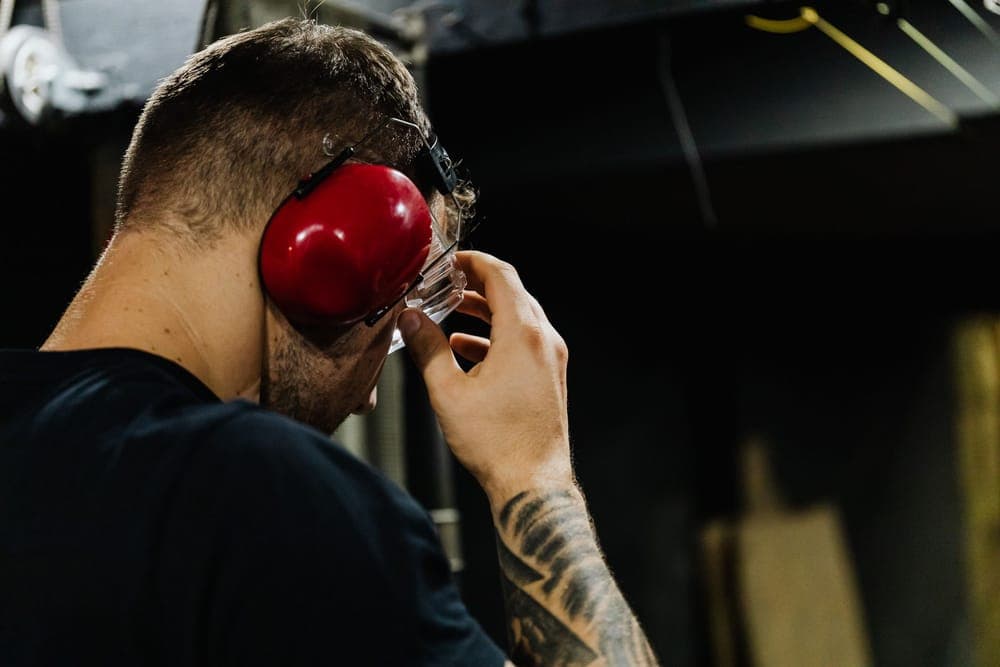
Almost every shooter wears glasses and muffs at the same time, and almost nobody thinks about what happens where they meet. An earmuff works by sealing a volume of air around your ear. A spectacle temple arm runs straight through that seal. The cushion deforms around it, mostly, and what it cannot close becomes a channel.
This is the only page on the site organized around a spec no manufacturer publishes. Nobody lists temple thickness, so the ranking here is built from what makers do say about arm design plus the one structural alternative that removes the problem entirely. Every pick is currently sold, every pick carries a published Z87 high-impact marking, and every spec comes from the maker's own page, linked in Sources.
What the temple arm actually does
Three things, and only the first is obvious:
- It lifts the cushion off your head. The thicker and rounder the arm, the bigger the gap either side of it. A flat arm lets the cushion close much closer to flush.
- It concentrates pressure on your temple. The muff pushes the arm into the side of your head at one point. That is the ache you get after an hour, and it is why people take the muffs off rather than the glasses.
- It shifts when you move. Mount a rifle, turn your head to talk, push the muffs up and pull them back down, and the arm ends up in a slightly different place each time. So the leak is not constant, which makes it harder to notice.
How we picked
Bench & Berm does not test gear, so nothing here is a test result. Picks are researched from published maker information and scored on the eye rubric published on how we pick, and the gate is the same as the rest of the hub: marked ANSI Z87.1 high impact on the maker's own page.
For this page specifically we ranked on:
- Whether the design has a temple arm at the cushion at all. A strap-mounted goggle does not, which is why two goggles are on this list.
- Arm profile as the maker describes it, and as the photographs show. Thin and flat beats thick and rubber-tipped. We have said where this is a judgment from photographs rather than a published spec.
- Adjustability. Uvex publishes adjustable temples for the Ultra-spec 2001, which lets you set the angle so the arm lies against your head rather than standing away from it.
- Frame width. Because a narrow frame puts the arm closer to your skull before the cushion even arrives.
We did not rank on price. The site shows live prices where it can and a "check price" link where it cannot, because a number typed into an article is stale the week after it is published.
How much protection it actually costs
Honest answer: we cannot give you a number, and neither can anyone else, because it depends on your head, your muffs and your frames. What we can do is show why it is worth taking seriously rather than shrugging at.
The practical conclusion is not to panic, it is to stop paying for protection you then defeat. If you bought NRR 30 muffs and wear them over thick rubber temples, you are not getting NRR 30.
What to judge, since nobody publishes it
Four things you can assess from a product photograph and a two-minute check at home:
- Thickness. Look at the arm end-on in the photos. Safety-supply frames like the Pyramex Intruder use a thin flat blade. Sporty shooting frames use a thicker section with a rubber grip molded over it.
- Rubber tips and grips. Comfortable on their own, and the single worst feature for this job. They are thick by design and they grab the cushion rather than sliding under it.
- Where the arm sits vertically. An arm that runs along the top of your ear is closer to the headband, where the cushion has most force. An arm that runs across the middle of the cushion is worst.
- Adjustability. Uvex states "adjustable temples and lightweight design" for the Ultra-spec 2001 OTG (Uvex), which lets you flatten the angle against your head.
The strap answer
The clean fix is to remove the arm. Pyramex states the I-Force is a dual-pane goggle with "quick-release interchangeable temples and strap" (Pyramex), so you can run it on temples when you are not in muffs and swap to the strap when you are. The strap passes around the back of your head under the muff headband, not across the cushion.
The Edge Super 64 OTG is the other route: a goggle with a stated ballistic rating and room for prescription glasses underneath, which solves two problems at once.
Two caveats, because a goggle is not free:
- Goggles fog more than open frames, which is why the I-Force has an anti-fog coating and dual panes. Our fogging page covers the rest.
- A strap has to go somewhere. It competes with a hat and with the muff headband, so try the whole combination together before a class rather than on the day.
Fixing it from the muff side instead
Worth knowing that this is a two-sided problem, and sometimes the muff is the easier thing to change:
- Gel cushions deform around an arm better than firm foam. Some makers sell them as an upgrade.
- A muff with more clamping force closes tighter around an arm, at the cost of comfort.
- Earplugs instead of muffs removes the interaction completely, and foam plugs carry the highest ratings we cover anyway. This is the answer a lot of experienced shooters land on, and our best earplugs for shooting page has the lineup.
- Plugs under muffs means the muff seal matters less, because the plugs are doing work independently. Our double hearing protection page explains how the two combine, which is not by adding the ratings.
Our ear protection with glasses page is the muff-side version of this whole page, if that is the half you would rather change.
Order of operations
Small habits, real difference:
- Glasses on first. Settle them where they belong.
- Muffs down over the top, rather than sliding glasses in under seated muffs, which bends arms and leaves them proud.
- Run a finger along the cushion at the temple. You are feeling for a gap you can get a fingertip into.
- Re-check after you push the muffs up. Every time you lift a cup to talk, the arm resets somewhere slightly different.
- Gather hair low, at the nape, so the headband sits on your skull and the arm is the only thing at the cushion.
Which pair for which shooter
- You want the problem gone: Pyramex I-Force on the strap.
- You want normal glasses that behave: Pyramex Intruder. Thin flat arms, buy two.
- You wear a prescription: Uvex Ultra-spec 2001 OTG, and set the adjustable temples flat.
- Your muffs already sit loose: Radians Mirage Small, because a narrow frame puts the arm closer to your head.
- You want a goggle with a ballistic rating: Edge Super 64 OTG.
In detail
The picks, in full
Rank 1
Best under earmuffs overall
Pyramex I-Force
On its strap there is no temple arm at the cushion at all, so your muffs seal as though you were wearing nothing.
Published specsResearched · not tested by us
How the 6.7 score breaks down
- Ballistic rating (MIL-PRF-32432) (20%)
- 8.5
- Lens options & tints (20%)
- 7
- Fit: OTG, youth, thin temples (30%)
- 7
- Anti-fog & scratch coating (30%)
- 5
What the specs support
- States Z87.1-2020 high impact plus the MIL-PRF-32432 high-velocity standard
- Swaps between temple arms and a strap, per Pyramex
- Clear and amber tints for indoor and low-light ranges
Where it falls short
- A goggle is more than most first range trips need
- Whether it fits over prescription glasses isn't stated by the maker
- The anti-fog coating isn't among the specs we could confirm on the maker page
Skip it if…
…you want the lightest, simplest pair for a first indoor range trip; a goggle is more than most beginners need, and the Intruder covers the basics.
#ad · Price set by Amazon · How we make money for the link to Pyramex I-Force
Rank 2
Best conventional pair
Pyramex Intruder
Plain thin flat arms, which is exactly what you want and exactly what sporty frames give up. Cheap enough to own two.
Published specsResearched · not tested by us
How the 6.9 score breaks down
- Ballistic rating (MIL-PRF-32432) (20%)
- 5
- Lens options & tints (20%)
- 8.5
- Fit: OTG, youth, thin temples (30%)
- 6.5
- Anti-fog & scratch coating (30%)
- 7.5
What the specs support
- Pyramex states the Z87.1-2020 high-impact rating on its own page
- Seven lens tints, including clear for indoor ranges and gray for sun
- Choice of Standard or H2MAX anti-fog
Where it falls short
- No MIL-PRF-32432 ballistic claim on Pyramex's page
- Not made to fit over prescription glasses
- Frame sizing isn't published by the maker
Skip it if…
…you wear prescription glasses at the range; the Intruder isn't built to go over them, so look at the Pyramex OTS instead.
#ad · Price set by Amazon · How we make money for the link to Pyramex Intruder
Rank 3
Best over prescription glasses
Uvex Ultra-spec 2001 OTG
Adjustable temples let you set the arm angle so it lies flat against your head instead of standing off it.
Published specsResearched · not tested by us
How the 6.1 score breaks down
- Ballistic rating (MIL-PRF-32432) (20%)
- 5
- Lens options & tints (20%)
- 4.5
- Fit: OTG, youth, thin temples (30%)
- 7
- Anti-fog & scratch coating (30%)
- 7
What the specs support
- States ANSI Z87.1+ and CSA Z94.3
- Replaceable lenses, per the maker
- Anti-fog (S0112C) and hard-coated (S0112) versions
- Adjustable temples
Where it falls short
- Fit-over dimensions aren't published
- Only clear lenses in the versions we could confirm
- Pick the S0112C for anti-fog; the S0112 is hard-coated instead
Skip it if…
…you shoot outdoors in bright sun; the versions we could confirm are clear-lens only.
#ad · Price set by Amazon · How we make money for the link to Uvex Ultra-spec 2001 OTG
Rank 4
Best for a smaller head
Radians Mirage Small
A slim frame matters most when your muffs are already near the end of their headband travel and have less force to spare.
Published specsResearched · not tested by us
How the 5.6 score breaks down
- Ballistic rating (MIL-PRF-32432) (20%)
- 5
- Lens options & tints (20%)
- 4
- Fit: OTG, youth, thin temples (30%)
- 8
- Anti-fog & scratch coating (30%)
- 4.5
What the specs support
- States ANSI Z87.1+ on Radians' page
- A 10% smaller frame than the standard Mirage
- Under 1 ounce, per Radians
Where it falls short
- Lens colors aren't among the specs we could confirm
- An anti-fog coating isn't among the specs we could confirm
- Radians gives no age; it describes the fit for men and women
Skip it if…
…you need a specific tint; we couldn't confirm which lens colors Radians sells for the Mirage Small, so check the listing first.
#ad · Price set by Amazon · How we make money for the link to Radians Mirage Small
Rank 5
Best goggle with a ballistic rating
Edge Super 64 OTG
The other no-temple-arm route, with a stated ballistic rating and room for prescription glasses underneath.
Published specsResearched · not tested by us
How the 7.9 score breaks down
- Ballistic rating (MIL-PRF-32432) (20%)
- 9
- Lens options & tints (20%)
- 5.5
- Fit: OTG, youth, thin temples (30%)
- 8
- Anti-fog & scratch coating (30%)
- 8.5
What the specs support
- States MIL-PRF 32432-A on top of ANSI Z87.1+
- Vapor Shield anti-fog and a TPR gasket
- Published frame measurements
Where it falls short
- It's a goggle, not spectacles, which is more than most first range trips need
- The G-15 version was unavailable on Edge's store on 2026-09-19 (clear was available)
- Amazon search results we checked showed the standard Super 64; make sure the listing says OTG
Skip it if…
…you want ordinary glasses for an indoor pistol lane; this is a fit-over goggle, and a spectacle like the Pyramex OTS is simpler.
#ad · Price set by Amazon · How we make money for the link to Edge Super 64 OTG
What to look for
- A Z87+ marking on the maker's own page. The one thing that is not a judgment call. A guide to reading the markings on a lens is worth five minutes (HexArmor).
- Thin, flat temple arms rather than thick sections with rubber grips molded on.
- A strap option, if you wear muffs for most of your shooting. It is the only way to remove the arm rather than minimize it.
- Adjustable temples, so you can flatten the angle.
- A frame no wider than your face, which starts the arm closer to your skull.
- Anti-fog, if you go with a goggle. Sealed designs trade airflow for coverage.
Beginner mistakes
- Buying the comfiest-looking frame. Thick rubber temples are comfortable alone and the worst choice under muffs.
- Never running the check. Talk out loud with the glasses on, then off. It takes thirty seconds.
- Sliding glasses under seated muffs. Glasses first, muffs second, every time.
- Assuming the printed NRR still applies. It assumes a seal, and OSHA derates it even with one.
- Taking the muffs off instead of fixing the fit. The ache at your temple is a solvable equipment problem, not something to endure or ignore.
- Forgetting hair and hats. Both change where the headband sits, and so change how much force is left to close around the arm.
How we scored this
Units we claim to have tested: none
Most gear sites say they tested thirty muffs. We haven't put these on a sound meter, and we say so. Every pick here is labeled Researched: we compiled each maker's published specs (the EPA-labeled NRR on hearing protection, the Z87+ mark on glasses), read the manuals, and scored everything on a public rubric. Every figure links to where it came from, and marketing claims are labeled “maker's claim.”
Scores are editorial judgments from that documented research, not test results. Commissions never set a score or decide a pick. The rubric and its weights are published.
Questions
Common questions
What are the best shooting glasses to wear under earmuffs?
Do glasses really reduce how well earmuffs work?
How can you tell how much protection your glasses are costing you?
Are goggles better than glasses under earmuffs?
Should you just wear earplugs instead?
Do thinner temple arms fit under muffs better than thicker ones?
Where this comes from
Sources
- Pyramex, I-Force product page, accessed 2026-09-28
- Pyramex, Intruder product page, accessed 2026-09-28
- Uvex (PIP), Ultra-spec 2001 OTG product listing, accessed 2026-09-28
- Radians, Mirage Small Safety Eyewear product page, accessed 2026-09-28
- Edge Eyewear, Super 64 OTG product page, accessed 2026-09-28
- eCFR, 40 CFR Part 211 Subpart B (EPA hearing protector labeling, the rule behind the NRR), accessed 2026-09-28
- OSHA Technical Manual, Section 3 Chapter 5 (Noise), on derating published ratings, accessed 2026-09-28
- ASHA, "Recreational Firearm Noise Exposure" information series (PDF), accessed 2026-09-28
- HexArmor, "What do lens markings and Z87 mean", accessed 2026-09-28
We haven't tested the gear on this page and we don't pretend to. Specs come from each maker's own pages and data sheets (linked on every product); ratings like NRR and Z87+ are explained from the standards and agencies behind them. Prices are set by Amazon and change often, so we don't print them. Where a figure isn't published, we say so. Read the full method.