Not medical advice. This page shares general guidance from the public-health sources linked in the text. If you're worried about your hearing or lead exposure, talk to a doctor.

You will meet both acronyms within about ten minutes of shopping for hearing protection, usually on the same listing. A pair of plugs will say NRR 32 in one line and SNR 38 two lines down, and the obvious conclusion, that the 38 is a better number, is wrong. They are not two measurements of the same thing on the same scale. They are two regulatory systems that happen to both end in a decibel figure.
This matters for exactly one practical reason: if you let an SNR figure into your comparison, you will rank a worse protector above a better one. Here is how to keep them apart.
The short version
- NRR is American. It is defined and required by the US EPA, and it is the number printed on the EPA label on any hearing protector sold in the United States.
- SNR is European. It is the single-number figure that accompanies hearing protection under the European system, and the UK's Health and Safety Executive builds its selection guidance around it.
- SNR figures run higher than the NRR on the same product, typically by a few decibels, because of how each is calculated.
- There is no conversion you should do yourself. Rules of thumb circulate; none of them are published by the EPA, and a guessed number is worse than no number.
What the NRR is
The Noise Reduction Rating comes from 40 CFR Part 211 Subpart B, the EPA's rule on hearing protective devices. That rule is the reason your foam plugs arrive in packaging with a decibel figure on it at all: labeling is a requirement, not a marketing choice.
Two consequences follow, and both are useful. First, every protector legitimately sold for hearing protection in the US has an NRR, so there is always a comparable number. Second, if a product aimed at American shooters does not publish one, that is information: either it was never rated to the US standard or the maker would rather you did not see the figure.
This is why our picks carry a hard gate. Every muff, plug and earbud on this site publishes a US EPA NRR from its maker, which is the rule written down on how we pick. Our what NRR do I need for shooting page then works out what figure you actually need for a given range.
What the SNR is
The Single Number Rating is the European equivalent, and it is used in exactly the same way: as a one-figure shorthand for how much a protector attenuates. The UK's Health and Safety Executive publishes a selection table for employers that is explicitly "based on the single number rating (SNR) value provided with a hearing protection device".
You will run into SNR figures on American listings for three reasons. Some brands sell the same product on both sides of the Atlantic and print both numbers. Some publish an SNR because it is the flattering one. And some import a product that was only ever rated in Europe.
Why SNR numbers read higher
Both ratings start from the same kind of laboratory data: a panel of subjects wearing the protector, measured band by band across frequencies. What differs is the arithmetic that turns those bands into one number, including how much statistical safety margin is subtracted and which reference noise spectrum is assumed.
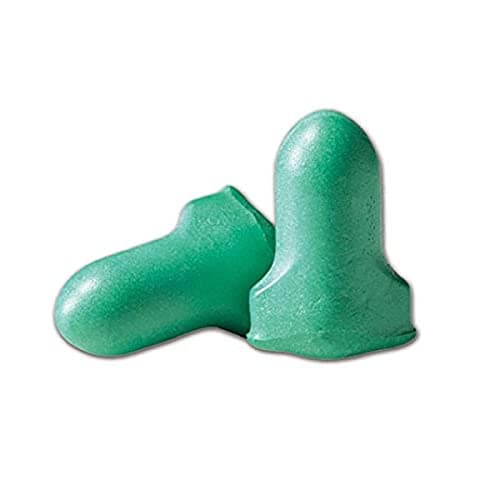
The result is systematic rather than random. On a product where both figures are published, the SNR is the larger one. Honeywell's own page for the Laser Lite foam plug publishes NRR 32 and lists SNR separately, and this site quotes only the 32 for exactly this reason.
AXIL is the clearest case in our registry. Its GS Extreme 3.0 publishes 21 dB NRR with the foam tips and 17 dB with silicone, and separately quotes SNR figures. Shop on the SNR and those earbuds look like serious protection. Shop on the NRR and you can see that 21 dB is the lowest plug rating we cover, and that indoors you should wear muffs over them.
Why you cannot convert one to the other
You will find subtraction rules online: knock four off the SNR, or five, or seven. Do not use them, for three reasons.
- The EPA does not publish one. There is no official conversion in 40 CFR Part 211, so any number you apply is somebody's estimate.
- The gap is not constant. It depends on the protector's attenuation curve, so the difference on a deep-seated foam plug is not the difference on a thin electronic earbud.
- You are already derating. You should be halving whichever rating you use, as below. Stacking a guessed conversion on top of a derate gives you a number with no meaning at all.
The workable rule is simpler: if the only figure a product publishes is an SNR, treat that product as unrated for US purposes and buy something that publishes an NRR instead. There is no shortage of choice, and our best hearing protection for shooting page is built entirely out of products that do.
Products that publish the number you need
Three from our registry that make this concrete: the highest NRR we cover in a muff, the foam plug whose own page shows both figures side by side, and the earbud whose NRR changes with the tip you fit.
Our picks for this
Three products, three published NRRs
Every figure below is the US EPA NRR as its maker publishes it. Where the maker also lists an SNR, we leave it out on purpose.
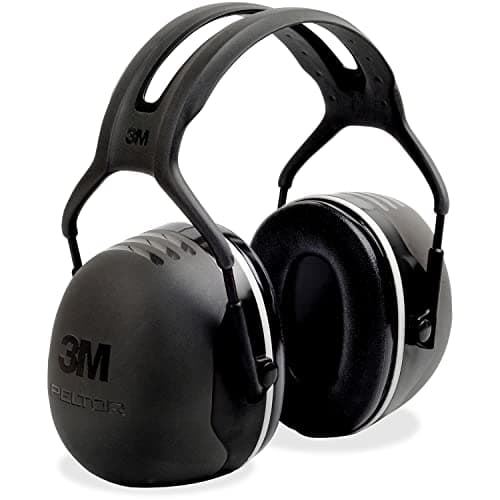
Highest-NRR passive muff
3M Peltor X5A
NRR 316.7/10ResearchedNRR 31 from the X5A row of 3M's own X Series NRR table. The same data sheet tells you to halve it to estimate real-world protection.
$47.27Amazon#ad · Price as of November 3, 2026 · How we make money for the link to 3M Peltor X5A
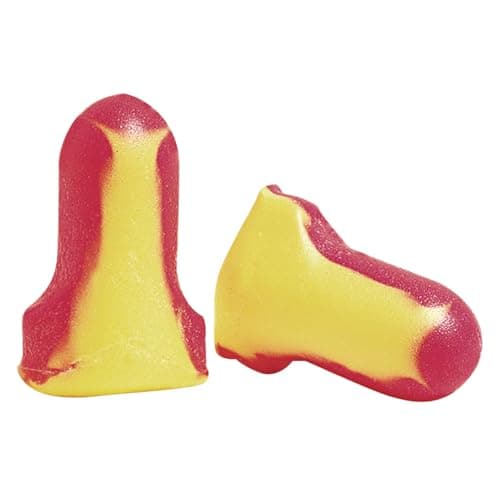
Best foam plug in corded or uncorded form
Howard Leight Laser Lite
NRR 327.1/10ResearchedNRR 32 foam, on a Honeywell page that lists an SNR separately. The 32 is the figure to compare in the US.
$32.19Amazon#ad · Price as of November 3, 2026 · How we make money for the link to Howard Leight Laser Lite
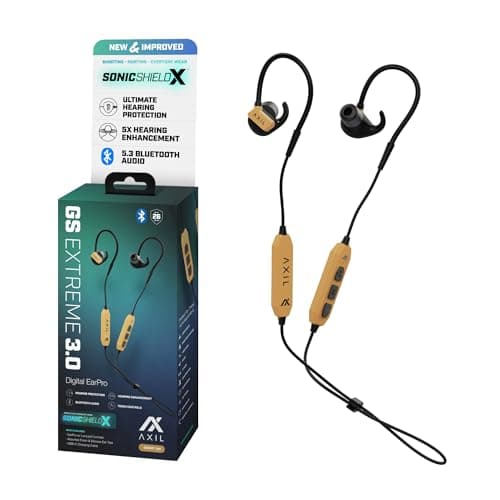
Best Bluetooth electronic earbuds
AXIL GS Extreme 3.0
NRR 216.7/10Researched21 dB NRR with the foam tips, 17 dB with silicone, published per tip. Read on the NRR and the tip choice is the whole decision.
$119.95Amazon#ad · Price as of November 3, 2026 · How we make money for the link to AXIL GS Extreme 3.0
What to do with an SNR-only product
Put it back. That sounds blunt, but the situation is specific: a product sold to American shooters that publishes a European figure and not the one the EPA requires has told you something about itself. One widely sold electronic earbud is excluded from every pick on this site for exactly that reason, because its maker publishes only an SNR.
The exception is a product you already own. An SNR of 30-something is not nothing, and a protector you actually wear beats a better one in a drawer. Wear it, derate it hard, and add foam plugs underneath at an indoor range until you replace it.
Derating either number
Whichever rating you end up holding, the last step is the same, and it is the step most people skip. 3M states in its own X Series data sheet that many users will receive less noise reduction than the NRR indicates because of variation in fit, fitting skill and motivation, and recommends reducing the NRR by 50 percent to estimate typical workplace protection. OSHA's Appendix B to 1910.95 sets out comparable methods, and the underlying standard is 29 CFR 1910.95.
Run that on the best case. Halve an NRR of 31 and you remove roughly 15 dB. Meinke and colleagues put recreational firearms larger than a .22 at about 150 to 165 dB peak (Meinke et al., 2017), so the arithmetic lands you above the 140 dB impulse limit with the highest-rated muff on the site. That is not an argument against muffs. It is the argument for plugs underneath, which our double hearing protection page sets out, and for understanding how loud the gun actually is on our how loud is a gunshot page.
For the published NRR figures themselves, laid out by protector type, see our NRR rating chart.
How we scored this
Every pick, scored on numbers you can check
Every pick here is labeled Researched: we compiled each maker's published specs (the EPA-labeled NRR on hearing protection, the Z87+ mark on glasses), read the manuals, checked the standards behind them, and scored everything on a public rubric. Every figure links to where it came from, and marketing claims are labeled “maker's claim,” so you can see exactly why a pick ranks where it does.
Scores are editorial judgments built from that documented research. Commissions never set a score or decide a pick. The rubric and its weights are published.
Questions
Common questions
Is NRR or SNR better?
How do you convert SNR to NRR?
Why is the SNR number higher than the NRR on the same earplugs?
Should you trust the NRR on the box?
Does a higher NRR mean I can skip earplugs under my muffs?
Where this comes from
Sources
- US EPA, 40 CFR Part 211 Subpart B, Hearing Protective Devices (eCFR), accessed 2026-10-10
- HSE (UK), Hearing protection: select protectors to reduce noise and avoid overprotection, accessed 2026-10-10
- OSHA, 29 CFR 1910.95, Occupational noise exposure, accessed 2026-10-10
- OSHA, Appendix B to 29 CFR 1910.95, Methods for estimating hearing protector attenuation, accessed 2026-10-10
- Honeywell (GB), Laser Lite Disposable Foam Earplugs product page, accessed 2026-10-10
- AXIL, GS Extreme 3.0 product page, accessed 2026-10-10
- 3M, PELTOR X Series passive earmuff technical data sheet (official 3M PDF), accessed 2026-10-10
- Meinke DK, Finan DS, Flamme GA, Murphy WJ, et al., Prevention of Noise-Induced Hearing Loss from Recreational Firearms, Seminars in Hearing 2017 (CDC Stacks), accessed 2026-10-10
Specs come from each maker's own pages and data sheets (linked on every product); ratings like NRR and Z87+ are explained from the standards and agencies behind them. Prices are set by Amazon and change often, so the buy button always takes you to the current one. Where a figure isn't published, we say so. Read the full method.