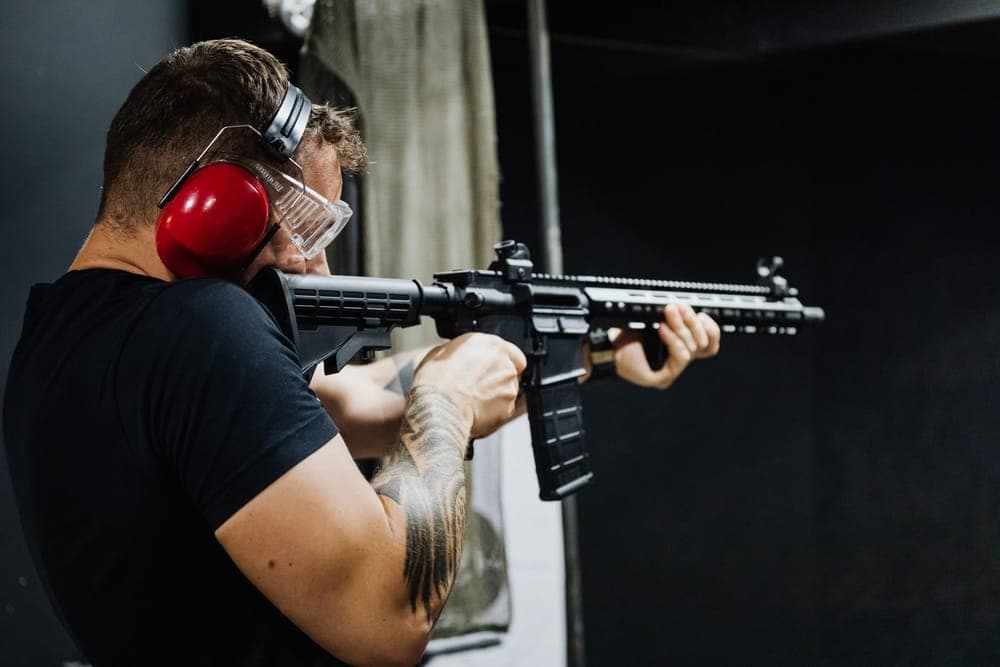
If you've been told to "double up" at the range, this is what it means: foam earplugs in your ears, earmuffs over the top. Hearing researchers at NIOSH (the federal workplace-safety research agency) and the audiologists at ASHA both recommend it. It also raises fair questions. When do you actually need it, how much does it add, and how do you wear both without one undoing the other?
Who recommends it
- NIOSH researchers: "NIOSH recommends that hunters and shooters use double hearing protection every time a weapon is fired. Double protection involves wearing both earplugs and earmuffs" (Murphy, Byrne and Franks, 2007).
- NIOSH, for indoor ranges: "All workers and shooters should be required to use dual hearing protection devices (earmuffs and earplugs) when the range is in use" (NIOSH Publication 2009-136). That document was written to protect range employees and people who shoot as part of their job, so read it as NIOSH's recommendation for ranges rather than a rule for hobby shooters.
- ASHA (the American Speech-Language-Hearing Association): "Double-protect your ears by putting earmuffs over earplugs when shooting firearms" (ASHA, Recreational Firearm Noise Exposure).
- A NIOSH-authored review: "Dual hearing protection (earplug worn in combination with an earmuff) provides the greatest protection" (Meinke et al., 2017).
When to double up
The sources point to a few situations where it matters most:
- Every indoor range. Both NIOSH and ASHA single out indoor shooting. ASHA's advice for an indoor facility is to choose one that has been acoustically treated for reverberation "and wear double hearing protection." NIOSH researchers note that in an indoor range, "reflected sound (reverberation) also becomes an important factor."
- Enclosed or covered spots outdoors. Meinke et al. write that "shooting in an enclosed, reflective, reverberant environment (indoors or hunting blind) increases the hazard to hearing," and that "shooting from a bench or over a table also increases the peak SPL reaching the shooter's ear." Shooting from a bench under a roof combines both, so it's worth treating like indoors.
- Long sessions and lots of rounds. NIOSH researchers point out that peak level "is not the sole factor for hearing damage. Other factors, such as the duration and number of impulses, also have an effect."
- When your muff is modestly rated. If your muff is rated in the low 20s, like the slim electronic muffs we cover (NRR 21 to 23), a foam plug underneath is the easy upgrade. Our guide to what NRR you need explains the ratings.
NIOSH's own researchers go further and recommend doubling up every time a weapon is fired. If you're unsure, doubling up is never the wrong call. Our guide to how loud a gunshot is shows the numbers behind that advice.
Does double hearing protection work?
Yes, and the measured gain with real gunfire is large. NIOSH evaluated hearing protectors on a test head during live-fire measurements with law-enforcement firearms and reported: "The mean peak reduction for earmuffs was 26dB, while earplugs alone provided a mean peak reduction of 24dB. The mean peak reduction for the combined earmuff and earplugs was 44dB" (NIOSH 2009-136).
A second NIOSH example is even more concrete. With a 12-gauge shotgun, a David Clark earmuff reduced the peak level "from 161 dB ... to 130 dB SPL," and "the addition of a deeply-inserted foam earplug adds another 21 dB to the attenuation." The same article concludes that "the combination of an earmuff and a deeply-inserted foam earplug can provide as much as 50 dB of peak reduction, which is adequate in most cases" (Murphy, Byrne and Franks, 2007).
Those figures are for the specific products NIOSH measured, not a promise for yours. But they answer the question clearly: a second layer makes a real difference with gunfire.
Why the NRRs don't add up: OSHA's +5 rule
A common mistake is to add the two ratings: an NRR 33 plug plus an NRR 22 muff does not make NRR 55. OSHA's technical manual gives the method it uses for estimating dual protection: "Determine the hearing protector with the higher rated NRR (NRRh) and subtract 7 dB if using A-weighted sound level data. Add 5 dB to this field-adjusted NRR to account for the use of the second hearing protector." It adds: "It is important to note that using such double protection will add only 5 dB of attenuation" ( OSHA Technical Manual, Section III Chapter 5).
OSHA's own worked example uses a 110 dBA workplace, an NRR 29 plug and an NRR 25 muff: "Estimated Exposure = 110 - [(29 - 7) + 5] = 83 dBA." Here's the same method with our two picks below:
| Step (OSHA method) | Howard Leight MAX-1 plug (NRR 33) + Impact Sport muff (NRR 22) |
|---|---|
| 1. Take the higher NRR | 33 (the plug) |
| 2. Subtract 7 dB (A-weighted data) | 33 - 7 = 26 |
| 3. Add 5 dB for the second protector | 26 + 5 = 31 dB estimated reduction |
Two things to take from this. First, OSHA's method is a planning estimate for steady workplace noise, and the EPA's label rule warns that the NRR "may not be an accurate indicator of the protection attainable against impulsive noise such as gunfire" ( 40 CFR 211.204-4). NIOSH's gunfire measurements above found a much bigger gain from the second layer than 5 dB. Second, because OSHA's method starts from the higher rating, a well-fitted high-NRR foam plug is often the layer doing the most work. That's worth knowing when you choose a pair.
How to wear earplugs under earmuffs
There's no special technique beyond fitting each layer the way its maker says. Every protector sold in the US must include "instructions as to the proper insertion or placement of the device" (40 CFR 211.204-4), and the package must warn that improper fit reduces protection. Follow them in this order:
- Plugs first, deeply. Insert foam plugs exactly as the package instructions show. NIOSH researchers describe the best combination as "a deeply-inserted foam earplug and a well-seated earmuff." A plug that's only halfway in is the weak link.
- Glasses next, with thin temples. Your eye protection has to go on too, and its temples sit right where the muff cushion seals. 3M advises choosing "eyeglasses or goggles that have thin, flat temples or straps which will minimize interference with the seal of the earmuff cushions" (3M PELTOR X Series data sheet). NIOSH suggests glasses "with a strap or low profile stem" (NIOSH 2009-136).
- Muffs last, sealed. 3M's fitting instructions: "Position the earcups over your ears so the cushions fully enclose the ears and seal tightly against the head," then adjust the height of each cup until you have "a tight and comfortable fit that exerts even pressure around the ears." The headband should sit straight on your head.
- Clear the seal. 3M also says to "pull long hair back to the extent possible and remove other items that may degrade the earmuff seal such as pencils, hats, jewelry or earbuds." Anything caught under the edge of a cushion counts.
- Switch on and check you can hear. With an electronic muff, turn it on before you step to the line. If your model has a volume control (check its manual), set it so you can hear voices through the plugs.
Hearing range commands while doubled up
The honest downside of two passive layers is that you won't hear much. NIOSH researchers put it bluntly: double protection "can severely compromise one's ability to communicate when both devices are passive, linear-attenuation protectors. The use of an electronic level-dependent earmuff with a deeply-inserted foam earplug can compensate for this loss of communication ability." They add that "in some cases, the earmuff may provide sufficient gain (~20 dB) to overcome the attenuation of the earplug" (Murphy, Byrne and Franks, 2007). NIOSH's indoor-range guidance makes the same call: "electronic level-limiting or sound restoration earmuffs with passive earplugs" for shooters who need to communicate (NIOSH 2009-136).
What about electronic earbuds under a passive muff? The same NIOSH authors noted there were "no data on the use of an active level-dependent earplug in combination with a passive earmuff" and that "it is doubtful that the pairing would be as effective as the active level-dependent earmuff with foam earplug." For a beginner, the simple, well-supported setup is foam plugs under an electronic muff. Being able to hear matters: our range etiquette guide covers the commands you'll be listening for, and electronic vs passive ear muffs explains the electronics.
What to look for in a plug-and-muff pair
- A high-NRR foam plug you can insert well. It's the inner layer and, by OSHA's method, often the higher-rated one. Our best earplugs for shooting lists foam plugs up to NRR 33.
- An electronic muff, so you can still hear. This is the combination NIOSH describes for indoor ranges.
- A muff that seals over your glasses. Pair it with thin-temple eye protection; see ear protection with glasses.
- A slim cup if you shoot long guns. The stock sits against the cup when you shoulder a rifle or shotgun, and several makers design slim cups for that.
Our picks for this
A plug-and-muff pair to start with
A high-NRR foam plug for the inner layer and an electronic muff on top, so you can still hear range commands. It's the setup NIOSH describes for indoor ranges.
- Stock photo
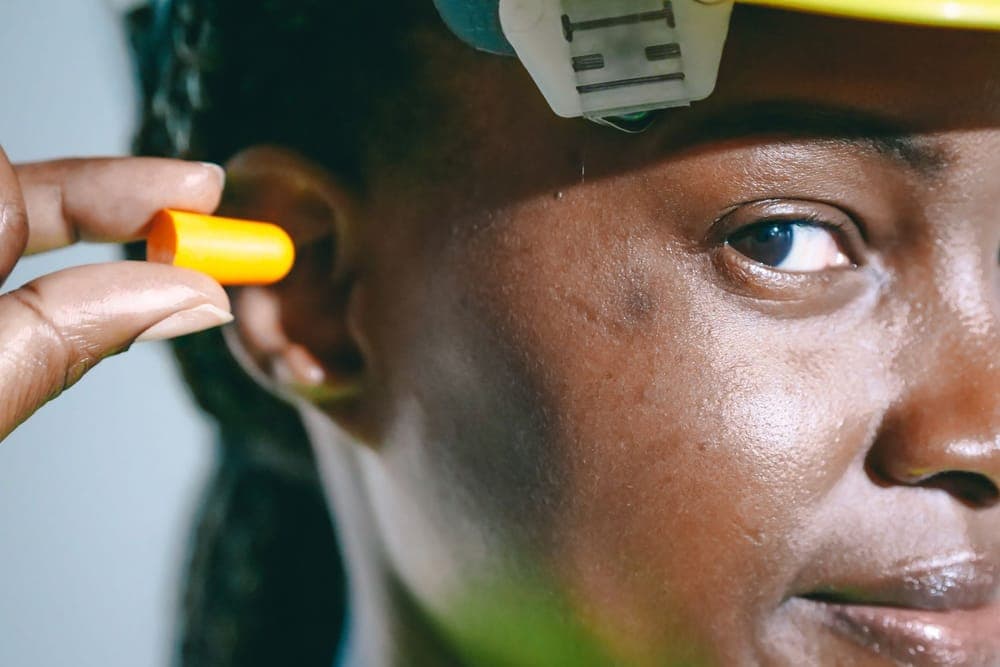
Highest-NRR earplug
Howard Leight MAX-1
NRR 337.1/10ResearchedNRR 33 disposable foam, 200 pairs to a pack. By OSHA's method, it's the higher-rated layer in this pair, so seat it deeply.
Check price · Amazon#ad · Price set by Amazon · How we make money for the link to Howard Leight MAX-1
- Stock photo
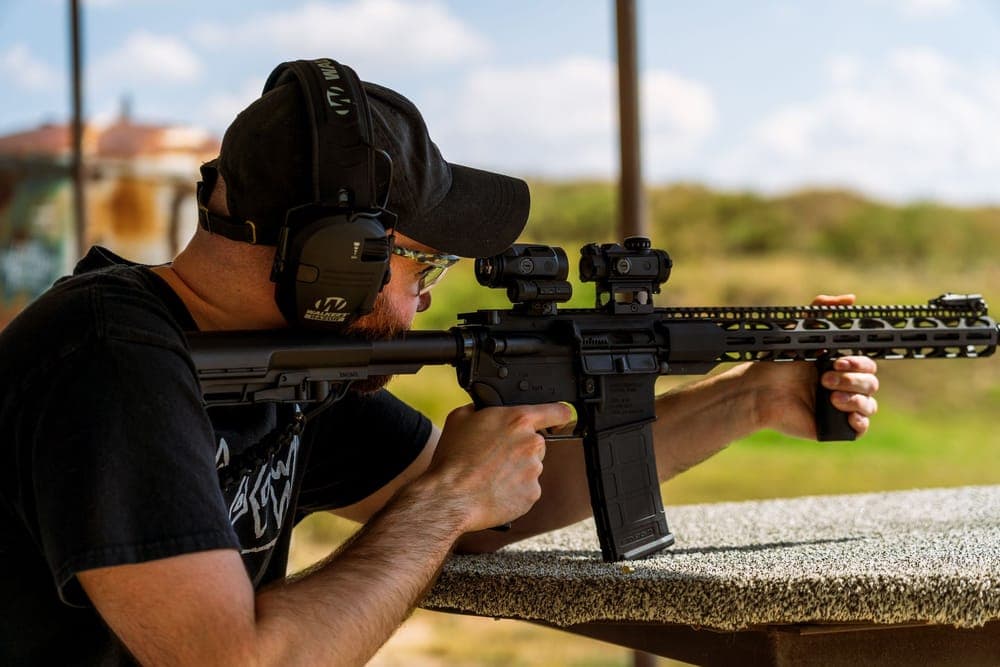
Best first electronic muff
Howard Leight Impact Sport
NRR 227.2/10ResearchedNRR 22 electronic muff that amplifies range commands up to 82 dB, with a slim earcup and a 4-hour auto shut-off.
Check price · Amazon#ad · Price set by Amazon · How we make money for the link to Howard Leight Impact Sport
Specs above are from the MAX-1 listing on Honeywell's licensed store and Howard Leight's Impact Sport page. Want a stronger muff for the top layer? The NRR 30 Impact Pro is covered in our Impact Sport vs Impact Pro comparison. For more pairs chosen for indoor bays, see best ear protection for indoor ranges, and for everything else, our best hearing protection for shooting.
How we scored this
Units we claim to have tested: none
Most gear sites say they tested thirty muffs. We haven't put these on a sound meter, and we say so. Every pick here is labeled Researched: we compiled each maker's published specs (the EPA-labeled NRR on hearing protection, the Z87+ mark on glasses), read the manuals, and scored everything on a public rubric. Every figure links to where it came from, and marketing claims are labeled “maker's claim.”
Scores are editorial judgments from that documented research, not test results. Commissions never set a score or decide a pick. The rubric and its weights are published.
Questions
Common questions
Does double hearing protection work?
When should double hearing protection be used?
Do you add the NRR of earplugs and earmuffs?
Can you hear range commands with earplugs and earmuffs on?
Can you wear electronic earbuds under earmuffs?
Where this comes from
Sources
- OSHA Technical Manual, Section III Chapter 5 (Noise), Appendix F, accessed 2026-09-19
- NIOSH, Preventing Occupational Exposures to Lead and Noise at Indoor Firing Ranges (Pub. 2009-136), accessed 2026-09-19
- Murphy WJ, Byrne DC, Franks JR (NIOSH), Firearms and Hearing Protection, The Hearing Review, March 2007 (CDC Stacks), accessed 2026-09-19
- Meinke DK et al., Prevention of Noise-Induced Hearing Loss from Recreational Firearms, Seminars in Hearing 2017 (CDC Stacks), accessed 2026-09-19
- ASHA, Audiology Information Series: Recreational Firearm Noise Exposure (PDF, 2024), accessed 2026-09-19
- US EPA, 40 CFR Part 211 Subpart B, Hearing Protective Devices (eCFR), accessed 2026-09-19
- 3M, PELTOR X Series passive earmuff technical data sheet (PDF), accessed 2026-09-19
- HoneywellStore.com (licensed Honeywell store), Howard Leight MAX-1 disposable foam earplugs listing, accessed 2026-09-19
- Howard Leight Shooting Sports, Impact Sport Electronic Earmuff product page, accessed 2026-09-19
We haven't tested the gear on this page and we don't pretend to. Specs come from each maker's own pages and data sheets (linked on every product); ratings like NRR and Z87+ are explained from the standards and agencies behind them. Prices are set by Amazon and change often, so we don't print them. Where a figure isn't published, we say so. Read the full method.