This shooting glasses lens color guide answers one beginner question: what color lens should your first pair have? The honest answer is that color is about light, not protection. A tint changes how much light reaches your eyes and how targets stand out against the background. It does nothing for impact. That comes from the Z87+ mark, which we cover below.
Lens colors get a lot of confident advice online. We've kept to what the lens makers themselves publish. Two sources do most of the work here: the Uvex SCT filters and tints brochure (Uvex is a safety-eyewear brand; the brochure is written for workplaces, not ranges) and the Decot Hy-Wyd lens color guide (Decot makes sport shooting glasses). Every claim below names the maker it came from.
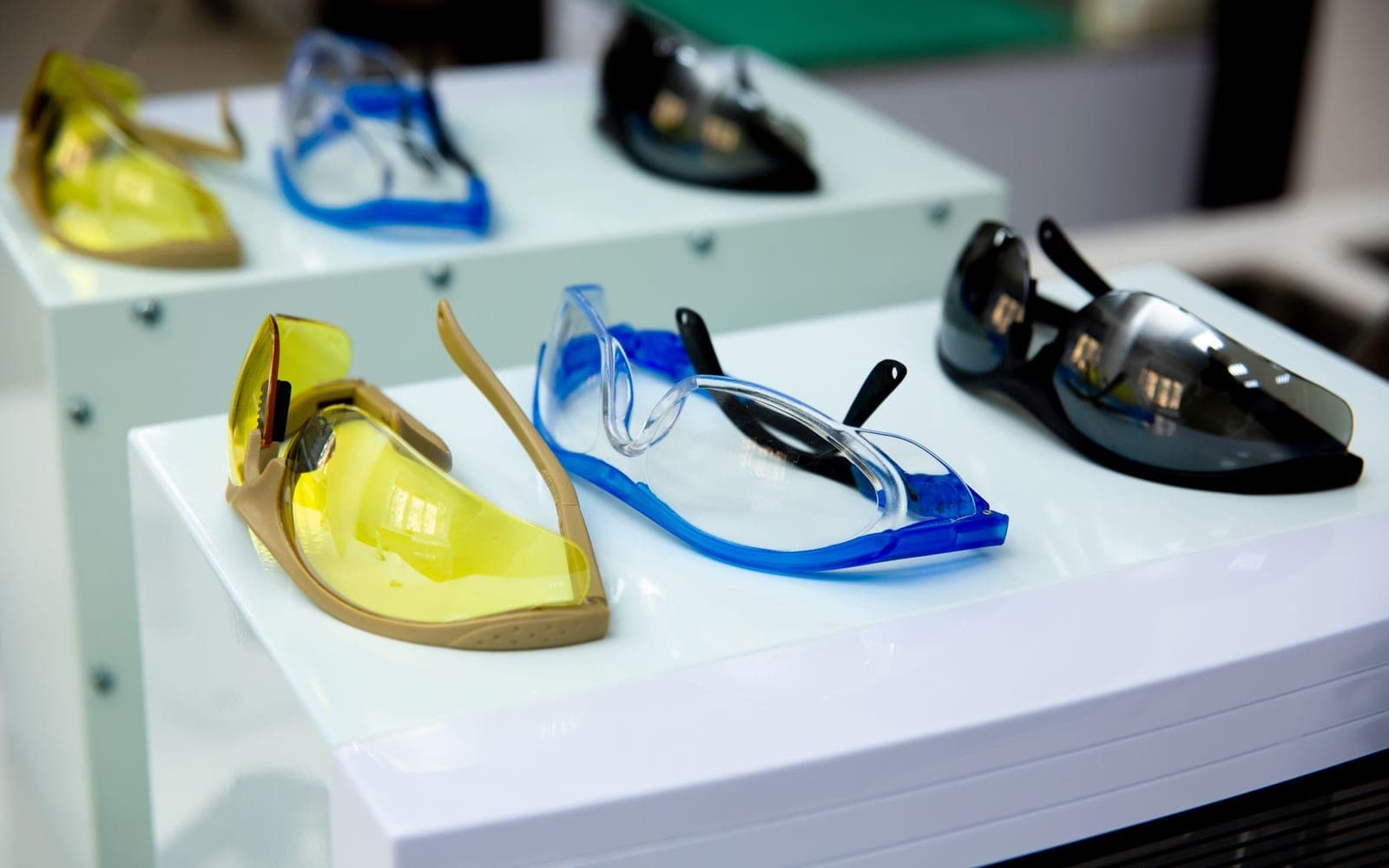
Lens color chart: what each maker says
VLT (visible light transmittance) is the share of visible light a lens lets through. Higher means brighter. Uvex publishes it; Decot's guide doesn't.
| Lens color | What the maker says it's for | VLT | Source |
|---|---|---|---|
| Clear | "Indoor and outdoor environments where normal to low light conditions exist"; "true color recognition" | 92% | Uvex |
| Amber | "Indoor and low light environments" where "enhanced contrast is desired"; "not recommended for night time" | About 90% | Uvex |
| Yellow, gold, fawn, Sunglo (and clear) | Low light: "a high percentage of light transmission and better definition of your target" | Not published | Decot |
| Gray | "Outdoor environments where sunlight and glare causes eyestrain and fatigue" | About 15% | Uvex |
| Indoor/outdoor mirror (Uvex SCT Reflect 50) | People who "transition between indoor and outdoor" environments | About 50% | Uvex |
| Silver, gold, red or blue mirror | Outdoor environments; reflects "sunlight and glare that causes eyestrain and fatigue" | About 15% | Uvex |
| Vermilion (Uvex SCT-Vermilion) | "Indoor applications where enhanced contrast is desired in normal to intense light"; not for driving | About 55% | Uvex |
| Vermilion (red) | Enhances target colors; best for general conditions for people with red/green color deficiency | Not published | Decot |
| Rose (Decot V-lite) | Orange, orange-with-black-edge and black targets; "darkens the sky and fades out the green background" | Not published | Decot |
| Bronze | "A good all purpose lens for skeet, Trap and sporting clays on bright days" | Not published | Decot |
Sources: Uvex rows from the Uvex tint brochure; Decot rows from Decot's lens color guide. Other makers' lenses with the same color name may transmit a different amount of light.
Two things a tint can't tell you
Impact protection. A lens color is not an impact rating. What tells you a pair passed the high-impact tests is a "+" next to the Z87 marking on the temple arm or lens, as HexArmor explains. Every pair we recommend states Z87+ (or Z87.1 high impact) on its maker's page, whatever the color. Our Z87 vs Z87+ guide explains the tests behind the plus sign.
UV protection. Dark doesn't automatically mean more UV blocking. In Uvex's brochure, the amber lens (about 90% VLT) and the gray lens (about 15% VLT) are both listed as absorbing 99.9% of UVA and UVB radiation. If UV matters to you, read the maker's UV figure rather than judging by how dark the lens looks.
Clear lenses: indoor ranges and low light
Uvex recommends its clear lens "for indoor and outdoor environments where normal to low light conditions exist," lists a VLT of 92%, and says it "provides true color recognition." Decot also lists clear among its low-light colors.
For a new shooter, clear is the safe first choice for an indoor range, where the light is artificial and any tint only takes light away. It's also the lens to keep in your bag for overcast days outdoors. If you're weighing an indoor lane against an outdoor bay, our guide to indoor vs outdoor shooting ranges covers the other differences.
Yellow and amber lenses: low light and contrast
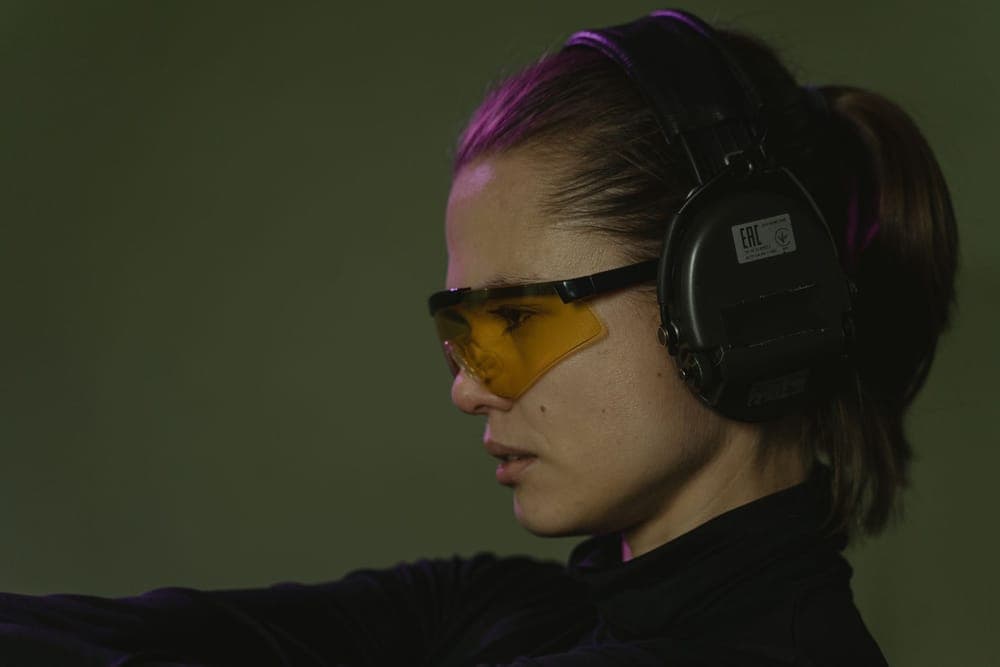
Yellow and amber are the low-light colors. Uvex recommends its amber lens "for indoor and low light environments and situations where enhanced contrast is desired in normal to low daylight," with a VLT of about 90%. The brochure says the amber tint filters light at the blue end of the spectrum while letting green and red through, to improve contrast and reduce a hazy look in foggy or dusk conditions. It also says plainly: "The amber lens is not recommended for night time."
Decot puts gold, clear, fawn, yellow and Sunglo in its low-light group and says those colors "will give you a high percentage of light transmission and better definition of your target."
When they suit you: early mornings, late afternoons, heavy cloud, or a covered bay where the light is flat. If you just want one lens for an indoor range, clear does the job; amber is for people who want extra contrast.
Gray and smoke lenses: bright sun
Gray is the sun lens. Uvex recommends its gray lens "for workers in outdoor environments where sunlight and glare causes eyestrain and fatigue" and gives it a VLT of about 15%, so it blocks roughly 85% of visible light. Decot lists its darker gray shades under "Intense Sunlight or Glare." Makers use "smoke" and "gray" for this family: Walker's calls its IKON Vector lens smoke, and Wiley X offers a smoke gray lens for the Saber Advanced.
That low VLT is exactly why gray is the wrong lens indoors. If your first range is indoors, buy clear first and add gray when you start shooting outside. If you're wondering whether your regular sunglasses can stand in, our shooting glasses vs sunglasses comparison explains why they need the Z87+ mark first.
Indoor/outdoor and mirror lenses: moving between the two
Mirror lenses come in two very different kinds, and beginners mix them up.
- Indoor/outdoor (I/O) mirror. Uvex recommends its SCT Reflect 50 mirror lens "for workers that transition between indoor and outdoor work environments," with a VLT of about 50%. That's the in-between lens: darker than clear, much lighter than gray. Pyramex sells an I/O mirror version of the Intruder (Pyramex), though we couldn't fetch Pyramex's own description of that lens, so we lean on Uvex's.
- Full mirrors (silver, gold, red, blue). Uvex recommends these for outdoor work and says each reflects "sunlight and glare that causes eyestrain and fatigue," at a VLT of about 15%, the same as its gray. Treat a full mirror as a sun lens, not an indoor one. The Intruder also comes in silver mirror and blue mirror; Pyramex's darkness figures for those aren't among the specs we could confirm, so assume a full mirror is for sun unless its maker says otherwise.
An I/O mirror suits a range with covered firing points and bright ground beyond, or a day that starts indoors and ends outside. For a purely indoor range, clear still lets in more light.
Vermilion, rose and bronze lenses: target contrast
These are the specialist colors, mostly talked about by clay and target shooters.
- Vermilion. Uvex recommends its SCT-Vermilion lens "for indoor applications where enhanced contrast is desired in normal to intense light," at a VLT of about 55%, and says it "is not recommended for driving or general purpose use." Decot says most of the daylight lenses in its guide have some vermilion in the coating "to enhance the target colors," and that people with red/green color deficiency "find this lens best for general conditions." Revision sells a StingerHawk 3 Lens Vermillion kit (Revision).
- Rose. Decot calls its V-lite rose lens "fantastic when shooting orange, orange with black edge, and black targets," and says it "darkens the sky and fades out the green background." Walker's lists a rose lens for the IKON Vector (Walker's).
- Bronze. Decot calls bronze "a good all purpose lens for skeet, Trap and sporting clays on bright days and general hunting conditions."
Should a beginner start here? Usually not. These tints are about seeing a particular target color against a particular background. Start with clear (and gray if you shoot outside), then try a contrast lens once you know what you shoot at most. Our guide to the types of shooting targets shows which targets come in high-visibility colors.
What color lens for shooting glasses? Pick by where you shoot
| Where and when you shoot | Start with | Why (per the maker) |
|---|---|---|
| Indoor range | Clear | Uvex: for normal to low light, 92% VLT, true color recognition |
| Outdoors, bright sun | Gray or smoke | Uvex: for outdoor sunlight and glare, about 15% VLT |
| Outdoors, dawn, dusk or heavy cloud | Yellow, amber or clear | Uvex: amber for low light and contrast; Decot: yellow, gold and clear for low light |
| In and out of covered bays | Indoor/outdoor mirror | Uvex: SCT Reflect 50 for moving between indoors and outdoors, about 50% VLT |
| Clays or orange targets on bright days | Bronze, rose or vermilion | Decot: bronze for clays on bright days; rose for orange and black targets |
| After dark | Not amber | Uvex: "The amber lens is not recommended for night time" |
You can start with the first two rows and add the others later. If you're taking a child along, the same colors apply; our best kids shooting glasses lists smaller frames with the Z87+ mark.
One frame or several pairs?
There are three ways to cover more than one kind of light:
- Two single-tint pairs. The simplest route. The Pyramex Intruder comes in seven tints (clear, gray, I/O mirror, amber, Infinity Blue, silver mirror and blue mirror), so a clear pair and a gray pair from the same model fit the same way.
- One frame with swappable lenses. Wiley X lists interchangeable lenses for the Saber Advanced, such as smoke gray and clear (Wiley X). One frame, one fit, and you change the lens for the day.
- A lens kit. Revision sells StingerHawk as kits: 1 Lens, Photochromic, 3 Lens Vermillion and Polarized, in Regular and Large frame sizes. More choice, and more reading before you buy.
If you're never going to shoot outside, skip all of this and buy one good clear pair.
What to look for
- The Z87+ mark first, color second. Check the maker's page (or the temple arm) for Z87+ or "Z87.1 ... High Impact" before you think about tint.
- The exact tint in your cart. A model like the Intruder is sold in seven tints; make sure the listing you pick is the color you want.
- Clear if you're unsure. It's the lens you'll want at an indoor range, and Uvex rates its clear lens for outdoor use in normal to low light too.
- Swappable lenses or a kit if you shoot in mixed light and want one frame for everything.
- An anti-fog option if you shoot in humid or cold weather; our guide on how to stop shooting glasses from fogging covers the coatings.
- A frame that fits over your glasses if you wear a prescription; see our shooting glasses for glasses wearers.
Ready to buy? See our top picks for the best shooting glasses, ranked on published specs with the Z87+ mark as the gate.
Our picks for this
Shooting glasses sold in more than one tint
Each states a Z87+ (or Z87.1 high-impact) rating on its maker's page and comes in more than one lens color, so you can match the tint to your range.
- Stock photo

Best for a stated ballistic rating
Wiley X Saber Advanced
Z87+6.7/10ResearchedInterchangeable lenses, such as smoke gray and clear, so one frame covers indoor and outdoor shooting. Wiley X lists ANSI Z87.1+ and MIL-PRF-32432A.
Check price · Amazon#ad · Price set by Amazon · How we make money for the link to Wiley X Saber Advanced
- Stock photo
Best documented ballistic rating
Revision StingerHawk Eyewear
Z87+7.3/10ResearchedSold as lens kits (1 Lens, Photochromic, 3 Lens Vermillion, Polarized) in Regular and Large. Revision quotes the Z87+ clause.
Check price · Amazon#ad · Price set by Amazon · How we make money for the link to Revision StingerHawk Eyewear
- Stock photo
Best first pair of shooting glasses
Pyramex Intruder
Z87+6.9/10ResearchedSeven single-tint versions, including clear, gray, amber and I/O mirror. Pyramex states ANSI/ISEA Z87.1-2020 + High Impact.
Check price · Amazon#ad · Price set by Amazon · How we make money for the link to Pyramex Intruder
- Stock photo
Best full-frame pair with a rose lens
Walker's IKON Vector Glasses
Z87+5.8/10ResearchedRose, amber, clear and smoke lenses; Walker's says the lenses exceed ANSI Z87.1-2010 High Impact. Out of stock on Walker's store on 2026-09-19.
Check price · Amazon#ad · Price set by Amazon · How we make money for the link to Walker's IKON Vector Glasses
How we scored this
Units we claim to have tested: none
Most gear sites say they tested thirty muffs. We haven't put these on a sound meter, and we say so. Every pick here is labeled Researched: we compiled each maker's published specs (the EPA-labeled NRR on hearing protection, the Z87+ mark on glasses), read the manuals, and scored everything on a public rubric. Every figure links to where it came from, and marketing claims are labeled “maker's claim.”
Scores are editorial judgments from that documented research, not test results. Commissions never set a score or decide a pick. The rubric and its weights are published.
Questions
Common questions
What color lens is best for shooting glasses?
What are yellow shooting glasses for?
What color shooting glasses for an indoor range?
Are mirrored shooting glasses good indoors?
Does lens color change UV or impact protection?
Where this comes from
Sources
- Honeywell Uvex, SCT Filters and Tints brochure (PDF), accessed 2026-09-19
- Decot Hy-Wyd Sport Glasses, Shooting Glasses Lens Color Guide, accessed 2026-09-19
- HexArmor, Safety eyewear: What do lens markings and ANSI Z87+ mean?, accessed 2026-09-19
- Pyramex, Intruder product page, accessed 2026-09-19
- Wiley X, Saber Advanced product page, accessed 2026-09-19
- Revision, StingerHawk eyewear range page, accessed 2026-09-19
- Walker's, IKON Vector Glasses product page, accessed 2026-09-19
We haven't tested the gear on this page and we don't pretend to. Specs come from each maker's own pages and data sheets (linked on every product); ratings like NRR and Z87+ are explained from the standards and agencies behind them. Prices are set by Amazon and change often, so we don't print them. Where a figure isn't published, we say so. Read the full method.