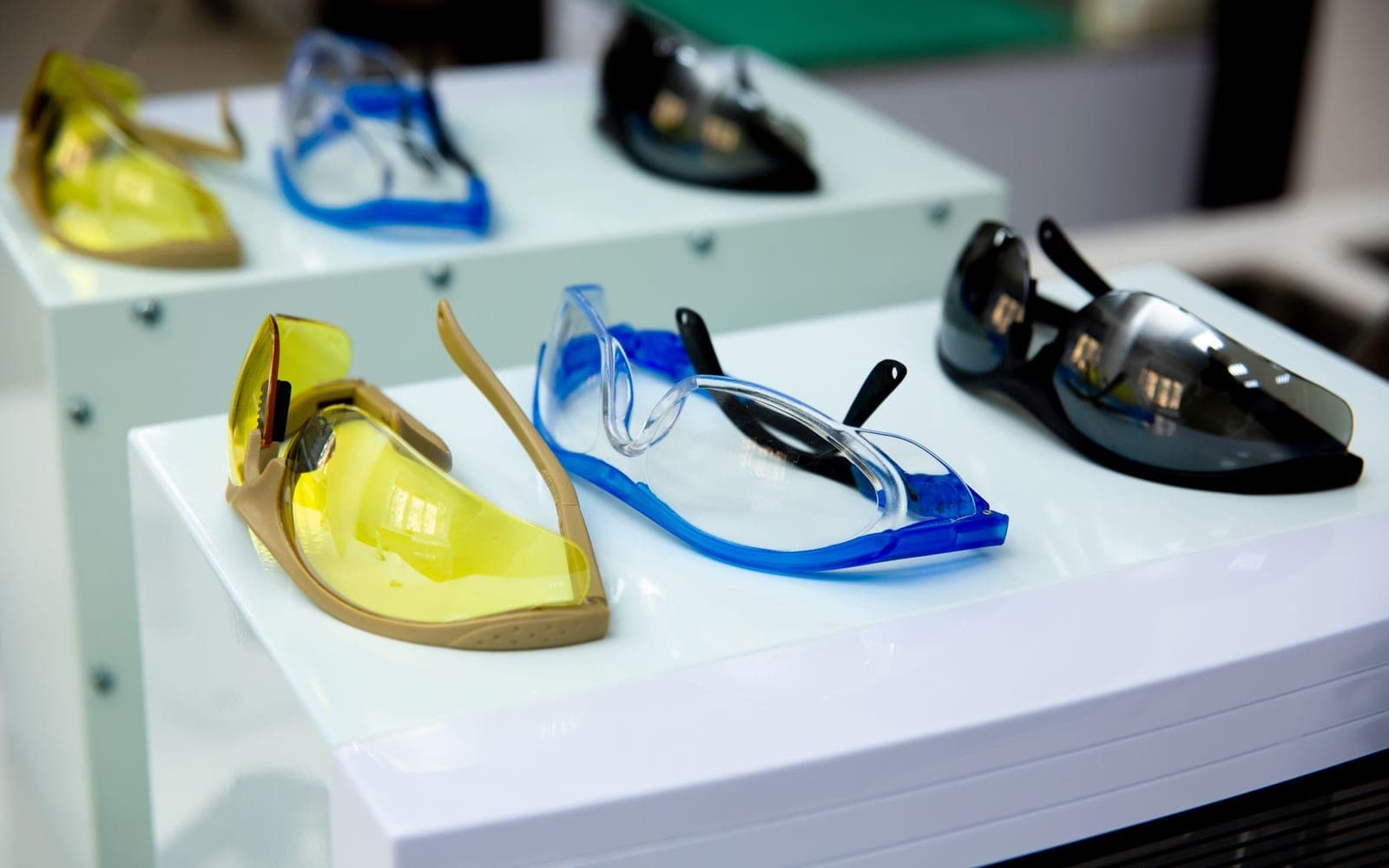
The contenders
Side by side
- Stock photo

Pick for a simple gray-lens pair
Pyramex Intruder
Z87+6.9/10Pyramex states ANSI/ISEA Z87.1-2020 + High Impact and sells the Intruder in gray, I/O mirror, clear, amber and three more tints, with Standard or H2MAX anti-fog options. A gray pair for sun, a clear pair for indoors.
Check price · Amazon#ad · Price set by Amazon · How we make money for the link to Pyramex Intruder
- Stock photo
Pick for one frame, sun and indoor lenses
Wiley X Saber Advanced
Z87+6.7/10Wiley X lists ANSI Z87.1+ and MIL-PRF-32432A, and the lenses swap, so one frame takes a smoke gray lens outdoors and a clear lens indoors.
Check price · Amazon#ad · Price set by Amazon · How we make money for the link to Wiley X Saber Advanced
- Stock photo
Pick for a Z87+ polarized option
Revision StingerHawk Eyewear
Z87+7.3/10Revision states ANSI Z87.1-2020 Impact Protector (Z87+) and MIL-PRF-32432A Class 1, in Regular and Large, with a Polarized Kit among its lens kits (out of stock on Revision's store on 2026-09-19).
Check price · Amazon#ad · Price set by Amazon · How we make money for the link to Revision StingerHawk Eyewear
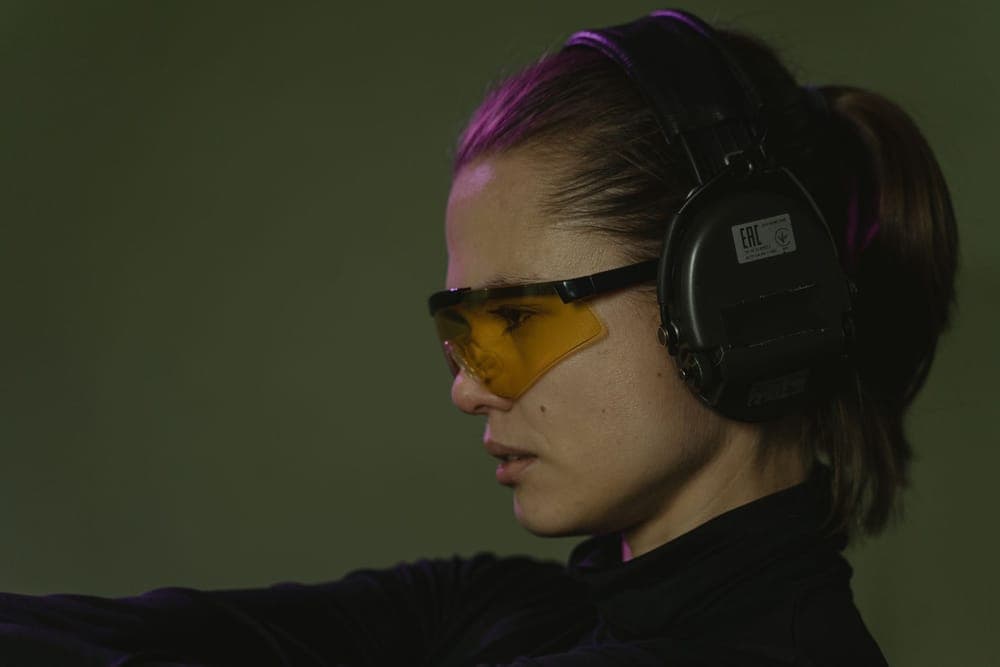
Shooting glasses vs sunglasses comes down to one question: has this pair passed an impact test? Plenty of sunglasses look the part, with dark lenses and a wraparound shape. What counts on the firing line is the small Z87+ mark, and whether your pair has it. We haven't impact-tested any of these glasses ourselves. We compared each maker's published impact marking, lens options and coatings, and scored them on the public rubric on our how we pick page.
Shooting glasses vs sunglasses: the real difference
The difference isn't the shape or the color. It's the standard. ANSI/ISEA Z87.1 sets the design, performance and marking rules for safety eyewear, according to ISEA, the safety-equipment association that runs the committee behind it. The current edition is Z87.1-2025, announced in January 2026 (ISEA).
Safety-eyewear maker HexArmor explains the two levels you'll see on a frame:
- Z87 means the eyewear passed the basic drop-ball test: a steel ball one inch across, weighing about 2.4 oz, dropped from 50 inches. The lens and frame have to stay intact.
- Z87+ means it also passed tougher high-impact tests. Those include a high-mass test (a 500-gram pointed weight dropped from about 50 inches) and a high-velocity test (a 1/4-inch steel ball fired at safety glasses at 102 mph).
Wiley X gives the same high-velocity bar in feet per second: for spectacles, a .25-inch steel ball traveling at 150 fps (Wiley X). A sunglass lens is made to cut light. Unless its maker marks it Z87 or Z87+, you have no published sign it was ever impact-tested.
Some sunglasses do clear that bar. Wiley X sells a line it calls ballistic-rated sunglasses and says that eyewear "meets ANSI Z87.1+ and MIL-PRF-32432A impact testing standards." So the useful question isn't "sunglasses or shooting glasses?" It's "is this pair marked?" For the full story on the plus sign, see our Z87 vs Z87+ explainer.
Three tinted Z87+ pairs side by side
Each of these three has a Z87+ (or Z87.1 + High Impact) rating stated on its maker's page and a tinted lens for sun. Every value in the table links to the maker's page.
| Published spec | Pyramex Intruder | Wiley X Saber Advanced | Revision StingerHawk Eyewear |
|---|---|---|---|
| Impact rating | ANSI/ISEA Z87.1-2020 + High Impact; CAN/CSA Z94.3-2020 | "ANSI Z87.1+ Optical clarity and high mass/high velocity impact standards" | "ANSI Z87.1-2020 clause 7.1 Impact Protector (Z87+)"; EN 166 FT |
| Ballistic rating | Not published | "MIL-PRF-32432A Ballistic safety standards" | "MIL-PRF-32432A clause 3.8.4.1 Ballistic fragmentation characteristics Class 1" |
| Lenses | Clear, gray, I/O mirror, amber, Infinity Blue, silver mirror, blue mirror | Interchangeable lenses (for example smoke gray and clear shields) | Sold as kits: 1 Lens Kit, Photochromic, 3 Lens Vermillion and Polarized Kit |
| Anti-fog | Offered with no anti-fog, Standard anti-fog or H2MAX anti-fog | Not published | Not published |
| Score | 6.9/10 | 6.7/10 | 7.3/10 |
How to check the sunglasses you already own
Before you buy anything, look at the pair you have. It takes a minute.
- Check the temple arms. HexArmor says markings on safety glasses sit "either on the sidearm of the frames or on the right side of the lens."
- Look for the plus sign. A "+" next to the Z87 marking means the pair passed the high-impact standard, per HexArmor. Z87 without the plus is the basic level.
- Look for the maker's mark. OSHA's eye-protection rule says protective eyewear "shall be distinctly marked to facilitate identification of the manufacturer" (OSHA 1910.133(a)(4)).
- Check the product page. If the arm is unmarked or the print has worn off, the maker's own listing should state the Z87.1 rating. If it doesn't, treat the pair as sunglasses, not eye protection.
No mark and no published rating? Keep them for the drive home and wear a marked pair on the line.
Coverage: side protection and fit
The impact mark is half the story. The other half is coverage. OSHA's workplace rule says that where there's a hazard from flying objects, eye protection must provide side protection, and it accepts clip-on or slide-on side shields that meet the rule (OSHA 1910.133(a)(2)). A flat fashion frame with open sides doesn't give you that, however good its lens is. Wraparound frames and integral side shields are how safety eyewear closes the gap.
Fit matters too, because your glasses share space with ear protection. The temple arms sit under the muff cushions, and 3M notes that a muff's noise reduction may be lower when eyeglasses are worn between the cushions and the sides of your head (3M PELTOR X Series data sheet). That applies to any glasses, sunglasses included, which is why fit under muffs is one of the things we score. Our guide to ear protection with glasses covers the pairing.
Tint: dark lenses belong outdoors
Even a marked pair of sunglasses is the wrong tool indoors. Uvex's tint guide recommends its gray lens "for workers in outdoor environments where sunlight and glare causes eyestrain and fatigue," and lists it at a visible light transmittance (VLT, the share of light that gets through) of about 15%. Its clear lens lets through 92% and is recommended where "normal to low light conditions exist" (Uvex tint brochure). That brochure is written for workplaces, not ranges, but the numbers carry over: a lens that blocks about 85% of the light makes a dim indoor lane dimmer.
Outdoors in full sun, a gray or smoke lens with a Z87+ mark is the straight swap for sunglasses. For dawn, dusk or overcast days, Decot, a shooting-glasses maker, lists gold, clear, fawn, yellow and Sunglo as its low-light colors, saying they "give you a high percentage of light transmission." Our shooting glasses lens color guide goes color by color, with each claim tied to the maker that made it.
Are polarized sunglasses good for shooting?
Polarized lenses are about glare, and one shooting-glasses maker says that's where they fit. Decot's lens guide says polarized shades "are good for medium to intense sunlight that produces glare," and suggests them if you "shoot over cement, snow, water or any surface that reflects light" (Decot).
Two cautions. First, polarization says nothing about impact. A polarized lens still needs the Z87+ mark to count as eye protection. Revision sells a StingerHawk Polarized Kit and its page states "ANSI Z87.1-2020 clause 7.1 Impact Protector (Z87+)" (Revision), though that kit was out of stock on Revision's store when we checked on September 19, 2026. Wiley X's ballistic-rated sunglasses page also lets you filter for polarized lenses.
Second, we couldn't find a maker or standards source that sets out the downsides of polarized lenses for shooting, so we won't repeat the ones that circulate online. If you're unsure, a plain gray Z87+ lens does the basic job of cutting bright sun, by Uvex's description.
Prescription sunglasses
Prescription sunglasses follow the same rule: marked or not. OSHA's workplace rule says a worker who wears prescription lenses needs eye protection that either builds the prescription into its design or fits over the prescription lenses "without disturbing the proper position of the prescription lenses or the protective lenses" (OSHA 1910.133(a)(3)). For a range day, that points to one of two things: an over-the-glasses (OTG) pair on top of your regular glasses, or prescription safety glasses from an optician that carry the Z87+ mark.
Our guide to wearing glasses at a shooting range walks through both, and our best shooting glasses for glasses wearers lists OTG frames whose makers publish how big a frame they fit over.
What ranges ask for
Ranges set their own rules, so check before you go. Two examples: The Range 702 in Las Vegas says "Eye and ear protection are mandatory on the range," and that most ranges rent or sell protective gear if you don't have your own (The Range 702). Triangle Shooting Academy in North Carolina says "Eye protection is required to be worn while inside the range," and that its dress code is there for safety, including keeping hot brass off your skin (Triangle Shooting Academy).
Hot brass (the empty cases a gun ejects) is the everyday hazard those dress codes are written around. NRA Women suggests a hat, which "will protect your head and face from ejected cartridges" (NRA Women). A Z87+ pair plus a brimmed cap is a simple habit. Our guide to what to wear to a shooting range covers the rest of the outfit.
Range policies also differ on what counts as eye protection. Triangle Shooting Academy, for example, lists prescription eyeglasses as an approved replacement for standard eye protection. That's one range's policy, not a safety standard. None of the range policies we cite mention sunglasses either way, so ask. The NSSF suggests asking "the range manager, safety officer or counter staff to go over the range rules" on your first visit (NSSF Let's Go Shooting).
Which tinted pair suits you
- Pyramex Intruder if you want one low-fuss pair for outdoor days. Pyramex states ANSI/ISEA Z87.1-2020 + High Impact and sells it in seven tints, including gray, I/O mirror, clear and amber, with a choice of no anti-fog, Standard or H2MAX anti-fog (Pyramex). Buy the gray for sun and, if you'll also shoot indoors, a clear one. Skip it if you wear prescription glasses; it isn't an over-the-glasses design.
- Wiley X Saber Advanced if you move between indoor lanes and outdoor bays. Wiley X lists "ANSI Z87.1+ Optical clarity and high mass/high velocity impact standards" and "MIL-PRF-32432A Ballistic safety standards," with interchangeable lenses such as smoke gray and clear (Wiley X). Wiley X doesn't publish an anti-fog coating for it.
- Revision StingerHawk if you want the most fully documented rating and a choice of lens kits. Revision quotes the exact Z87+ clause and a MIL-PRF-32432A Class 1 ballistic clause, sells Regular and Large sizes, and lists 1 Lens, Photochromic, 3 Lens Vermillion and Polarized kits (Revision). Choosing a kit and size takes more reading than buying a single pair.
Do you need the military ballistic rating the last two carry? Our gate for every pair is the Z87+ mark; the ballistic claim is a bonus we score, not a requirement. Our ballistic glasses vs safety glasses comparison explains what the military standard adds.
Or consider
Want more than three to choose from? Our best shooting glasses roundup ranks every Z87+ pair we've verified, including the sealed Pyramex V2G for fog-prone days and the Walker's IKON Vector, which comes with a smoke lens. If you'd rather buy ear and eye protection together, see our ear and eye protection combos. Building a whole first kit? Start with our first range kit.
In detail
The contenders, in full
Pick for a simple gray-lens pair
Pyramex Intruder
Pyramex states ANSI/ISEA Z87.1-2020 + High Impact and sells the Intruder in gray, I/O mirror, clear, amber and three more tints, with Standard or H2MAX anti-fog options. A gray pair for sun, a clear pair for indoors.
Published specsResearched · not tested by us
How the 6.9 score breaks down
- Ballistic rating (MIL-PRF-32432) (20%)
- 5
- Lens options & tints (20%)
- 8.5
- Fit: OTG, youth, thin temples (30%)
- 6.5
- Anti-fog & scratch coating (30%)
- 7.5
What the specs support
- Pyramex states the Z87.1-2020 high-impact rating on its own page
- Seven lens tints, including clear for indoor ranges and gray for sun
- Choice of Standard or H2MAX anti-fog
Where it falls short
- No MIL-PRF-32432 ballistic claim on Pyramex's page
- Not made to fit over prescription glasses
- Frame sizing isn't published by the maker
Skip it if…
…you wear prescription glasses at the range; the Intruder isn't built to go over them, so look at the Pyramex OTS instead.
#ad · Price set by Amazon · How we make money for the link to Pyramex Intruder
Pick for one frame, sun and indoor lenses
Wiley X Saber Advanced
Wiley X lists ANSI Z87.1+ and MIL-PRF-32432A, and the lenses swap, so one frame takes a smoke gray lens outdoors and a clear lens indoors.
Published specsResearched · not tested by us
How the 6.7 score breaks down
- Ballistic rating (MIL-PRF-32432) (20%)
- 9
- Lens options & tints (20%)
- 7
- Fit: OTG, youth, thin temples (30%)
- 6.5
- Anti-fog & scratch coating (30%)
- 5
What the specs support
- States both ANSI Z87.1+ and MIL-PRF-32432A on the maker page
- Lenses swap, so one frame covers indoor (clear) and outdoor (smoke gray) shooting
- All eight variants were listed as available on Wiley X's store on 2026-09-19
Where it falls short
- Anti-fog coating isn't published by the maker
- Frame sizing and over-the-glasses fit aren't mentioned by the maker
Skip it if…
…you only need a basic pair for occasional indoor pistol practice; the Pyramex Intruder carries a Z87.1-2020 high-impact rating without the extra ballistic spec.
#ad · Price set by Amazon · How we make money for the link to Wiley X Saber Advanced
Pick for a Z87+ polarized option
Revision StingerHawk Eyewear
Revision states ANSI Z87.1-2020 Impact Protector (Z87+) and MIL-PRF-32432A Class 1, in Regular and Large, with a Polarized Kit among its lens kits (out of stock on Revision's store on 2026-09-19).
Published specsResearched · not tested by us
How the 7.3 score breaks down
- Ballistic rating (MIL-PRF-32432) (20%)
- 9.5
- Lens options & tints (20%)
- 7.5
- Fit: OTG, youth, thin temples (30%)
- 8
- Anti-fog & scratch coating (30%)
- 5
What the specs support
- Quotes the exact Z87+ clause and the MIL-PRF-32432A Class 1 ballistic clause
- Two frame sizes, Regular and Large
- Several lens kits, including photochromic and polarized
Where it falls short
- The Polarized Kit was out of stock on Revision's store on 2026-09-19
- Anti-fog coating isn't among the specs we could confirm on the maker page
- Kit choice takes more reading than a single-lens pair
Skip it if…
…you want one simple clear pair for an indoor range; picking a StingerHawk kit and size is more than a first trip needs, and the Pyramex Intruder is simpler.
#ad · Price set by Amazon · How we make money for the link to Revision StingerHawk Eyewear
How we scored this
Units we claim to have tested: none
Most gear sites say they tested thirty muffs. We haven't put these on a sound meter, and we say so. Every pick here is labeled Researched: we compiled each maker's published specs (the EPA-labeled NRR on hearing protection, the Z87+ mark on glasses), read the manuals, and scored everything on a public rubric. Every figure links to where it came from, and marketing claims are labeled “maker's claim.”
Scores are editorial judgments from that documented research, not test results. Commissions never set a score or decide a pick. The rubric and its weights are published.
Questions
Common questions
Are sunglasses good for shooting?
Are polarized sunglasses good for shooting?
Can I wear Z87+ sunglasses at an indoor range?
Where is the Z87 mark on glasses?
Can I wear prescription sunglasses to shoot?
Where this comes from
Sources
- OSHA, 29 CFR 1910.133 Eye and face protection, accessed 2026-09-19
- ISEA, Eye & Face Protection (ANSI/ISEA Z87.1), accessed 2026-09-19
- ISEA, ISEA Releases Updated ANSI/ISEA Z87.1 Standard for Eye and Face Protection (January 8, 2026), accessed 2026-09-19
- HexArmor, Safety eyewear: What do lens markings and ANSI Z87+ mean?, accessed 2026-09-19
- Wiley X, Ballistic Rated Sunglasses, accessed 2026-09-19
- Honeywell Uvex, SCT Filters and Tints brochure (PDF), accessed 2026-09-19
- Decot Hy-Wyd Sport Glasses, Shooting Glasses Lens Color Guide, accessed 2026-09-19
- 3M, PELTOR X Series passive earmuff technical data sheet (PDF), accessed 2026-09-19
- The Range 702, First-Time Indoor Range Visit? Your Complete Beginner Guide, accessed 2026-09-19
- Triangle Shooting Academy, Dress Code, accessed 2026-09-19
- NRA Women, The Dos and Don'ts of Gun Range Attire (August 27, 2020), accessed 2026-09-19
- NSSF Let's Go Shooting, New Shooters, accessed 2026-09-19
- Pyramex, Intruder product page, accessed 2026-09-19
- Wiley X, Saber Advanced product page, accessed 2026-09-19
- Revision, StingerHawk Eyewear Polarized Kit product page, accessed 2026-09-19
- Revision, StingerHawk eyewear range page, accessed 2026-09-19
We haven't tested the gear on this page and we don't pretend to. Specs come from each maker's own pages and data sheets (linked on every product); ratings like NRR and Z87+ are explained from the standards and agencies behind them. Prices are set by Amazon and change often, so we don't print them. Where a figure isn't published, we say so. Read the full method.