Not medical advice. This page shares general guidance from the public-health sources linked in the text. If you're worried about your hearing or lead exposure, talk to a doctor.
Safety first. This is general information, not a substitute for hands-on instruction. Follow your range's rules and your firearm's manual, and consider a certified safety course. See our gun safety rules.
This question gets asked honestly and answered badly. It gets asked because a .22 genuinely is quiet in the sense that matters to your intuition: you can hold a conversation near someone shooting one outdoors, and it does not hit you in the chest the way a .308 does. And it gets answered badly because "it is only a .22" is range-counter folklore rather than a measurement.
The measurements exist, they are public, and they are not ambiguous.
The answer, with numbers
Three published figures, all from peer-reviewed or federal sources:
- .17 and .22 caliber rifles: about 140 to 144 dB peak. Meinke and colleagues, writing in Seminars in Hearing (Meinke et al., 2017), measured at the shooter's left ear.
- .22 caliber pistols: about 155 to 158 dB peak. Same source, same measurement position.
- 144 dB SPL for a .22 caliber rifle. Murphy, Byrne and Franks of NIOSH, writing in The Hearing Review (Murphy et al., 2007), which was the quietest firearm in their range of figures.
Put next to the 140 dB peak limit that NIOSH applies to impulse noise, the conclusion writes itself: the quietest published .22 figure is at the line, and a .22 handgun is well past it. Our how loud is a gunshot page has the full table by firearm type if you want the context.
Why a .22 feels safe when it is not
Three things conspire here, and understanding them is what makes the advice stick.
Decibels are logarithmic. A 144 dB rifle and a 160 dB rifle do not feel like numbers sixteen apart. They feel like different categories of event, because every 10 dB is roughly a doubling of perceived loudness. So the .22 reads as "quiet" when it is actually sitting just under a figure that is already dangerous.
There is no recoil to warn you. Your body uses physical impact as a proxy for severity. A .22 delivers almost none, so nothing in the experience tells you to be careful.
Rimfire sessions are long. Ammunition is cheap and magazines are large, so a .22 afternoon can easily be several hundred rounds, where a centerfire session might be fifty. More exposures at a slightly lower peak is not the safer trade people assume it is.
A .22 pistol is louder than a .22 rifle
This is the detail that surprises people, and it is the practical takeaway if you own both. Meinke and colleagues put .22 caliber pistols at about 155 to 158 dB against 140 to 144 dB for .17 and .22 rifles. Same cartridge family, roughly 14 dB apart.
The reason is barrel length and where the muzzle sits. A short barrel means more unburned powder leaving the muzzle and more of the report, and the muzzle of a handgun is an arm's length from your ears rather than out past your shoulder. A rifle puts distance and the stock between the blast and your head.
So "it is only a .22" is at its most wrong when the .22 is a pistol. A .22 target pistol at an indoor range deserves the same protection you would wear for a 9mm.
The .22 is where most kids start, which raises the stakes
A .22 rifle is the standard first firearm for a young shooter, for good reasons: low recoil, cheap ammunition, manageable weight. It means the shooters most often exposed to .22 muzzle blast are the ones with the most hearing left to lose and the least ability to tell you something is wrong.
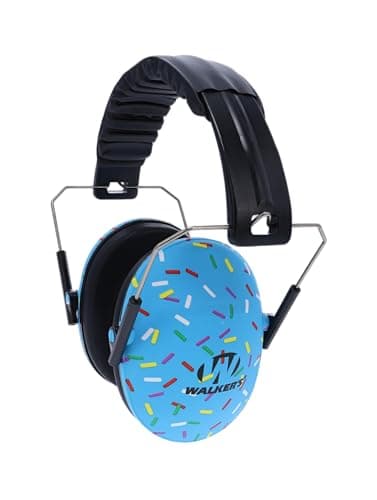
It also means the fit problem is at its worst. Adult muffs on a small head leave gaps at the cushions, and a gap is a leak. Our best kids ear protection for shooting page covers which makers publish an age or size and which do not, and taking kids to the shooting range covers the rest of the trip.
.22s indoors
An indoor lane changes the arithmetic badly. The report reflects off concrete and a low ceiling instead of dissipating, and you are also receiving everybody else's muzzle blast. NIOSH's work on indoor firing ranges (Pub. 2009-136) is the standard reference for why indoor ranges are treated as their own hazard.
Practical consequence: the fact that you brought a .22 does not get you out of the indoor rule. Plugs under muffs is the answer there whatever you are shooting, because the dominant noise source may not even be your gun. Our best ear protection for indoor ranges page and double hearing protection cover it.
Derate before you decide. OSHA's Appendix B to 1910.95 sets out methods for estimating real attenuation, and 3M recommends halving the NRR on its own muffs. Halve an NRR 22 electronic muff and you are removing about 11 dB from a 144 dB rifle report, which lands you at the line rather than comfortably under it.
Suppressed .22s
A suppressed .22 is the one case where the folklore has a grain of truth, and it still does not get you to "no protection".
Suppressors reduce the muzzle report, and a subsonic .22 avoids the supersonic crack as well, which is why a suppressed rimfire is the quietest thing most shooters will ever fire. But published attenuation figures for suppressors are maker claims measured in maker conditions, the reduction varies with ammunition, barrel and suppressor, and the first round out of a wet or cold can is louder than the rest. We do not publish suppressor decibel figures on this site because we have not found a source we are willing to stand behind for them.
The honest position: a suppressed subsonic .22 outdoors is genuinely much quieter, wearing plugs costs you nothing, and you cannot tell by ear whether you are under 140 dB. Keep them in.
What to wear for a rimfire session
Nothing special, which is the point. The same three things that work for everything else, with one note: a .22 session is long and sociable, so comfort and hearing conversation matter more than they do for a short centerfire string.
Our picks for this
A rimfire afternoon's worth of ear pro
Published NRR figures from each maker. For a long outdoor plinking session, the muff you keep on beats the muff you take off between strings.
Best first electronic muff
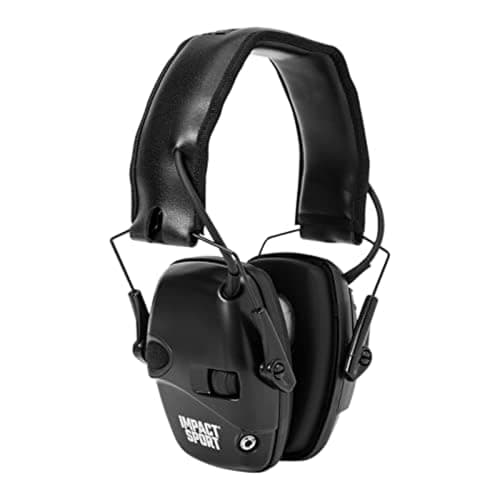
Howard Leight Impact Sport
NRR 227.2/10ResearchedNRR 22 with microphones that amplify ambient sound to a safe 82 dB, so you can talk between strings without lifting a cup. A 4-hour auto shut-off covers a long session.
$60.00Amazon#ad · Price as of November 3, 2026 · How we make money for the link to Howard Leight Impact Sport
Highest-NRR earplug
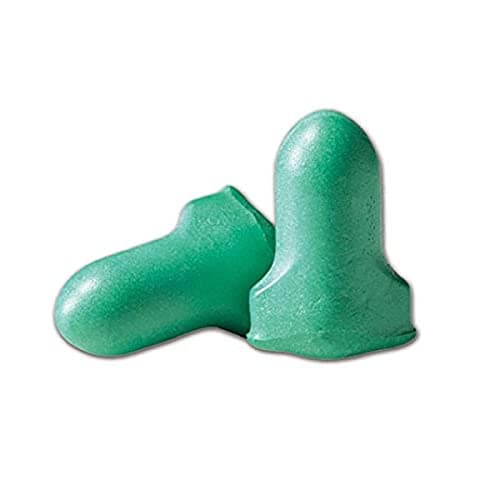
Howard Leight MAX-1
NRR 337.1/10ResearchedNRR 33 pre-shaped foam, 200 pairs to a pack. The layer to add indoors, and the bag to keep in the vehicle for whoever came with you.
$39.89Amazon#ad · Price as of November 3, 2026 · How we make money for the link to Howard Leight MAX-1
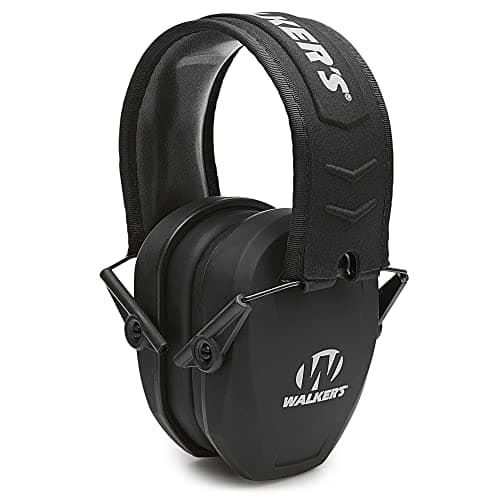
Best all-round passive muff
Walker's Razor Slim Passive
NRR 277.5/10ResearchedNRR 27 with ultra low profile cups and a folding design, which is what you want when a .22 rifle stock is coming to your cheek.
$22.83Amazon#ad · Price as of November 3, 2026 · How we make money for the link to Walker's Razor Slim Passive
What the gun makers say
You do not have to take our word for it, and you do not have to take the range's. Ruger publishes the instruction for its own rimfires. The Mark IV pistol manual and the American Rimfire rifle manual both tell the owner to wear eye and hearing protection when shooting, with no caveat about caliber. Every major maker says the same thing in the same place, and it is the one piece of safety guidance that ships in the box with the gun.
Which is the simplest way to settle the argument at a family range trip. The manufacturer of the .22 in your hands put it in writing. Our gun safety rules page covers the rest of what travels with the firearm rather than with the caliber.
For what an unprotected exposure at that level actually does, and whether a single shot can be enough, see hearing damage from gunshots.
How we scored this
Every pick, scored on numbers you can check
Every pick here is labeled Researched: we compiled each maker's published specs (the EPA-labeled NRR on hearing protection, the Z87+ mark on glasses), read the manuals, checked the standards behind them, and scored everything on a public rubric. Every figure links to where it came from, and marketing claims are labeled “maker's claim,” so you can see exactly why a pick ranks where it does.
Scores are editorial judgments built from that documented research. Commissions never set a score or decide a pick. The rubric and its weights are published.
Questions
Common questions
Do you need hearing protection for a .22?
How loud is a .22 rifle in decibels?
Is a .22 pistol louder than a .22 rifle?
Do kids need ear protection for a .22?
Do you need ear protection for a suppressed .22?
What ear protection is best for a long .22 plinking session?
Where this comes from
Sources
- Meinke DK, Finan DS, Flamme GA, Murphy WJ, et al., Prevention of Noise-Induced Hearing Loss from Recreational Firearms, Seminars in Hearing 2017 (CDC Stacks), accessed 2026-10-10
- Murphy WJ, Byrne DC, Franks JR (NIOSH), Firearms and Hearing Protection, The Hearing Review, March 2007 (CDC Stacks), accessed 2026-10-10
- ASHA, Audiology Information Series: Recreational Firearm Noise Exposure (PDF), accessed 2026-10-10
- NIH/NIDCD, Noise-Induced Hearing Loss, accessed 2026-10-10
- NIOSH, Preventing Occupational Exposures to Lead and Noise at Indoor Firing Ranges (Pub. 2009-136), accessed 2026-10-10
- OSHA, Appendix B to 29 CFR 1910.95, Methods for estimating hearing protector attenuation, accessed 2026-10-10
- Ruger, Mark IV pistol instruction manual (PDF), accessed 2026-10-10
- Ruger, American Rimfire rifle instruction manual (PDF), accessed 2026-10-10
Specs come from each maker's own pages and data sheets (linked on every product); ratings like NRR and Z87+ are explained from the standards and agencies behind them. Prices are set by Amazon and change often, so the buy button always takes you to the current one. Where a figure isn't published, we say so. Read the full method.