Not medical advice. This page shares general guidance from the public-health sources linked in the text. If you're worried about your hearing or lead exposure, talk to a doctor.
This is the page nobody wants to read and everybody should. It is not medical advice, we are not clinicians, and nothing here can tell you what has happened to your ears. What it does is collect what federal hearing researchers and professional bodies publish, with each claim attributed, so you can see the basis for the advice that every shooting range and every firearm manual gives you.
The short version
The numbers, and the 140 dB line
Start with how loud a gunshot is. A 2017 review by Meinke, Finan, Flamme, Murphy and colleagues at NIOSH, hosted by the CDC, reports that "peak sound pressure levels (SPLs) from firearms range from [about] 140 to 175 dB", with most recreational firearms other than small-caliber rifles and air rifles between 150 and 165 dB. Murphy, Byrne and Franks at NIOSH report measurements from 144 dB for a .22 caliber rifle to 172 dB for a .357 revolver, and NIOSH's measurements of law-enforcement firearms at indoor and outdoor ranges came in at 155 to 168 dB peak.
Now the reference line. OSHA's occupational noise standard sets a ceiling of 140 dB peak sound pressure level for impulsive or impact noise, and NIOSH uses the same figure in its recommendations. Every published figure above is at or beyond that line, including the quietest one. Our how loud is a gunshot page has the full table by firearm type, and do you need ear protection for a .22 deals with the caliber people most often assume is harmless.
Can one gunshot do permanent damage?
The published position is that a single intense exposure is a recognized route to permanent hearing loss. The National Institute on Deafness and Other Communication Disorders describes noise-induced hearing loss as resulting from either long or repeated exposure to loud sound or from a one-time exposure to an intense sound, and notes that the effect can be immediate or take a long time to become noticeable. NIDCD specifically names an explosion as an example of the one-time case.
ASHA's guidance on recreational firearm noise exposure is written for shooters rather than for workplaces, and it makes two points that matter here. The first is that firearm noise is impulse noise, which behaves differently from the steady noise occupational limits were designed around. The second is that for right-handed shooters firing rifles and shotguns, it is typically the left ear that shows more loss, because the blast reaches it from the open side.
What none of these sources will do — and what we will not do either — is tell you the probability that any particular single shot injures any particular person. That depends on the firearm, the ammunition, the environment, how close the muzzle was and the individual. The honest framing is that the exposure is well above the published safety line and the injury is permanent when it occurs, which is why the guidance is universal rather than probabilistic.
How the damage works
NIDCD's explanation of noise-induced hearing loss centers on the hair cells of the inner ear: the sensory cells that convert sound vibration into the nerve signals your brain reads. Loud sound can damage those cells and the structures around them, and in humans they do not regenerate. That is the whole reason this kind of hearing loss is described as permanent, and the reason prevention is the only effective intervention.
Two consequences follow, and both are counter-intuitive:
- It does not hurt. There is no pain receptor that reports hair-cell damage. People expect an injury to announce itself and this one does not.
- It accumulates silently. Because the loss often starts in frequencies you do not use for everyday conversation, a shooter can lose a measurable amount of hearing over years and notice nothing until speech in a noisy restaurant becomes hard.
Tinnitus and temporary threshold shift
Two things commonly happen after loud noise exposure, and the published sources treat them as warnings rather than as diagnoses.
Tinnitus is the ringing, buzzing or hissing sound heard without an external source. NIDCD describes it as a common accompaniment of noise exposure; it may fade or it may persist.
Temporary threshold shift is the muffled, underwater hearing that follows a loud event and then recovers over hours. The important point in the literature is that "temporary" describes the shift, not the exposure: an exposure big enough to produce it is an exposure big enough to be taken seriously, and repeated temporary shifts are associated with permanent loss over time.
What to watch for after a range trip
These are the signs the published guidance associates with noise exposure. They are reasons to see a professional, not a self-diagnosis checklist:
- Ringing, buzzing or hissing that starts after shooting, whether or not it fades.
- Muffled or underwater hearing in one or both ears.
- Difficulty following speech in a noisy room that was not there before.
- A sense that one ear is now worse than the other — remember ASHA's point about the exposed side.
- Fullness or pressure in the ear after a loud session.
What actually protects you
Three things, in order of how much difference they make:
- Wearing protection for every shot, including the one you did not expect. The exposure that hurts people is almost always the unplanned one: a cup lifted to hear an instruction, a shot fired on the next bench while you were resetting, a moment on the line with the muffs around your neck.
- A real seal. Published ratings come from laboratory tests on properly fitted protectors. A plug rolled too thin, a muff resting on a thick glasses temple or a cushion gone hard are all ways to wear the rating without getting it. HSE's hearing protection guidance is explicit that protection "will only be effective when used and fitted correctly" and that removing it for a few minutes considerably lowers the protection.
- Doubling up where it is loud. Indoors especially. It does not add the two ratings together — our double hearing protection page shows the arithmetic — but it is the single biggest step up available.
Choosing the number is a separate question, and we work through the federal arithmetic on what NRR do I need for shooting. Our NRR rating chart lists the published ratings for every protector type side by side if you would rather start from the numbers.
What to wear
Our picks for this
The three highest-rated protectors we recommend
One foam plug, one passive muff and one electronic muff, chosen on published NRR. All three are covered in more detail in our main hearing protection roundup.
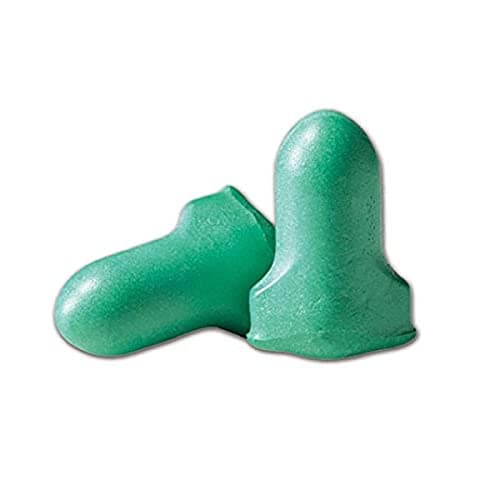
Highest-NRR earplug
Howard Leight MAX-1
NRR 337.1/10ResearchedNRR 33, the highest published rating of any protector we list, and the cheapest. Disposable foam, so a fresh pair every session.
$39.89Amazon#ad · Price as of November 3, 2026 · How we make money for the link to Howard Leight MAX-1
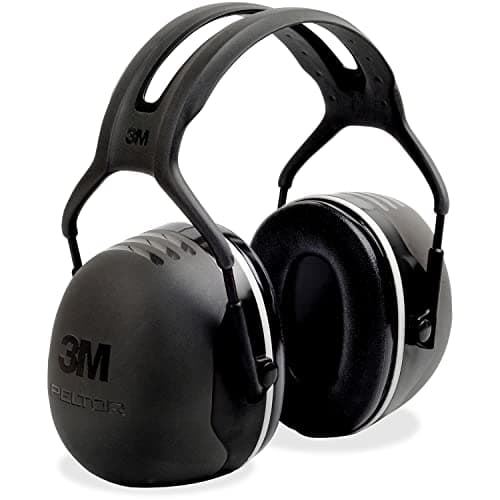
Highest-NRR passive muff
3M Peltor X5A
NRR 316.7/10ResearchedNRR 31 from 3M's own X Series data sheet: the highest-rated earmuff we list. A deep cup, so check it clears your gun's stock.
$47.27Amazon#ad · Price as of November 3, 2026 · How we make money for the link to 3M Peltor X5A
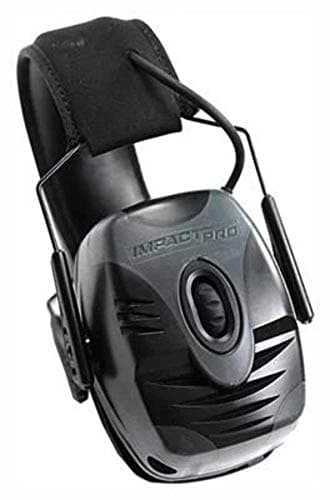
Best electronic muff for indoor ranges
Howard Leight Impact Pro
NRR 307.4/10ResearchedNRR 30 with microphones, so you can hear range commands without ever lifting a cup. The compromise that stops the behavior that causes exposures.
$101.59Amazon#ad · Price as of November 3, 2026 · How we make money for the link to Howard Leight Impact Pro
If you shoot indoors, read ear protection for indoor ranges before you buy, because that is the environment where the published guidance is most emphatic. If you shoot a shotgun, the cup shape matters as much as the rating: ear protection for shotgun shooting. And if there are children on the bench, their protection is a separate purchase — see kids' ear protection and taking kids to the shooting range.
If you think it has already happened
See an audiologist or a physician. That is the whole of our advice, and we are not qualified to extend it. An audiologist can measure your hearing across frequencies and compare it with what is typical, which is something no amount of reading can do for you. NIDCD's noise-induced hearing loss page is a reasonable place to read more before that appointment.
Two things worth knowing in the meantime. First, a baseline hearing test is useful even if nothing is wrong: occupational hearing conservation programs are built around baselines for exactly that reason, and a shooter with a baseline can detect a change years earlier than one without. Second, hearing loss from noise is not reversible, but tinnitus and hearing difficulty have management options, and a professional is the person to discuss them with.
NIOSH's own science blog on firearms training is worth reading if you shoot a lot or instruct: it treats repeated range exposure as an occupational hazard with a conservation program around it, which is a useful frame even for recreational volume shooters.
How we scored this
Every pick, scored on numbers you can check
Every pick here is labeled Researched: we compiled each maker's published specs (the EPA-labeled NRR on hearing protection, the Z87+ mark on glasses), read the manuals, checked the standards behind them, and scored everything on a public rubric. Every figure links to where it came from, and marketing claims are labeled “maker's claim,” so you can see exactly why a pick ranks where it does.
Scores are editorial judgments built from that documented research. Commissions never set a score or decide a pick. The rubric and its weights are published.
Questions
Common questions
Can one gunshot cause permanent hearing loss?
Why do my ears ring after shooting?
Is hearing damage from shooting reversible?
Which ear gets damaged more from shooting?
How much hearing protection do I need to prevent damage?
Should I get a hearing test if I shoot regularly?
Where this comes from
Sources
- NIDCD (NIH), Noise-Induced Hearing Loss
- Meinke, Finan, Flamme, Murphy et al. (NIOSH), peak levels from recreational firearms, 2017
- Murphy, Byrne and Franks (NIOSH), firearm peak level measurements, 2007
- NIOSH Publication 2009-136, law-enforcement firearm noise at ranges
- NIOSH Science Blog, firearms training noise, 2017
- ASHA, Recreational Firearm Noise Exposure
- OSHA 29 CFR 1910.95, occupational noise exposure (140 dB peak impulse ceiling)
- HSE, hearing protection guidance
Specs come from each maker's own pages and data sheets (linked on every product); ratings like NRR and Z87+ are explained from the standards and agencies behind them. Prices are set by Amazon and change often, so the buy button always takes you to the current one. Where a figure isn't published, we say so. Read the full method.