Not medical advice. This page shares general guidance from the public-health sources linked in the text. If you're worried about your hearing or lead exposure, talk to a doctor.
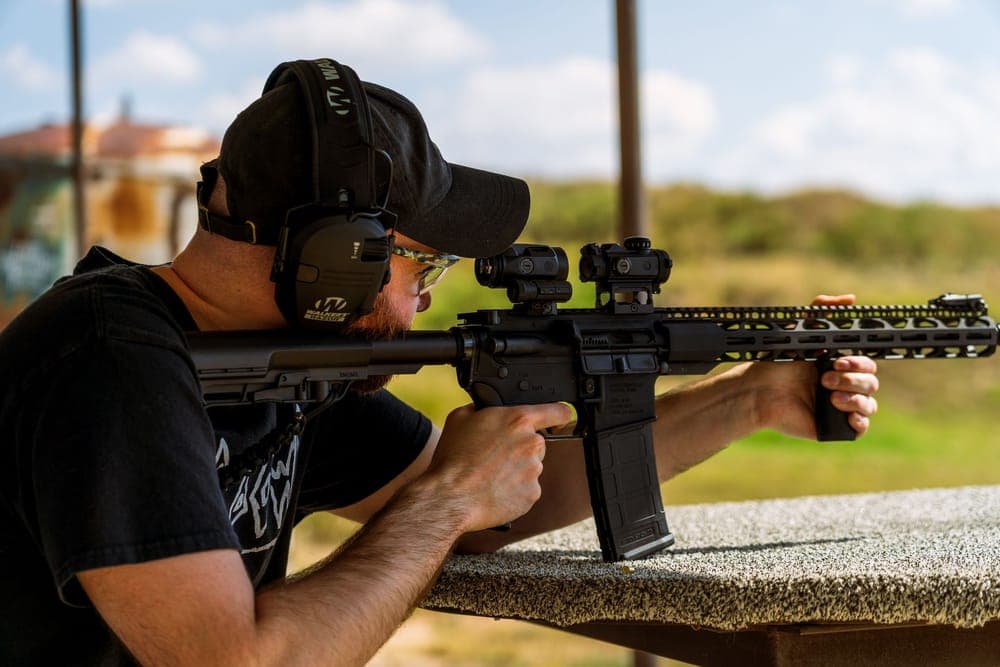
If you have only ever worn a plain muff, electronic muffs look like magic and get sold like magic. They are not. The honest one-sentence description is that an electronic muff is a normal passive earmuff with a hearing aid bolted onto the outside of each cup, and once you see it that way every buying decision in the category gets easier.
That also tells you where the protection comes from, which is the single most misunderstood thing about them.
The short version
- A microphone on the outside of each cup listens to the world. Howard Leight calls them built-in directional microphones.
- An amplifier makes that signal louder and feeds it to a small speaker inside the cup.
- A limiter watches the level. Howard Leight says its microphones amplify ambient sounds "to a safe 82dB", and that when a gunshot arrives "amplification automatically stops, and you're protected".
- The cup, the foam and the cushion then do exactly what they do on a passive muff: block sound. That is where the NRR comes from.
The four parts inside
The microphones. One per cup on nearly every muff worth buying, which is what makes amplified hearing directional: if the left mic hears the range officer and the right one does not, your brain still knows which way to look. A single-microphone muff collapses that to mono and is worth avoiding.
The amplifier. This is the part people assume is a volume control for the world. It is really a gain stage with a ceiling, and the ceiling is the number that matters. Howard Leight publishes 82 dB for the Impact Sport. Most makers publish nothing at all, which is one reason that figure is worth looking for.
The limiter. Sometimes called compression, sound suppression or active shut-off depending on who is writing the box. Functionally it is a fast circuit that stops the amplifier passing a loud transient through to your ear.
The speaker and the cup. The speaker is tiny and sits inside the cup near your ear. The cup is an ordinary passive earmuff, and it is doing the work.
The limiter, and what it really catches
Here is the part the marketing blurs. The limiter protects you from the amplifier, not from the gunshot.
Think about what happens when the shot goes off. Sound arrives at the outside of the cup. Two things then happen in parallel: the cup attenuates it passively, exactly as a passive muff would, and the microphone picks it up and hands it to the amplifier. Without a limiter, the amplifier would take a 160 dB transient, add gain, and play an amplified gunshot directly into your ear canal through the speaker. The limiter stops that happening.
So the limiter is essential, and it also adds nothing to your protection against the shot itself. The attenuation you get is the attenuation the cup provides, which is why an NRR 22 electronic muff and an NRR 22 passive muff protect you equally well and the electronic one simply lets you hold a conversation between strings.
The electronics add no protection
Worth stating on its own because the pricing implies otherwise. The Noise Reduction Rating is measured on the protector as a physical object under the EPA's rule in 40 CFR Part 211 Subpart B. Nothing in that figure credits a circuit.
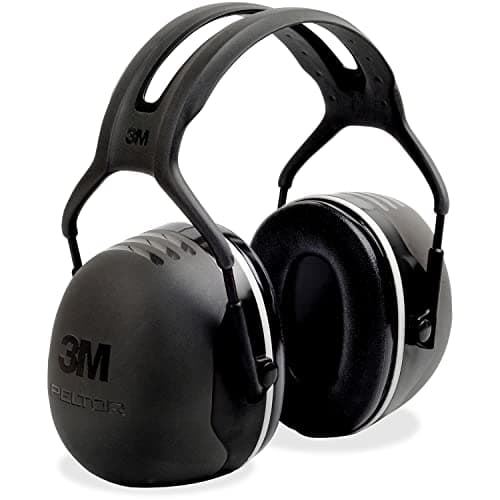
You can see it in our own registry. The best-rated electronic muff we cover, the Howard Leight Impact Pro, reaches NRR 30. Its passive stablemate the Leightning L3 also reaches NRR 30, and the passive 3M Peltor X5A reaches 31. Most budget electronic muffs sit at NRR 21 to 23, below almost every passive muff we list. Our best passive earmuffs page is the comparison, and electronic vs passive earmuffs argues the whole trade.
Not noise cancelling
Electronic shooting muffs and noise-cancelling headphones are near-opposites, and the words are close enough that people buy the wrong thing.
- Noise-cancelling headphones generate an inverted waveform to erase steady low-frequency sound, such as an aircraft cabin. They are tuned for continuous noise, they publish no NRR, and they are useless against a 160 dB impulse.
- Electronic shooting muffs do the reverse: they let quiet sound through and cut loud sound off. They publish an NRR because they are hearing protection.
If a pair of headphones does not publish a US EPA NRR, it is not hearing protection, whatever it costs. That gate is written down on how we pick, and the related trap of a European-only rating is covered on NRR vs SNR.
Batteries, auto shut-off and failure
Everything electronic has a failure mode, and this one is mercifully gentle: when the batteries die, an electronic muff becomes a passive muff at its rated NRR. You lose amplified hearing, not protection. That is worth knowing before your first dead-battery moment, because the instinct is to assume the muff has stopped working.
Three power details worth checking before you buy:
- Battery type. Two AAA cells is the overwhelming standard, and it is the good answer: you can buy spares anywhere and keep a pair in the range bag.
- Published battery life. Howard Leight quotes about 350 hours for the Impact Sport and Impact Pro. Several makers publish nothing.
- Auto shut-off. The feature that saves you from yourself. Howard Leight shuts off after four hours; Walker's lets you set 2, 4 or 6 hours on the Razor Pro Digital.
What to buy
Three muffs from our registry that show the whole spread: the easy first pair, the high-NRR version of the same thing, and the one with the timer you can set.
Our picks for this
Three electronic muffs, three published power stories
Every figure is from the maker's own product page. Note that the ratings come from the cups, not the circuits.
Best first electronic muff
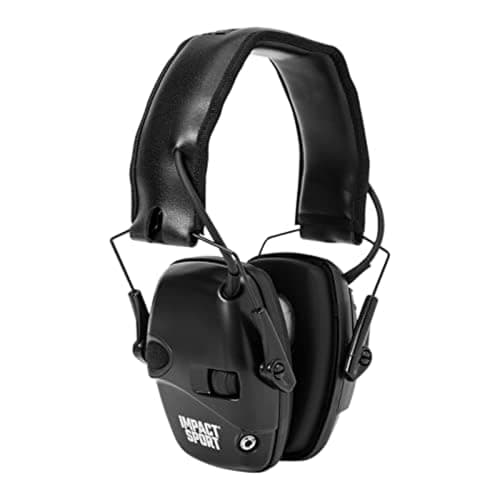
Howard Leight Impact Sport
NRR 227.2/10ResearchedNRR 22, microphones that amplify to a safe 82 dB, a 4-hour auto shut-off and about 350 hours on 2 AAAs. The clearest published spec sheet in the category.
$60.00Amazon#ad · Price as of November 3, 2026 · How we make money for the link to Howard Leight Impact Sport
Best electronic muff for indoor ranges
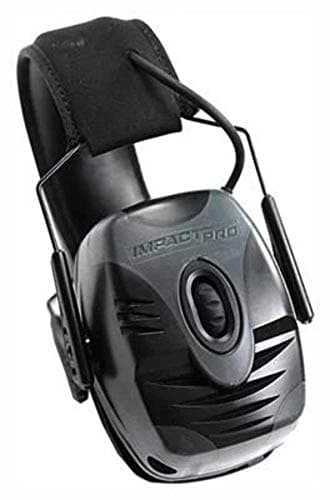
Howard Leight Impact Pro
NRR 307.4/10ResearchedNRR 30, the highest electronic rating we cover, with the same AAA power and 4-hour shut-off. Bigger cups, so check stock clearance for long guns.
$101.59Amazon#ad · Price as of November 3, 2026 · How we make money for the link to Howard Leight Impact Pro
- Walker'sNo image
Best adjustable auto shut-off
Walker's Razor Pro Digital
NRR 236.9/10ResearchedNRR 23 with an auto shut-off you set to 2, 4 or 6 hours, and compact cups Walker's says minimize interference when shouldering long guns.
Check price · Amazon#ad · Price as of November 3, 2026 · How we make money for the link to Walker's Razor Pro Digital
Is the circuit worth paying for?
For a first range trip, yes, and not for the reason the box gives. You are paying to hear the person running the line and the person next to you, which keeps you inside the etiquette our range etiquette page describes and means you are not the shooter who misses a cease-fire. That is a safety purchase.
What you are not paying for is more protection. If protection per dollar is the goal, buy a high-NRR passive muff and a box of foam plugs and you will be better protected than almost anyone on the line. If hearing matters too, buy electronic and put the plugs underneath indoors anyway. Our best electronic earmuffs page ranks the category, and best ear protection for indoor ranges covers the loudest case.
How we scored this
Every pick, scored on numbers you can check
Every pick here is labeled Researched: we compiled each maker's published specs (the EPA-labeled NRR on hearing protection, the Z87+ mark on glasses), read the manuals, checked the standards behind them, and scored everything on a public rubric. Every figure links to where it came from, and marketing claims are labeled “maker's claim,” so you can see exactly why a pick ranks where it does.
Scores are editorial judgments built from that documented research. Commissions never set a score or decide a pick. The rubric and its weights are published.
Questions
Common questions
How do electronic ear muffs work?
Do electronic ear muffs protect better than regular ones?
What happens when the batteries die in electronic ear muffs?
Are electronic ear muffs the same as noise cancelling headphones?
What does the limiter in electronic ear muffs actually protect you from?
Do you still need earplugs with electronic ear muffs?
Where this comes from
Sources
- Howard Leight Shooting Sports, Impact Sport Electronic Earmuff product page, accessed 2026-10-10
- Howard Leight Shooting Sports, Impact Pro Electronic Earmuff product page, accessed 2026-10-10
- Walker's, Razor Pro Digital Ear Muffs product page, accessed 2026-10-10
- US EPA, 40 CFR Part 211 Subpart B, Hearing Protective Devices (eCFR), accessed 2026-10-10
- NIOSH Science Blog, Hit the Mark: Firearms training without damaging your hearing, accessed 2026-10-10
- Meinke DK, Finan DS, Flamme GA, Murphy WJ, et al., Prevention of Noise-Induced Hearing Loss from Recreational Firearms, Seminars in Hearing 2017 (CDC Stacks), accessed 2026-10-10
Specs come from each maker's own pages and data sheets (linked on every product); ratings like NRR and Z87+ are explained from the standards and agencies behind them. Prices are set by Amazon and change often, so the buy button always takes you to the current one. Where a figure isn't published, we say so. Read the full method.