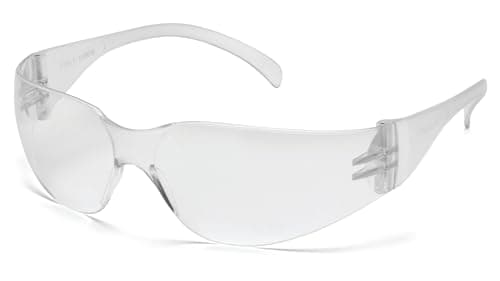
If you wear glasses, the eye-protection aisle is confusing in a specific way. Everything is sold as "shooting glasses," nothing says what to do about the prescription you already need, and nobody at the counter volunteers that your own glasses are not protective eyewear. This page sorts the actual options, with what each maker publishes.
One thing we will not do here is give you optical or medical advice. We are not opticians, we do not know your prescription, and the right lens for your eyes is a conversation with the person who writes your script. What we can do is explain the three mechanical routes and what each maker states about its own hardware.
Why your own glasses don't count
Ordinary prescription eyewear is not impact-rated. The standard that matters for shooting is ANSI/ISEA Z87.1, and the marking that matters within it is the high-impact one, written as Z87+ on the lens or frame. A useful plain-English explainer of those lens markings is worth five minutes before you shop; our own page on Z87 vs Z87+ covers why the plus sign is the whole point.
OSHA's eye protection rule, 29 CFR 1910.133, is written for workplaces rather than ranges, but it says the useful thing out loud: employees who wear prescription lenses must use eye protection that incorporates the prescription in its design, or wear protection that can be worn over the prescription glasses. Those are routes 2 and 3, and route 1, in regulatory language. It is the same three options.
On a range, eye protection is not optional either. The NSSF's firearms safety rules list eye and ear protection as standard equipment for shooting, and most ranges enforce it at the door. If you are new to all of this, start with your first trip to a range, then come back here for the eyewear detail.
The three routes
| Route | How it works | Cost | Main drawback |
|---|---|---|---|
| 1. Over-the-glasses (OTG) | A deeper, wider Z87+ pair goes on over the frames you own | Lowest | Bulk, and two lens surfaces that can both fog |
| 2. Rx insert or carrier | An optician puts your lenses in a small carrier; the carrier clips behind the protective lens | Middle, plus the optician's lens charge | Two purchases and an appointment before you can shoot |
| 3. Ballistic lenses in your prescription | The maker's lab surfaces your prescription into its own impact-rated lens | Highest | Lead time, and a prescription range limit set by the frame's curvature |
Route 1: wear protection over your glasses
This is the route to start with, and not as a consolation prize. An over-the-glasses pair solves the problem completely for a price that will not make you flinch, and nothing about it depends on your prescription, so it keeps working when your script changes.
The one number to check is whether it fits over the frames you actually own, and most makers do not publish it. Pyramex does. Its OTS is published as fitting over frames up to 5 3/8 in wide by 1 3/4 in high, which is 137 mm by 44 mm, and Pyramex states ANSI/ISEA Z87.1-2020 + High Impact on the same page. Take a ruler to your own glasses before you order anything: measure the full outside width of the frame, and the height of one lens at its tallest.
We rank the OTG field in detail on best shooting glasses for glasses wearers, including the larger OTS XL for wide frames and which pairs publish a fit-over measurement at all. If route 1 is where you are landing, that page is the one to read next.
Route 2: a prescription insert
An Rx insert, sometimes called an Rx carrier, is a small lightweight frame that holds your prescription lenses and sits behind the protective lens of a sealed or wrap-around pair. You get one impact-rated lens in front of your eyes instead of a protective lens plus your own glasses, which is why people move to this route.
Pyramex V2G Rx Insert. Pyramex sells the V2G Rx Insert (model RX1800) for its V2G sealed eyewear. Pyramex describes it as "specially designed for V2G sealed eyewear to fit a variety of prescription lens options," says it "easily snaps securely into place above nosepiece," publishes a weight of 3 grams and a 37 mm vertical frame size, and includes a micro-fiber storage case. The instruction that matters most is the plainest one on the page: "take insert to local optometrist for Rx lens installation." You buy the insert, then pay your optician for the lenses.
The V2G itself is the part that does the protecting, and Pyramex states ANSI/ISEA Z87.1-2020 + High Impact for it, plus that it "passes MIL-PRF-32432 High Velocity Impact Standards." It is also foam-sealed, which is a real advantage on a dusty outdoor range and a mixed blessing for fog.
Revision Rx Carrier. Revision takes the same approach at the military end of the market. Its Rx Carrier spec sheet describes an optician inserting prescription lenses into the carrier, which the wearer then inserts into the Revision spectacle or goggle, and states that the carrier frame accommodates prescriptions up to plus or minus 11 diopters with one size fitting the StingerHawk and other Revision systems. On the StingerHawk you swap in an Rx nosepiece supplied with the carrier, then press the carrier into place until it clicks.
That plus or minus 11 diopter figure is the most generous published prescription range of anything on this page, which is the quiet argument for the carrier approach: a carrier sits flat and close to the eye, so it is not fighting a steeply curved lens the way a wrap-around prescription lens has to.
Route 3: ballistic lenses in your prescription
The third route is to have the maker put your prescription into its own impact-rated lens, so you end up with one pair that looks and wears like normal eyewear and carries a Z87+ mark.
Wiley X is the maker that documents this most clearly. Its prescription technology page says Wiley X can produce prescriptions "as high as -7.00 to +5.00 in most styles" using its digital lens technology for high-wrap frames, that "each prescription lens created by Wiley X is etched and certified," and, importantly, that "the only way to ensure your glasses are ANSI-rated for clarity and protection is to have your prescription filled by Wiley X or a certified partner lab." Its prescription ordering page describes choosing an Rx-ready frame and entering the prescription at checkout, with made-to-order lenses.
Read that middle quote twice, because it is the one that protects you. A prescription lens dropped into a ballistic frame by an unaffiliated lab is not automatically the rated article. If you go this route, order through the maker or a lab the maker recognizes, and keep the certification paperwork.
There is also a fourth, narrower option worth knowing about: adding side protection to prescription frames. Pyramex sells side shields for prescription lenses. Treat this as a workplace solution rather than a shooting one. Side shields do nothing about the impact rating of the lens in front of your eye, which is the part that matters when something comes back off a steel target or a berm.
What to buy for each route
Four products, one per route, plus the premium carrier option. Every one of these states a high-impact Z87 rating on its maker's own page, which is the gate everything on this site has to clear.
Our picks for this
One pick per prescription route
Each states its Z87 high-impact rating on the maker's page. The route each one serves is different, so read the labels rather than the scores.
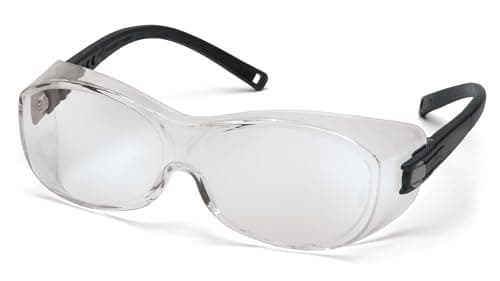
Best over-the-glasses pair
Pyramex OTS
Z87+7.1/10ResearchedRoute 1, and where most readers should start. Pyramex publishes the fit-over limit (137 x 44 mm) so you can measure your own frames first, and states Z87.1-2020 + High Impact. An H2X anti-fog version is sold.
$6.08Amazon#ad · Price as of October 9, 2026 · How we make money for the link to Pyramex OTS
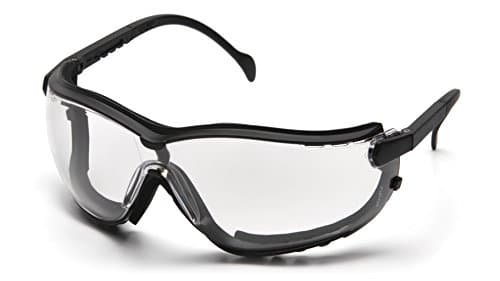
Best sealed glasses for fog-prone days
Pyramex V2G
Z87+7.6/10ResearchedRoute 2 on a budget. The sealed V2G states Z87.1-2020 + High Impact and that it passes MIL-PRF-32432 high-velocity standards; Pyramex sells the matching V2G Rx Insert (RX1800) separately, and your optometrist fits the lenses into it.
$8.10Amazon#ad · Price as of October 9, 2026 · How we make money for the link to Pyramex V2G
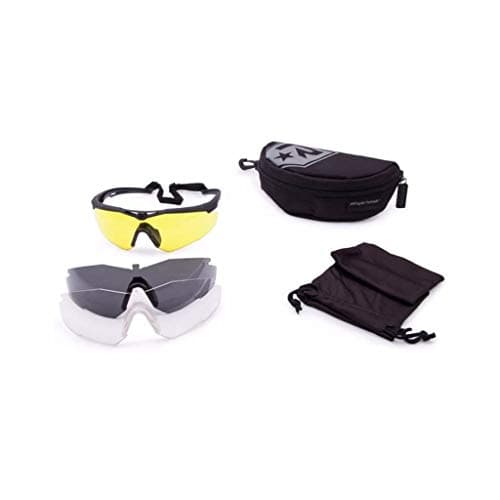
Best documented ballistic rating
Revision StingerHawk Eyewear
Z87+7.3/10ResearchedRoute 2 at the top end. Revision quotes the exact Z87+ clause and MIL-PRF-32432A Class 1, and its Rx Carrier takes prescriptions up to plus or minus 11 diopters and clips into the StingerHawk with an Rx nosepiece.
$143.09Amazon#ad · Price as of October 9, 2026 · How we make money for the link to Revision StingerHawk Eyewear
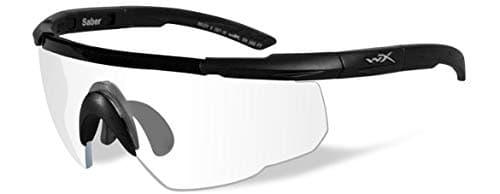
Best for a stated ballistic rating
Wiley X Saber Advanced
Z87+6.7/10ResearchedRoute 3 territory. Z87.1+ and MIL-PRF-32432A on Wiley X's page, and Wiley X runs an Rx program with made-to-order lenses. The Saber Advanced page itself does not list Rx, so confirm this model is Rx-ready before ordering.
$65.00Amazon#ad · Price as of October 9, 2026 · How we make money for the link to Wiley X Saber Advanced
Which route fits you
| If this is you | Route | Why |
|---|---|---|
| First range trip, borrowed gun, unsure you'll go back | 1. Over-the-glasses | Cheapest, available immediately, and independent of your prescription |
| Shooting monthly, tired of fog between two lenses | 2. Rx insert | One protective lens in front of your eyes instead of two surfaces |
| Strong prescription past the usual wrap limits | 2. Rx carrier | Revision publishes up to plus or minus 11 diopters for its carrier |
| You want one pair that does not look like safety gear | 3. Rx ballistic lenses | Made to order in an Rx-ready frame, etched and certified by the maker's lab |
| Your prescription changes often | 1. Over-the-glasses | Nothing to re-order when your script changes; your own glasses update themselves |
| You wear contact lenses some days | Any standard Z87+ pair | With contacts in, you are shopping ordinary shooting glasses, not prescription ones |
That last row is worth saying plainly: if you can wear contact lenses comfortably for a couple of hours, the whole problem goes away and you can buy from our main best shooting glasses roundup like anybody else. Many glasses wearers who shoot regularly end up doing exactly that, and keeping an OTG pair in the bag as a backup.
What to look for
- A Z87+ mark, stated by the maker. Not Z87 alone. Not "meets ANSI standards" with no clause. The high-impact level is the one that matters, and it should appear on the maker's own page and on the product itself.
- Who is allowed to fit the lenses. On the Rx-lens route, Wiley X is explicit that the ANSI rating depends on the lens being filled by the maker or a certified partner lab. On the insert route, the maker tells you to take the carrier to an optometrist. Follow whichever applies.
- The published prescription range. Wiley X states -7.00 to +5.00 in most styles; Revision states plus or minus 11 diopters for its carrier. If your script is outside a frame's range, no amount of wanting that frame will fix it.
- Anti-fog, and more of it than usual. Two lens surfaces fog twice as readily as one. Look for a named coating, not just the word "anti-fog" in a bullet list.
- Temple thickness, if you wear earmuffs. Whatever route you pick, something has to run under the muff cushion. Thin and flat beats thick and wrapped.
- A clear lens for indoor ranges. Tinted lenses look better in photos; an indoor bay is dim, and clear is what you want there. Our lens color guide covers when a tint earns its place.
Fog, and three things on your head
Two problems hit prescription wearers harder than everyone else, and both are solvable.
Fog. Route 1 puts two lens surfaces in front of each eye, and route 2 puts a carrier behind a sealed lens, which traps warm air. Both fog more readily than a single open lens. The fixes are a named anti-fog coating, vents where the design allows them, and an anti-fog wipe in the bag. Our full guide to stopping shooting glasses from fogging goes through what actually works and what just smears.
Stacking. On route 1 you have your own temples, the OTG temples, and then earmuff cushions over all of it. Every layer breaks the muff seal a little more, and the noise reduction rating on the label never accounted for any of them. Our pages on glasses for under earmuffs and ear protection with glasses cover the combinations that work; the short version is that routes 2 and 3 are kinder to a muff seal because there is only one set of temples.
Mistakes prescription wearers make
- Assuming polycarbonate means protective. Material is not a rating. The Z87+ mark is the rating, and your optician's standard lens does not carry it.
- Ordering a frame first and the prescription later. Check the specific model is Rx-ready before you buy. Not every model in an Rx-capable maker's range is on the list.
- Buying OTG glasses without measuring. Pyramex publishes a fit-over limit precisely so you can check. Two minutes with a ruler beats a return.
- Letting a cheap lab fill a ballistic frame. Wiley X states the ANSI rating depends on who fills the prescription. A bargain lens in a rated frame is not a rated pair.
- Skipping protection entirely because it is awkward. This is the one that actually hurts people. An awkward OTG pair you own beats a perfect prescription pair you are still saving for.
- Forgetting the backup. Keep a cheap OTG pair in the range bag whichever route you choose. Lenses get scratched, inserts get left at home, and ranges do not hand out eye protection to people who forgot theirs. See our range bag checklist.
How we scored this
Every pick, scored on numbers you can check
Every pick here is labeled Researched: we compiled each maker's published specs (the EPA-labeled NRR on hearing protection, the Z87+ mark on glasses), read the manuals, checked the standards behind them, and scored everything on a public rubric. Every figure links to where it came from, and marketing claims are labeled “maker's claim,” so you can see exactly why a pick ranks where it does.
Scores are editorial judgments built from that documented research. Commissions never set a score or decide a pick. The rubric and its weights are published.
What changed
- First published. Pyramex, Wiley X and Revision prescription pages checked the same day; the Pyramex V2G Rx Insert was added to the V2G registry entry at the same time.
Questions
Common questions
Can I just wear my prescription glasses at the shooting range?
What is a prescription insert for shooting glasses?
How strong a prescription can ballistic shooting glasses take?
Are prescription shooting glasses worth it over an OTG pair?
Who should fill the prescription in a ballistic frame?
Do side shields make my prescription glasses range-legal?
Will contact lenses solve this?
Where this comes from
Sources
- Pyramex, OTS Over the Spectacle product page, accessed 2026-10-09
- Pyramex, V2G Sealed Eyewear product page, accessed 2026-10-09
- Pyramex, V2G Rx Insert (RX1800) product page, accessed 2026-10-09
- Pyramex, Side Shields for Prescription Lenses product page, accessed 2026-10-09
- Wiley X, Prescription technology page, accessed 2026-10-09
- Wiley X, Prescription Sunglasses ordering page, accessed 2026-10-09
- Wiley X, Saber Advanced product page, accessed 2026-10-09
- Revision Military, Rx Carrier spec sheet (PDF), accessed 2026-10-09
- Revision Military, StingerHawk eyewear range page, accessed 2026-10-09
- OSHA, 29 CFR 1910.133 Eye and face protection, accessed 2026-10-09
- HexArmor, What do lens markings and Z87 mean?, accessed 2026-10-09
- NSSF, Rules for Firearms Safety, accessed 2026-10-09
Specs come from each maker's own pages and data sheets (linked on every product); ratings like NRR and Z87+ are explained from the standards and agencies behind them. Prices are set by Amazon and change often, so the buy button always takes you to the current one. Where a figure isn't published, we say so. Read the full method.