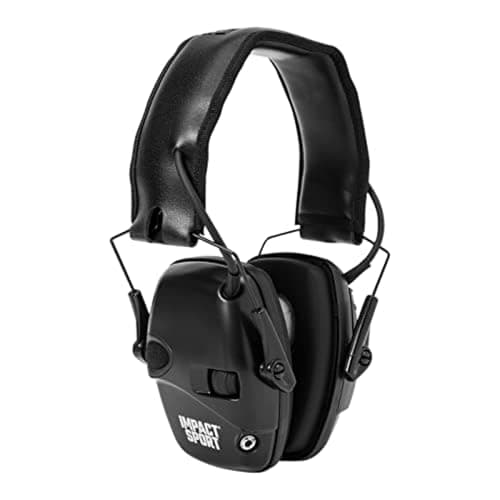
The contenders
Side by side
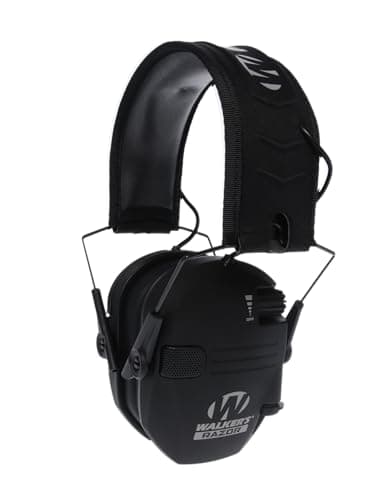
Pick for a first electronic muff on a budget
Walker's Razor Slim Electronic
NRR 236.3/10NRR 23, two AAAs in the box, and a published .02 second reaction time. Walker's calls it a low-profile design. No battery life and no auto shut-off are published.
$31.48Amazon#ad · Price as of October 9, 2026 · How we make money for the link to Walker's Razor Slim Electronic
- Walker'sNo image
Pick if you forget to switch things off
Walker's Razor Pro Digital
NRR 236.9/10The same NRR 23 with digital circuitry Walker's says suppresses background noise and wind, plus an auto shut-off you set to 2, 4 or 6 hours.
Check price · Amazon#ad · Price as of October 9, 2026 · How we make money for the link to Walker's Razor Pro Digital

Walker's sells several muffs with "Razor" in the name, and the two that get compared most are the Razor Slim Electronic and the Razor Pro Digital. They look related, they use the same batteries, and they carry the same published noise reduction rating. The gap between them is not protection. It is circuitry, a timer and price.
Everything below comes from Walker's own product pages for the Razor Slim Electronic and the Razor Pro Digital, checked on the date at the top of this page, scored on the published rubric on how we pick gear. We have not measured either muff, and neither has anyone else whose numbers we could cite.
The published specs side by side
| Published spec | Walker's Razor Slim Electronic | Walker's Razor Pro Digital |
|---|---|---|
| NRR | 23 dB | 23 dB |
| Batteries | 2 x AAA (included) | 2 x AAA (included) |
| Battery life | Not stated on Walker's page | Not published |
| Auto shut-off | Not published | Adjustable: 2, 4 or 6 hours |
| Cup profile | "Low-profile design" (maker's claim) | "Compact ear cups that minimize interference when shouldering long guns" (maker's claim) |
| Bluetooth | Not mentioned on Walker's page | Not mentioned on Walker's page |
| Score | 6.3/10 | 6.9/10 |
Two rows do the work. The NRR row is a tie at 23 dB. The auto shut-off row is where the Pro Digital earns its name, and it is the only row where one muff has a published feature the other does not.
Both are NRR 23. That matters most
The Noise Reduction Rating is a labeling requirement, not a marketing number. The EPA sets how hearing protectors are tested and labeled under 40 CFR Part 211 Subpart B, which is why you can compare an NRR from one brand against an NRR from another at all. Walker's prints 23 dB on both of these muffs.
What it does not mean is that you get 23 dB of quiet at the firing line. NIOSH's hearing protector guidance explains why laboratory attenuation and real-world attenuation differ, and recommends derating. A muff worn over long hair, tilted by safety glasses temples, or settled badly on the head gives up protection the label never accounted for. That is a fit problem, and fit is something you control; the printed NRR is not.
What the Pro Digital's circuitry adds
Both muffs are electronic, which means microphones on the outside pass through quiet sound so you can hear a range officer, and the circuit clamps down when a shot goes off. Walker's describes each one differently.
For the Razor Slim Electronic, Walker's publishes a number: "Sound activated with .02 second reaction time protects hearing against sharp retorts." It also lists "Two high gain omnidirectional microphones pick up sounds from all directions" and "Full range high definition speakers provide clear and balanced sound."
For the Razor Pro Digital, Walker's leans on the processing instead. The page describes "advanced digital circuity," "Active dynamic sound suppression" and "Wind noise reduction," with "Hi-gain omnidirectional mics" giving "360-degree sound pickup." On reaction speed it says only "Lightning-fast reaction time" and gives no figure.
Read those two lists carefully and you get an honest picture. The Slim tells you how fast it reacts. The Pro tells you what it does with the sound in between shots. Neither tells you both, and we are not going to invent the missing half. If reaction time is the spec you care about, the Slim is the only one of the pair that publishes one.
Wind noise reduction is the claim most likely to matter in practice, and it matters outdoors. An electronic muff with the volume up on a breezy day can turn wind across the microphones into a constant rush. Walker's naming that as a feature on the Pro Digital, and not on the Slim, is the clearest functional difference between them after the timer. It is still the maker's claim, not a measurement.
The auto shut-off is the real difference
Walker's publishes "Auto shut off 2, 4, or 6 hours" for the Razor Pro Digital. It publishes no auto shut-off for the Razor Slim Electronic.
This sounds minor until you live with electronic muffs. They run on two AAA batteries, and the way most people kill a set is not shooting; it is leaving the muffs switched on in a bag for a week. A fixed timer solves that. An adjustable one solves it without cutting you off mid-session: set 2 hours for a quick range trip, 6 for a long day on a hunt or at a class.
Neither page publishes a battery life figure, which is worth saying plainly. Walker's gives you a timer on the Pro Digital and a reaction time on the Slim, but no hours-per-set number for either. If you want a published battery life, the Howard Leight Impact Pro quotes one, and we cover that pair on Impact Sport vs Impact Pro.
What Walker's says about each cup
Cup profile is the spec that decides whether a muff works with a rifle or shotgun. Shoulder a long gun and the stock comes up right where the bottom rear of the earcup sits. A fat cup gets bumped off your head, or pushes your cheek weld off the stock.
Walker's describes the Razor Slim Electronic as a "Low-profile design" and says it has "Soft and comfortable ear cups" that "provide extra sound absorption." For the Razor Pro Digital it is more specific about the use case: "Compact ear cups minimize interference when shouldering long guns," alongside a redesigned headband.
Both are claims rather than measurements, and neither page publishes a cup depth in millimeters. If long guns are most of your shooting and you want the thinnest cup Walker's makes, that is a third model: the Razor X-TRM, which Walker's calls an "ultra low-profile design." It is also the lowest-rated of the three at NRR 21, so you trade protection for clearance.
Is the step up worth it?
At Walker's own list prices, the Pro Digital sits well above the Slim: close to double, which is a real gap for a first electronic muff. We do not print prices in prose because they move; the buy buttons on this page show the current Amazon figure where we can read one, and say to check the price where we cannot.
Here is the honest way to decide:
- Buy the Slim if this is your first electronic muff, you shoot a handful of times a year, and you are still working out whether you want electronics at all. You get the same NRR for less money.
- Buy the Pro Digital if you shoot outdoors often enough that wind noise is a real annoyance, or if you have already killed a set of batteries by leaving muffs switched on. The timer is worth money to forgetful people, and most of us are forgetful people.
- Buy neither if your shooting is almost all handguns in an indoor bay and you want one muff to handle it alone. NRR 23 is modest for that; a higher-rated passive or electronic muff, or plugs under either of these, is the better answer.
Glasses, plugs and indoor ranges
Whichever you pick, two things will cost you protection and neither is in the spec sheet.
The first is safety glasses. Every pair of temples that runs under a muff cushion breaks the seal a little. Thin, flat temples lose less than thick wrap-around arms. We cover which pairs are built for this on shooting glasses for under earmuffs and on ear protection with glasses. If you wear a prescription, the route you choose changes how much temple ends up under the cushion; our guide to prescription shooting glasses covers that trade-off.
The second is the indoor range itself. Walls and a low ceiling bounce muzzle blast back at you, and NRR 23 on a muff is not much margin. Foam plugs under either of these muffs is cheap, and it is the single biggest upgrade available to someone shopping in this price range. Our indoor range ear protection page covers what to pair with what.
Who each one suits
| If this is you | Pick | Why |
|---|---|---|
| First electronic muff, a few range trips a year | Razor Slim Electronic | Same published NRR 23 for less money; a published .02 second reaction time |
| You leave gear switched on in a bag | Razor Pro Digital | Auto shut-off you set to 2, 4 or 6 hours |
| Mostly outdoor rifle or shotgun shooting | Razor Pro Digital | Walker's names wind noise reduction and compact cups for shouldering long guns |
| Indoor pistol bay, one muff only | Neither | NRR 23 is modest indoors; go higher-rated, or add foam plugs underneath |
| You want the thinnest possible cup | Razor X-TRM | Walker's calls it ultra low-profile, at NRR 21 instead of 23 |
Two buying traps on these listings
"Razor Slim" is not always electronic. Walker's sells a separate passive "Razor Slim" muff. Check the listing title says Electronic, and check it states NRR 23. A passive muff with no stated rating is not the product this page is about.
"Razor Pro" and "Razor Digital" are the same muff. Walker's hosts the Razor Pro Digital at a URL ending in razor-digital, and retailers list it under part numbers beginning GWP-DRSEM with several shell colors. If a listing says Razor Pro Digital, NRR 23, two AAAs and a 2, 4 or 6-hour shut-off, it is the right one. Color changes nothing about the specs.
One more note on stock: when we checked Walker's own store, the Pro Digital was listed but not available to order direct, while dealers had it. Walker's page is a spec source for this site, not a buy link, so that does not affect the pick, but it is worth knowing if you were planning to order from the maker.
Or consider
- Howard Leight Impact Pro if the indoor pistol bay is your range. It is rated NRR 30, seven points above either Walker's muff here, and Howard Leight publishes a battery life figure.
- Walker's Razor X-TRM if clearance for a rifle stock beats everything else. Ultra low-profile in Walker's words, NRR 21 on the label.
- Electronic muffs in general are not automatic. Our electronic vs passive comparison lays out when the pass-through is worth the batteries and when a plain passive muff with a higher NRR is the smarter buy.
In detail
The contenders, in full
Pick for a first electronic muff on a budget
Walker's Razor Slim Electronic
NRR 23, two AAAs in the box, and a published .02 second reaction time. Walker's calls it a low-profile design. No battery life and no auto shut-off are published.
Published specsResearched · every value sourced
| NRR | 23 dB |
|---|---|
| Batteries | 2 x AAA (included) |
| Cup profile | "Low-profile design"Maker's claim |
| Battery life | Not stated on Walker's page |
| Bluetooth | Not mentioned on Walker's page |
How the 6.3 score breaks down
- Published NRR (30%)
- 6.5
- Fit with glasses & cup profile (20%)
- 7.5
- Electronics: amplification & shut-off (20%)
- 6
- Power: battery & auto-off (15%)
- 5
- Comfort & adjustment (15%)
- 6
What the specs support
- Walker's calls it a low-profile design, which matters when a rifle or shotgun stock meets the cup
- NRR 23, one point above the Impact Sport
- Both AAA batteries come in the box
Where it falls short
- No battery life or auto shut-off time is published by Walker's
- Easy to confuse with Walker's separate "Razor Slim Muffs" listing, which doesn't state an NRR; check the listing says Electronic
Skip it if…
…you want a muff that switches itself off when you forget; Walker's doesn't publish an auto shut-off for this model, while the Razor Pro Digital lets you set 2, 4 or 6 hours.
#ad · Price as of October 9, 2026 · How we make money for the link to Walker's Razor Slim Electronic
Pick if you forget to switch things off
Walker's Razor Pro Digital
The same NRR 23 with digital circuitry Walker's says suppresses background noise and wind, plus an auto shut-off you set to 2, 4 or 6 hours.
Published specsResearched · every value sourced
| NRR | 23 dB |
|---|---|
| Batteries | 2 x AAA (included) |
| Auto shut-off | Adjustable: 2, 4 or 6 hours |
| Cup profile | "Compact ear cups that minimize interference when shouldering long guns"Maker's claim |
| Bluetooth | Not mentioned on Walker's page |
How the 6.9 score breaks down
- Published NRR (30%)
- 6.5
- Fit with glasses & cup profile (20%)
- 8
- Electronics: amplification & shut-off (20%)
- 6.5
- Power: battery & auto-off (15%)
- 7.5
- Comfort & adjustment (15%)
- 6
What the specs support
- Auto shut-off you can set to 2, 4 or 6 hours, the only adjustable timer among the muffs we cover
- Walker's says the compact cups minimize interference when you shoulder a rifle or shotgun
- Both AAA batteries come in the box
Where it falls short
- Walker's doesn't publish a battery life, so the timer is the only power detail you get
- NRR 23 is 7 dB short of the Howard Leight Impact Pro's 30
Skip it if…
…your range is an indoor pistol bay and you want one muff to handle it alone; NRR 23 is modest, and the NRR 30 Howard Leight Impact Pro gives more protection on its own.
#ad · Price as of October 9, 2026 · How we make money for the link to Walker's Razor Pro Digital
How we scored this
Every pick, scored on numbers you can check
Every pick here is labeled Researched: we compiled each maker's published specs (the EPA-labeled NRR on hearing protection, the Z87+ mark on glasses), read the manuals, checked the standards behind them, and scored everything on a public rubric. Every figure links to where it came from, and marketing claims are labeled “maker's claim,” so you can see exactly why a pick ranks where it does.
Scores are editorial judgments built from that documented research. Commissions never set a score or decide a pick. The rubric and its weights are published.
What changed
- First published. Both Walker's product pages re-checked the same day.
Questions
Common questions
Is the Walker's Razor Pro Digital quieter than the Razor Slim?
Does the Walker's Razor Slim Electronic have an auto shut-off?
Which Walker's Razor muff is best for rifles and shotguns?
Is NRR 23 enough for an indoor shooting range?
Do both Walker's Razor muffs come with batteries?
Does either muff have Bluetooth?
Where this comes from
Sources
- Walker's, Razor Slim Electronic Ear Muffs product page, accessed 2026-10-09
- Walker's, Razor Pro Digital Ear Muffs product page, accessed 2026-10-09
- Walker's, Razor X-TRM Ear Muffs product page, accessed 2026-10-09
- Howard Leight Shooting Sports, Impact Pro Electronic Earmuff product page, accessed 2026-10-09
- US EPA, 40 CFR Part 211 Subpart B (hearing protector labeling), accessed 2026-10-09
- NIOSH, Hearing Protector Device Compendium guidance (DHHS 2009-136), accessed 2026-10-09
Specs come from each maker's own pages and data sheets (linked on every product); ratings like NRR and Z87+ are explained from the standards and agencies behind them. Prices are set by Amazon and change often, so the buy button always takes you to the current one. Where a figure isn't published, we say so. Read the full method.