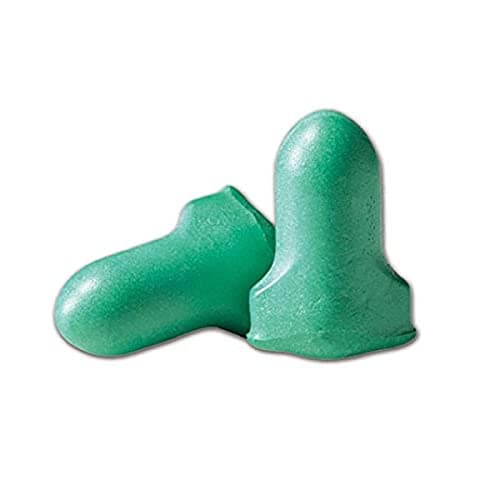
The contenders
Side by side
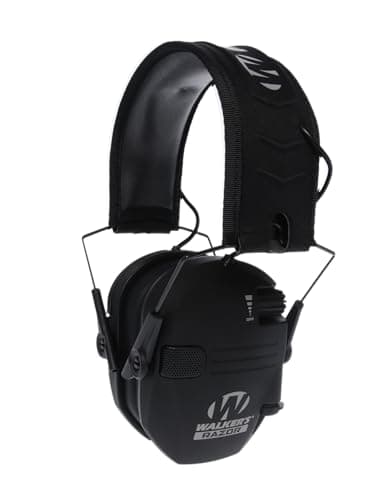
The one this review is about
Walker's Razor Slim Electronic
NRR 236.3/10NRR 23, two AAA batteries in the box, two high-gain omnidirectional microphones and sound-activated compression Walker's puts at 0.02 seconds. The low-profile Razor most people mean when they say Razor.
$31.48Amazon#ad · Price as of November 3, 2026 · How we make money for the link to Walker's Razor Slim Electronic
- Walker'sNo image
Buy this instead for a settable shut-off
Walker's Razor Pro Digital
NRR 236.9/10Same NRR 23, same AAAs, but a digital circuit with an auto shut-off you can set for two, four or six hours, plus wind-noise reduction. The upgrade that fixes the Slim's one real omission.
Check price · Amazon#ad · Price as of November 3, 2026 · How we make money for the link to Walker's Razor Pro Digital
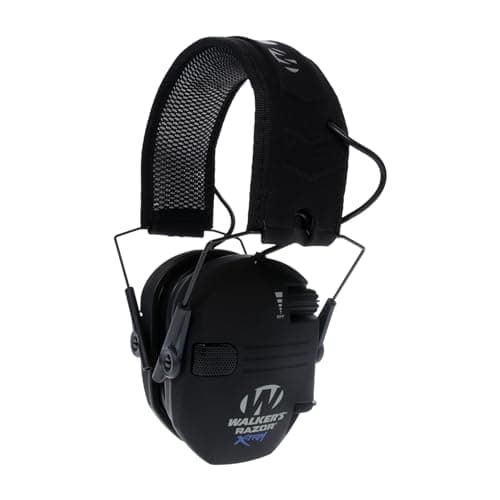
Buy this instead for the thinnest cup
Walker's Razor X-TRM
NRR 216.2/10The only Razor Walker's calls ultra low-profile, and the only one it says folds. You pay for that with NRR 21, the lowest rating of any electronic muff we list.
$58.59Amazon#ad · Price as of November 3, 2026 · How we make money for the link to Walker's Razor X-TRM
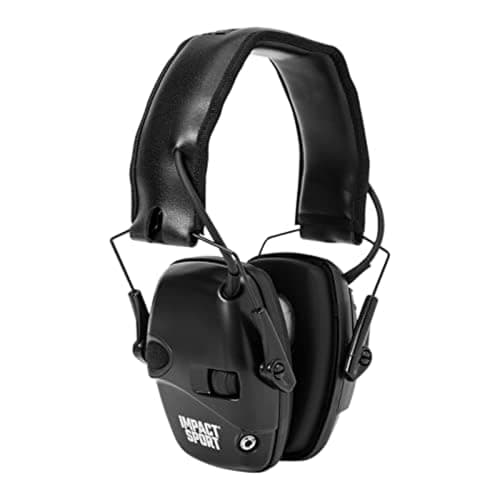
The cross-brand alternative
Howard Leight Impact Sport
NRR 227.2/10NRR 22, one point under the Slim, but Howard Leight publishes both of the figures Walker's does not: about 350 hours from two AAAs and a 4-hour auto shut-off.
$60.00Amazon#ad · Price as of November 3, 2026 · How we make money for the link to Howard Leight Impact Sport
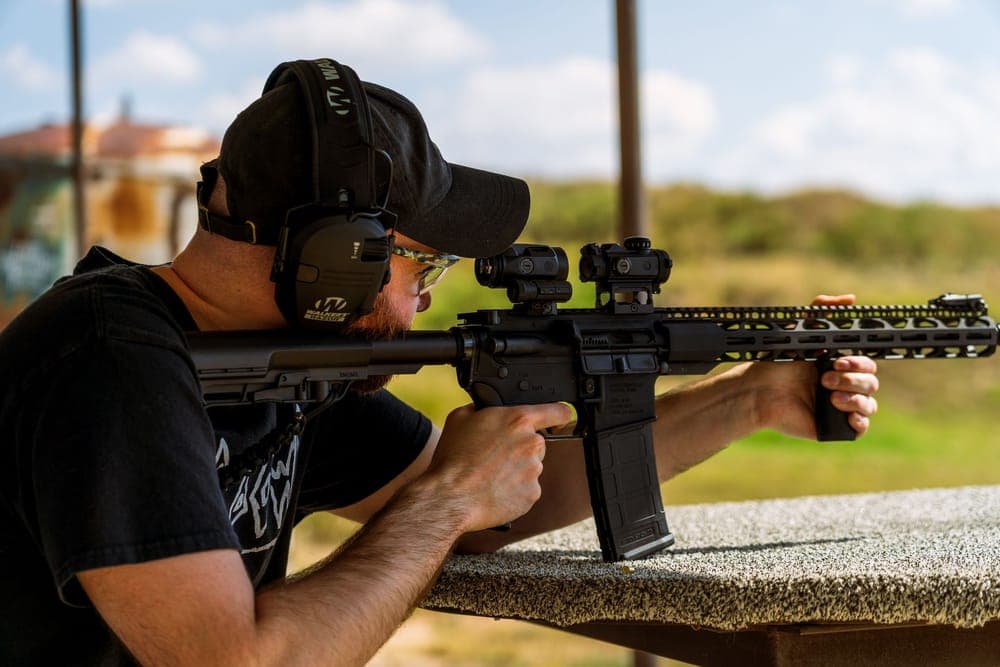
How we reviewed it
Bench & Berm does not test gear, and this page is not a test report. Every figure below is quoted from Walker's own product pages, from Howard Leight's page for the cross-brand comparison, or from a federal hearing-protection source, and all of them are linked in Sources at the bottom. Where Walker's does not publish something, this page says so rather than filling the gap.
That distinction matters more for hearing protection than for almost any other range purchase, because the one number everybody buys on is a laboratory measurement made on a panel of listeners, not a result anyone gets in a shooting bay. Our how we pick page publishes the rubric the score on this page comes from, including the gate every muff has to clear first: a US EPA Noise Reduction Rating published by the maker.
What the Razor Slim is
The Razor Slim Electronic is an over-the-head electronic earmuff, sold by Walker's Game Ear under SKU GWP-SF-DRSEM. "Electronic" is doing two jobs in that name. Microphones on the outside of the cups pick up quiet sound and pass it to speakers inside, so a range command, a safety brief or a conversation reaches you with the muffs still on. The same circuit clamps down the moment something loud arrives, so the shot is not amplified into your ears.
Underneath the electronics it is still a passive earmuff, and that is the part new buyers most often miss. The NRR on the box describes the cup, the cushion and the seal. It is not a rating of the circuit, and it does not improve when you turn the volume down. Our how electronic earmuffs work guide walks the whole chain from microphone to cushion, and electronic vs passive earmuffs covers whether you need the circuit at all for the shooting you actually do.
Walker's sells the Slim in an unusually long color list — thirty finishes on the page we checked, from plain black and olive drab through to flag prints and pastel sprinkle patterns. None of that changes the rating. It is worth knowing only because the color you want may be the one variant that is out of stock while the rest of the line is available.
The published specs
Here is every figure Walker's publishes for the Razor Slim, next to the two other Razors sold beside it and the Howard Leight muff most people compare it with. Each value links to the maker page it came from.
| Published spec | Walker's Razor Slim Electronic | Walker's Razor Pro Digital | Walker's Razor X-TRM | Howard Leight Impact Sport |
|---|---|---|---|---|
| NRR | 23 dB | 23 dB | 21 dB | 22 dB |
| Batteries | 2 x AAA (included) | 2 x AAA (included) | 2 x AAA (included) | 2 x AAA |
| Battery life | Not stated on Walker's page | Not published | Not stated on Walker's page | About 350 hours (maker's claim) |
| Auto shut-off | Not published | Adjustable: 2, 4 or 6 hours | Not published | After 4 hours |
| Cup profile | "Low-profile design" (maker's claim) | "Compact ear cups that minimize interference when shouldering long guns" (maker's claim) | "Ultra low-profile design" (maker's claim) | Slim earcup; Howard Leight says its Air Flow Control design ensures your firearm stock has clearance while shooting (maker's claim) |
| Bluetooth | Not mentioned on Walker's page | Not mentioned on Walker's page | Not mentioned on Walker's page | No (Howard Leight sells Bluetooth versions as separate products) |
| Score | 6.3/10 | 6.9/10 | 6.2/10 | 7.2/10 |
Four more details from the Razor Slim's own page do not fit a comparison row but matter once the muffs are on your head. Walker's lists "two high gain omnidirectional microphones" that "pick up sounds from all directions", "full range high definition speakers", "sleek recessed independent volume controls", and a comfort headband with a "sturdy wire frame". Independent volume controls mean one knob per cup, which is genuinely useful if your hearing is not symmetrical.
What NRR 23 actually covers
NRR is the Noise Reduction Rating, the single number American hearing protectors carry by federal requirement under 40 CFR Part 211 Subpart B. It comes from a laboratory procedure with a panel of listeners wearing the protector correctly, which is why it is a comparison tool between products rather than a promise about your next range trip.
At 23 dB, the Slim sits one point above the Howard Leight Impact Sport, two above Walker's own X-TRM, and level with the Razor Pro Digital. It is also seven points below the highest-rated passive muffs we list. In practice that puts it in the middle of the field: comfortably enough for outdoor pistol and rifle shooting, thin for a busy indoor bay with other shooters either side of you.
The honest way to read any NRR is with a derating. NIOSH's own 2025 fit-testing update exists precisely because real-world attenuation depends on fit, and NIOSH has long recommended derating labeled values when estimating what a wearer actually gets (NIOSH 2009-136). Our what NRR do I need for shooting page does that arithmetic properly, and the NRR rating chart lists every rating in our registry so you can see where 23 falls.
The 0.02-second compression
Walker's publishes one performance figure for the Slim's circuit, and it is the one worth understanding: "Sound activated with .02 second reaction time protects hearing against sharp retorts". That is the speed at which the electronics stop passing sound through the speakers when a loud impulse arrives.
Two things follow from it. First, the figure is about the circuit, not the cup. Even if the electronics did nothing at all, the gunshot is still attenuated by 23 dB of plastic and foam — that is what the NRR is for. What the compression protects you from is the much worse outcome of a gunshot being amplified and played into your ear canal through the speakers.
Second, Walker's publishes no detail about how the compression behaves after it triggers: no hold time, no recovery time, no threshold in decibels. Howard Leight does publish a threshold for the Impact Sport family (it caps amplification at 82 dB), so if you want a number for where the clamp kicks in rather than how fast it moves, that is the family that gives you one.
The two specs Walker's does not publish
This is the part of the review that should drive your decision, because it is the only place the Slim is beaten by cheaper muffs.
- No battery life. Walker's says the Slim is "Powered by 2 AAA Batteries (Included)" and stops there. There is no hour figure on the page we checked. Howard Leight quotes about 350 hours for the Impact Sport from the same two AAAs, so the comparison is available even though Walker's does not offer one.
- No auto shut-off. Nothing on the Razor Slim page describes a timer that turns the muffs off. Walker's own Razor Pro Digital page, by contrast, says plainly that "an auto shut-off function can be set for two, four, or six hours", and Howard Leight publishes a fixed 4-hour shut-off for the Impact Sport.
Those two omissions compound. A muff with no published runtime and no automatic cut-off is a muff you have to remember to switch off, and the batteries you will find flat are the ones that came in the box. It is a solvable problem — carry a spare pair of AAAs in the range bag, which our what to put in a range bag checklist tells you to do anyway — but it is a real one, and it is the single honest reason to look at the Pro Digital instead.
The cup, the stock and the headband
The reason this muff exists is the cup. Walker's describes a "low-profile design that sits snugly against your head", with "soft and comfortable ear cups" it says "provide extra sound absorption and protection". That is a maker's description rather than a measurement — Walker's publishes no cup depth in millimeters — but low profile is the right thing to want if you shoot long guns.
When you shoulder a rifle or a shotgun, the comb of the stock comes up under your cheek and the back edge of the ear cup is right there to meet it. A deep cup gets knocked, breaks its seal, or pushes your head off the stock so you cannot find the sights the same way twice. A thinner cup leaves that space alone. If stock clearance is your whole reason for buying, note that Walker's reserves the phrase "ultra low-profile" for the X-TRM, not the Slim, and our best ear protection for shotgun shooting roundup ranks the whole field on exactly that question.
The headband is a wire frame with fabric over it. It is light, it does not take up much room in a bag, and Walker's does not publish a weight or a head-size range for it. Worth noting: unlike the X-TRM, the Slim is not described as folding, so it packs flat rather than small.
The audio input, and what it is not
Walker's lists an audio input on the Slim and suggests you "plug in your phone or other favorite sound source" to use the muffs as headphones. That is a wired jack, not Bluetooth, and Walker's mentions no Bluetooth anywhere on this product page.
Treat the jack as a feature for the drive or the bench, not the firing line. A cable running from your head to your pocket is one more thing to catch on a bag strap while you are handling a firearm, and music through the speakers competes with the exact sounds the microphones are there to let you hear — the range officer, the person in the next bay, the squib you need to notice. If you want audio without a cable, our best shooting earmuffs with Bluetooth roundup covers the muffs built for it.
Which of the four Razors
Walker's Razor line is four products that look alike in thumbnails and differ in exactly the places that matter. Read it this way:
- Razor Slim Electronic — NRR 23, no published shut-off. The default. Buy it for a low-profile cup at a mid rating with batteries in the box.
- Razor Pro Digital — NRR 23, settable 2/4/6-hour shut-off. The same protection with the electronics the Slim leaves undocumented, plus active dynamic sound suppression and wind-noise reduction. Walker's also describes "compact ear cups that minimize interference when shouldering long guns" and a collapsible design.
- Razor X-TRM — NRR 21, ultra low-profile, folds. The thinnest cup Walker's claims and the only Razor it describes as compact folding, with gel earpads and sound-activated compression at the same 0.02 seconds. You give up two decibels for it.
- Not in this review: Walker's passive "Razor Slim Muffs". A separate listing with no electronics. See the naming trap below.
Our Razor Slim vs Razor Pro Digital comparison takes the first two head to head in detail, and Walker's Razor vs Howard Leight Impact Sport settles the cross-brand question most first-time buyers are actually asking.
The naming trap on these listings
Two mistakes are easy to make on a marketplace listing, and both of them cost you the thing you were buying.
The second trap is the bundle. Razor muffs are frequently sold with a case, with safety glasses, or as a two-pair pack, and the bundle is sometimes the only version in stock in the color you want. A bundle is fine; just confirm the muff inside it is the electronic model and that the glasses, if any, carry a Z87+ mark. Our Z87 vs Z87+ explainer is one paragraph long and will save you from the cheap lens in a bundle.
Who should skip it
- Indoor-only shooters who will not wear plugs. NRR 23 on its own is not the strongest answer for a busy indoor bay. Either commit to plugs underneath or buy a higher-rated muff; our best ear protection for indoor ranges roundup ranks for exactly that case.
- Anyone who wants a published runtime. If a battery figure matters to you, buy from a maker that prints one.
- People who leave things switched on. Buy the Pro Digital and set the timer.
- Smaller heads and kids. Walker's publishes no head-size range or youth sizing for the Slim. Start at best kids ear protection instead, and for the other end of the range, ear protection for big heads.
- Glasses wearers with thick temple arms. Any muff is only as good as its seal, and a temple arm breaks it. Read ear protection with glasses before you choose.
The verdict
The Razor Slim is a sound first electronic muff and a particularly good second one — the muff to buy when the pair you started with turned out to be too deep for a rifle stock. NRR 23 is respectable, the microphones and independent volume controls do what you need them to do, and Walker's puts the batteries in the box, which is a small thing that is annoying when it is missing.
What keeps it from being the automatic recommendation is a spec sheet with two holes in it. No published battery life and no auto shut-off are not performance failures; they are information failures, and both are filled in by products sitting next to it on the same shelf. If you want the Walker's cup with the documentation, the Razor Pro Digital is the honest answer. If the cup is the whole point and you shoot long guns, look at the X-TRM and accept NRR 21. If you want the most documented electronics at this rating, the Impact Sport is a point lower and tells you everything.
In detail
The contenders, in full
The one this review is about
Walker's Razor Slim Electronic
NRR 23, two AAA batteries in the box, two high-gain omnidirectional microphones and sound-activated compression Walker's puts at 0.02 seconds. The low-profile Razor most people mean when they say Razor.
Published specsResearched · every value sourced
| NRR | 23 dB |
|---|---|
| Batteries | 2 x AAA (included) |
| Cup profile | "Low-profile design"Maker's claim |
| Battery life | Not stated on Walker's page |
| Bluetooth | Not mentioned on Walker's page |
How the 6.3 score breaks down
- Published NRR (30%)
- 6.5
- Fit with glasses & cup profile (20%)
- 7.5
- Electronics: amplification & shut-off (20%)
- 6
- Power: battery & auto-off (15%)
- 5
- Comfort & adjustment (15%)
- 6
What the specs support
- Walker's calls it a low-profile design, which matters when a rifle or shotgun stock meets the cup
- NRR 23, one point above the Impact Sport
- Both AAA batteries come in the box
Where it falls short
- No battery life or auto shut-off time is published by Walker's
- Easy to confuse with Walker's separate "Razor Slim Muffs" listing, which doesn't state an NRR; check the listing says Electronic
Skip it if…
…you want a muff that switches itself off when you forget; Walker's doesn't publish an auto shut-off for this model, while the Razor Pro Digital lets you set 2, 4 or 6 hours.
#ad · Price as of November 3, 2026 · How we make money for the link to Walker's Razor Slim Electronic
Buy this instead for a settable shut-off
Walker's Razor Pro Digital
Same NRR 23, same AAAs, but a digital circuit with an auto shut-off you can set for two, four or six hours, plus wind-noise reduction. The upgrade that fixes the Slim's one real omission.
Published specsResearched · every value sourced
| NRR | 23 dB |
|---|---|
| Batteries | 2 x AAA (included) |
| Auto shut-off | Adjustable: 2, 4 or 6 hours |
| Cup profile | "Compact ear cups that minimize interference when shouldering long guns"Maker's claim |
| Bluetooth | Not mentioned on Walker's page |
How the 6.9 score breaks down
- Published NRR (30%)
- 6.5
- Fit with glasses & cup profile (20%)
- 8
- Electronics: amplification & shut-off (20%)
- 6.5
- Power: battery & auto-off (15%)
- 7.5
- Comfort & adjustment (15%)
- 6
What the specs support
- Auto shut-off you can set to 2, 4 or 6 hours, the only adjustable timer among the muffs we cover
- Walker's says the compact cups minimize interference when you shoulder a rifle or shotgun
- Both AAA batteries come in the box
Where it falls short
- Walker's doesn't publish a battery life, so the timer is the only power detail you get
- NRR 23 is 7 dB short of the Howard Leight Impact Pro's 30
Skip it if…
…your range is an indoor pistol bay and you want one muff to handle it alone; NRR 23 is modest, and the NRR 30 Howard Leight Impact Pro gives more protection on its own.
#ad · Price as of November 3, 2026 · How we make money for the link to Walker's Razor Pro Digital
Buy this instead for the thinnest cup
Walker's Razor X-TRM
The only Razor Walker's calls ultra low-profile, and the only one it says folds. You pay for that with NRR 21, the lowest rating of any electronic muff we list.
Published specsResearched · every value sourced
| NRR | 21 dB |
|---|---|
| Batteries | 2 x AAA (included) |
| Cup profile | "Ultra low-profile design"Maker's claim |
| Battery life | Not stated on Walker's page |
| Bluetooth | Not mentioned on Walker's page |
How the 6.2 score breaks down
- Published NRR (30%)
- 5.5
- Fit with glasses & cup profile (20%)
- 8.5
- Electronics: amplification & shut-off (20%)
- 6
- Power: battery & auto-off (15%)
- 5
- Comfort & adjustment (15%)
- 6
What the specs support
- The only muff here Walker's describes as "ultra low-profile"
- A lower cup leaves more room for the stock when you shoulder a rifle or shotgun
- Both AAA batteries come in the box
Where it falls short
- NRR 21 is the lowest of the electronic muffs we list
- No battery life or auto shut-off time is published by Walker's
Skip it if…
…most of your shooting is handguns at an indoor range; the ultra-low cup matters less there, and NRR 21 is the least protection of any electronic muff on our list.
#ad · Price as of November 3, 2026 · How we make money for the link to Walker's Razor X-TRM
The cross-brand alternative
Howard Leight Impact Sport
NRR 22, one point under the Slim, but Howard Leight publishes both of the figures Walker's does not: about 350 hours from two AAAs and a 4-hour auto shut-off.
Published specsResearched · every value sourced
| NRR | 22 dB |
|---|---|
| Batteries | 2 x AAA |
| Battery life | About 350 hoursMaker's claim |
| Auto shut-off | After 4 hours |
| Bluetooth | No (Howard Leight sells Bluetooth versions as separate products) |
| Cup profile | Slim earcup; Howard Leight says its Air Flow Control design ensures your firearm stock has clearance while shootingMaker's claim |
| Sizing | Medium/Large |
How the 7.2 score breaks down
- Published NRR (30%)
- 6
- Fit with glasses & cup profile (20%)
- 8.5
- Electronics: amplification & shut-off (20%)
- 7
- Power: battery & auto-off (15%)
- 9
- Comfort & adjustment (15%)
- 6.5
What the specs support
- Shuts itself off after 4 hours, so a muff left on in the range bag doesn't flatten the batteries
- Howard Leight quotes about 350 hours from two AAA batteries
- Slim earcup the maker says leaves your firearm stock clearance when you shoulder a long gun
Where it falls short
- NRR 22 is 8 dB below Howard Leight's own Impact Pro (NRR 30)
- No Bluetooth on this version; Bluetooth models are sold separately
- Listed in Medium/Large; smaller heads should look at the Youth/Adult Small version
Skip it if…
…you shoot mostly at an indoor range and want the most protection a muff can give on its own; NRR 22 is on the low side, so pair it with foam plugs or look at the NRR 30 Impact Pro.
#ad · Price as of November 3, 2026 · How we make money for the link to Howard Leight Impact Sport
How we scored this
Every pick, scored on numbers you can check
Every pick here is labeled Researched: we compiled each maker's published specs (the EPA-labeled NRR on hearing protection, the Z87+ mark on glasses), read the manuals, checked the standards behind them, and scored everything on a public rubric. Every figure links to where it came from, and marketing claims are labeled “maker's claim,” so you can see exactly why a pick ranks where it does.
Scores are editorial judgments built from that documented research. Commissions never set a score or decide a pick. The rubric and its weights are published.
What changed
- First published. Walker's Razor Slim, Razor Pro Digital and Razor X-TRM pages re-checked the same day; the Slim's 0.02-second compression, microphone and speaker wording, recessed independent volume controls, wire-frame headband, SKU and color count are quoted from Walker's own page.
Questions
Common questions
What is the NRR of the Walker's Razor Slim?
How long do the batteries last in the Razor Slim?
Does the Walker's Razor Slim turn itself off?
Does the Razor Slim have Bluetooth?
Is the Razor Slim good enough for an indoor range?
What is the difference between the Razor Slim and the Razor Slim Muffs?
Where this comes from
Sources
- Walker's, Razor Slim Electronic Ear Muff product page, accessed 2026-10-30
- Walker's, Razor Pro Digital Ear Muffs product page, accessed 2026-10-30
- Walker's, Razor X-TRM Muffs product page, accessed 2026-10-30
- Howard Leight Shooting Sports, Impact Sport electronic earmuff product page, accessed 2026-10-30
- US EPA, 40 CFR Part 211 Subpart B (hearing protector labeling), accessed 2026-10-30
- NIOSH, Hearing Protector Fit-Testing update (DHHS 2025-104), accessed 2026-10-30
- NIOSH, Hearing Protector Device Compendium guidance (DHHS 2009-136), accessed 2026-10-30
Specs come from each maker's own pages and data sheets (linked on every product); ratings like NRR and Z87+ are explained from the standards and agencies behind them. Prices are set by Amazon and change often, so the buy button always takes you to the current one. Where a figure isn't published, we say so. Read the full method.